Ganga
RamayanaGanga is both a river of the heavens and a personified figure in the epic’s account of sacred waters. Her narrative significance lies not in a sustained portrait of her thoughts or character, but in the consequences and meanings attached to her flow: divine release, the emergence of seven rivers, purification, and the ritual honoring of the dead. Across these passages, Ganga joins mythic history to the physical landscape and to human acts of devotion.
Identity and Sacred Character
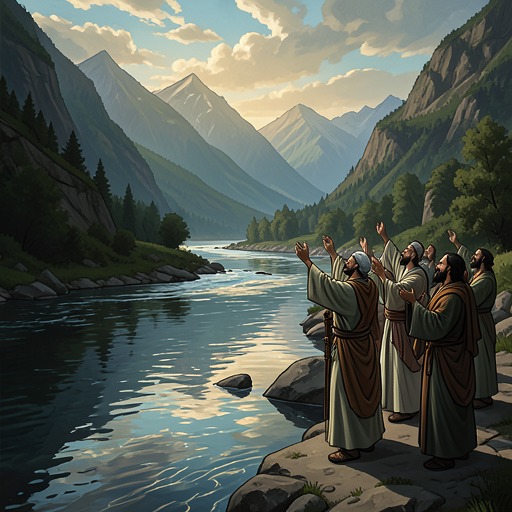
The poem names Ganga as a celestial river whose waters purify. At Bharadvája’s hermitage, she rolls past as a sweet, cleansing stream, making the place both a landscape of flowing water and a setting marked by sanctity. The description gives her a presence that is at once geographical and religious: her course can be located beside a hermitage and a settlement, while her water carries a power of purification.
The commentary supplies a genealogical identification, calling Ganga the daughter of Bhagiratha and equating her with the Ganges. That note links the river to the ruler whose story is associated with her descent, while distinguishing the poem’s personification from a merely physical description. The evidence here does not elaborate her birth or character beyond this relationship; instead, it emphasizes what her presence makes possible for landscapes, communities, and rites.
The Story Ráma Seeks
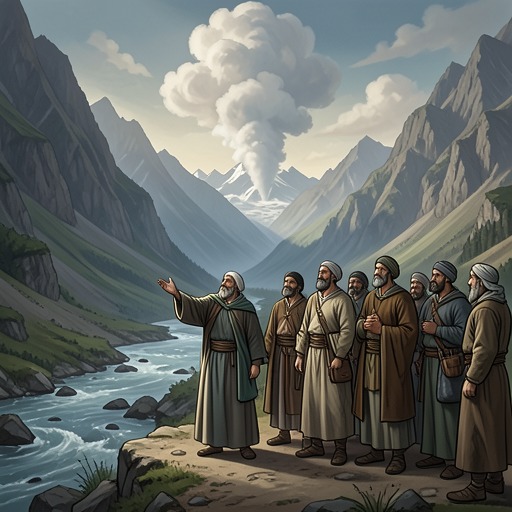
Ganga enters the narrative as the subject of a question. Ráma asks a sage to tell him the story of the three-pathed river, and the sage responds by recounting her tale. The exchange frames the river’s history as inherited knowledge: Ráma’s request turns a landscape feature into a story worthy of formal narration, and the sage’s answer places that story within the epic’s wider movement of instruction and remembered events.
The account associates Ganga with divine release and with a multiplication of waters. It says that seven noble rivers came from her after she was set free by a god. The image presents Ganga not as a diminished source but as the origin of further streams: her release expands into a branching geography. Elsewhere in the same river imagery, her weary waves descend into Vindu’s lake. Taken together, these details show a watercourse that moves, divides, and reaches distinct destinations, while retaining a sacred identity through those changes.
Water, Kinship, and Funeral Rites
The poem gives Ganga’s purifying force a human and familial consequence in the scene of a funeral offering. A ruler pours a libation over the dust of his kinsmen; when the flood wets that dust, the water’s contact completes the scene’s ritual action. The sequence matters: the offering is made over the dead, and the river then reaches the remains. Ganga’s flow thus becomes part of an act of remembrance, joining the movement of water to the obligations of kinship and funerary observance.
The commentary’s identification of Ganga as Bhagiratha’s daughter helps situate this episode within the river’s legendary history, but the lines themselves keep attention on the concrete gesture: dust, libation, and flood. Rather than explaining the rite at length, the poem makes the river’s arrival the decisive moment. Purification is expressed through contact, as the water passes over what remains of the dead.
Sacred Geography and Narrative Function
Ganga’s presence recurs across different scales of the epic’s world. At Bharadvája’s hermitage, the river is part of a settled, inhabited landscape, with Śringavera’s towers rising nearby. From high above, a traveler sees the place where Ganga and Yamuna River meet. The view from the air makes the confluence legible as a feature of the country, while the hermitage scene presents the same river at ground level as a purifying presence.
These appearances give Ganga more than one narrative function without requiring a continuous personal arc. She is the subject of a story requested by Ráma, the source from which other rivers emerge, a cleansing stream beside a hermitage, and the flood that reaches the dust of the dead. Her significance comes from the meeting of those roles. The river carries a remembered divine history through recognizable places, and its physical movement becomes the means by which the poem links sacred landscape, instruction, and ritual action.