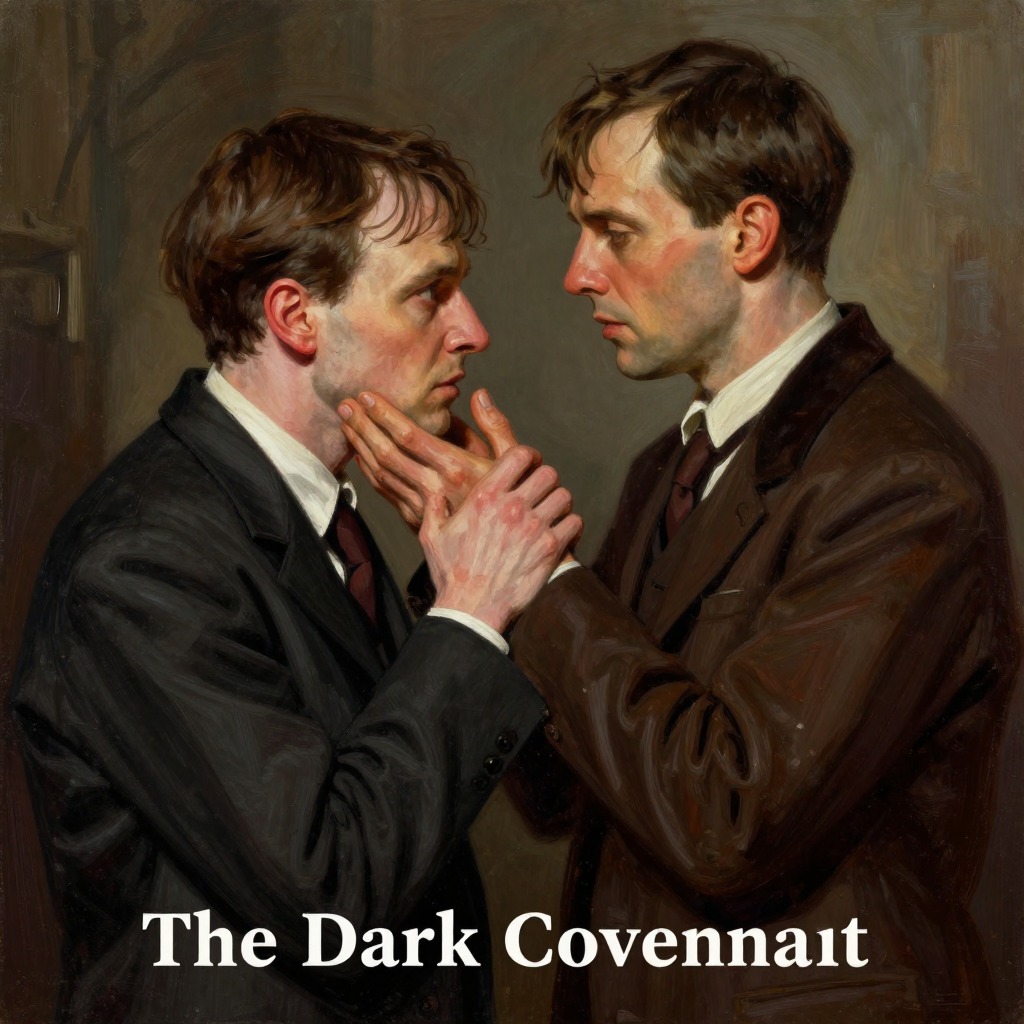
Meeting with O'Brien
Winston and Julia, having long suspected O'Brien of political heresy, finally dare to act on their intuition. They arrive together at his richly appointed Inner Party flat, a place of unprecedented luxury and silence. The moment they step inside, the sheer opulence—the soft carpet, the cream-papered walls, the absence of grime—intimidates Winston, but the encounter that follows will reshape his fate. O'Brien, with a deliberate gesture, presses a switch on the wall, and the telescreen's voice snaps off. 'You can turn it off!' Winston blurts, astonished. 'Yes,' O'Brien replies, 'we can turn it off. We have that privilege.' In that instant, the invisible barrier of total surveillance is breached, and an act of trust—or of entrapment—begins.
The Recruitment Ritual
O'Brien pours a dark-red liquid into glasses and raises a toast: 'To our Leader: To Emmanuel Goldstein.' Winston, who has only read about wine in books, finds the taste disappointing after years of Victory Gin, but the symbolic power of the gesture is unmistakable. O'Brien then questions Winston with a cold, pedagogical precision, asking whether he is prepared to give his life, to commit murder, to sabotage, to betray his country. Winston answers 'Yes' to each, until the question of separating from Julia. 'No,' he says, and O'Brien acknowledges the honesty. O'Brien declares that the Brotherhood is real, but that its members operate in total isolation, knowing only a handful of contacts. He hands Winston a flat white tablet to neutralize the smell of wine, instructs him to expect a copy of Goldstein's book delivered via a misprinted message, and tells them they must leave separately. The meeting is conducted with the efficiency of a military briefing, yet O'Brien's manner carries an ironic, almost affectionate weariness.
The Oath and Its Ironies
O'Brien's recruitment is a masterclass in psychological manipulation. He presents the Brotherhood as a pure idea, stripped of camaraderie or hope of victory, sustained only by the conviction that sanity must be preserved. 'We are the dead,' he says, echoing Winston's own phrase. Yet the very act of turning off the telescreen—a privilege of the Inner Party—demonstrates the inequality that the Party itself enforces. O'Brien's casual confirmation that Goldstein is alive and that the Brotherhood cannot be wiped out because it is held together by an indestructible idea offers Winston a fleeting sense of purpose. But the reader, attuned to the novel's design, senses the trap: O'Brien's flawless performance as a double agent, his later role as tormentor, is already in motion. The toast to Goldstein, the enemy of the Party, is simultaneously the most defiant and the most staged moment of the scene.
The Underside of the Encounter
Beneath the surface of commitment, the meeting contains the seeds of its own destruction. O'Brien's promise, 'We shall meet again in the place where there is no darkness,' echoes the dream Winston had years earlier, but the place without darkness is later revealed to be the windowless cells of the Ministry of Love. The room's material abundance—the wine, the cigarettes, the servant Martin—contrasts starkly with the austerity of the Outer Party, underscoring the Party's internal hierarchy. Winston's euphoria at having 'done it at last' is undercut by O'Brien's cold admission that the Brotherhood never saves its members. The scene ends with O'Brien already turning back to his official work, a reminder that the Party's machinery continues to grind. This meeting, for all its promise of solidarity, is the first step toward the annihilation of Winston's individuality.