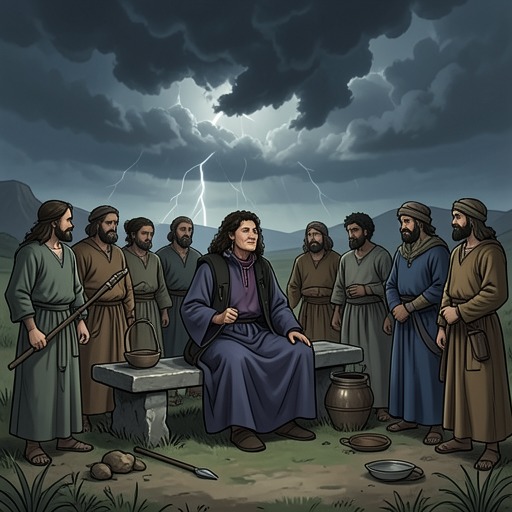
Gwyn ap Nudd
MabinogionGwyn ap Nudd stands at the meeting point of otherworldly authority and Arthurian politics: associated with Annwn and its devils, he is both an obstacle in a hero’s task and a chieftain whom Arthur must confront, restrain, and consult. His conflict with Gwythyr over Creiddylad ends not in a lasting victory but in a recurring contest fixed for every first of May until the end of time, leaving the question of her eventual claim unresolved.
Identity and Otherworldly Authority
In the account of the tasks set for Culhwch, Gwyn is described as having been placed by God over the brood of devils in Annwn, so that they would not destroy the present race. This position gives him a function beyond that of an ordinary rival or chieftain: his continued presence in the otherworld is presented as part of the protection of the human world. Yspaddaden therefore declares that Twrch Trwyth cannot be hunted without Gwyn and that Gwyn will not be spared from Annwn. The demand makes Gwyn a condition of an already difficult undertaking, and his otherworldly office helps explain why securing his participation is represented as impossible.
That claim of inaccessibility sits beside later episodes in which Arthur summons Gwyn and deals with him directly. The narrative does not explain how Gwyn can be drawn from the role assigned to him in Annwn, but it does place him within Arthur’s sphere of action: first as an opponent to be checked, and later as a figure whose knowledge and counsel may be sought. His appearances thus connect separate strands of the narrative without making him simply an enemy of Arthur.
Conflict over Creiddylad
Before Creiddylad became Gwythyr’s bride, Gwyn carried her away by force. Gwythyr gathered a host and fought Gwyn, but Gwyn overcame him and captured several of his companions, among them Greid son of Eri, Nwython, and Kyledyr Wyllt. During Gwyn’s captivity of the group, Nwython was killed and Kyledyr was made to consume his father’s heart; the episode is given as the cause of Kyledyr’s madness. The conflict therefore reaches beyond the two rivals’ claim over Creiddylad, bringing the capture and suffering of their wider circle into the dispute.
Arthur responded by going north, summoning Gwyn before him, and securing the release of the nobles Gwyn had imprisoned. He then made peace between Gwyn and Gwythyr. The settlement did not award Creiddylad to either rival. Instead, she was to remain at her father’s house, with neither man having the advantage, while Gwyn and Gwythyr were to fight for her on every first of May. The arrangement turns a violent conflict into a rule-bound recurrence, but does not resolve its underlying claim: the contest is to continue until the day of doom, and its eventual victor alone is to have Creiddylad.
Arthur’s Mediation and the Annual Contest
Arthur’s intervention establishes him as an authority capable of imposing terms on both chieftains. He does more than end the immediate fighting: he frees the imprisoned nobles and establishes a settlement intended to govern the rivals’ future conduct. Yet the terms preserve rather than settle their rivalry. Creiddylad remains in her father’s house, and the two men’s struggle is deferred into repeated May encounters. The account gives no final outcome for those contests, so the arrangement’s defining feature is its indefinite duration.
After reconciling the chieftains, Arthur obtains Mygdwn, Gweddw’s horse, and the leash of Cwrs Cant Ewin. These acquisitions follow the settlement in the narrative, linking Gwyn’s conflict with Gwythyr to Arthur’s wider campaign of gathering what is needed for the tasks. The story does not say that Gwyn gives Arthur these items; it records them as gains Arthur makes after the reconciliation. This distinction keeps Gwyn’s role focused on the dispute and its resolution rather than assigning him an unsupported part in the transfer.
Place in the Hunt for Twrch Trwyth
Gwyn’s connection to the hunt for Twrch Trwyth is framed first as a barrier. Yspaddaden insists that the boar cannot be hunted without him, because of Gwyn’s office in Annwn, and dismisses the prospect of obtaining him. Later, Arthur summons Gwyn and asks whether he knows anything about Twrch Trwyth. Gwyn says that he does not. The answer does not make him a source of hidden knowledge or a guide to the boar’s whereabouts; instead, it marks a limit to what he can provide in this episode.
His later presence in another consultation shows a different kind of usefulness. When Arthur seeks the blood of Orddu, Gwyn and Gwythyr counsel him not to enter the witch’s cave himself, advising that others should go in his place. The advice concerns the manner of approaching a dangerous task, not the hunt for Twrch Trwyth. Taken together, these episodes present Gwyn as a powerful figure whose knowledge is bounded: he cannot identify the boar’s whereabouts, but he can take part in counsel about how Arthur should proceed against a formidable adversary.
Narrative Role and Ending
Gwyn’s story has no personal resolution in the surviving episodes. The contest over Creiddylad is set to recur without a narrated final victory, while his relation to Arthur shifts between the supposedly unattainable requirement of a quest, a rival brought under a peace settlement, and a consulted participant in a later undertaking. This variation makes his otherworldly authority part of the practical political world of the tales: Arthur can negotiate with him, but cannot turn the central rivalry into a completed settlement.
The annual May fight gives Gwyn’s conflict a distinctive narrative shape. Rather than ending with a marriage, a permanent defeat, or a final reconciliation, it becomes a rule that renews the dispute at a fixed time. The account leaves the consequences of that repetition open, making the unresolved claim itself the lasting feature of Gwyn’s role.