Owain son of Urien
MabinogionOwain son of Urien is a knight of Arthur’s court whose pursuit of a marvel becomes both a test of arms and the beginning of a life away from his companions. After hearing Kynon son of Clydno describe the Fountain and its guardian, Owain sets out to find the place for himself. He defeats the knight, but the victory carries him into danger: the castle gate traps him, and he survives only through Luned’s intervention.
At Arthur’s Court and the Fountain Challenge
Owain first appears at Caerlleon upon Usk among Arthur’s company, with Kynon son of Clydno, Kai, and Gwenhwyvar present. While Arthur sleeps, Kynon is pressed to tell Kai a story. He recounts an earlier journey to a distant valley and a castle where he learned about a knight who guarded a fountain. Owain urges the company to seek the place; Kai answers that Owain often speaks of deeds he would not perform, and Gwenhwyvar rebukes Kai for the discourtesy. The exchange turns Kynon’s account into a challenge that Owain accepts in action.
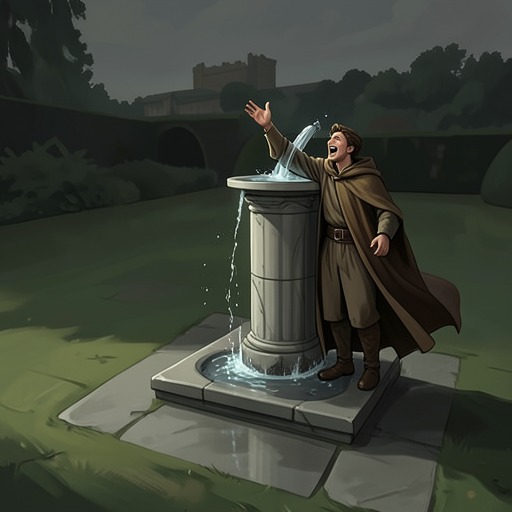
Owain travels through distant lands and desert mountains until he reaches the valley Kynon described. The scene appears in the same order and detail: the youths shooting daggers, the yellow-clad host, and the route to the fountain. After learning the guardian’s location, Owain follows the black man’s directions to the green tree, where a bowl rests beside the fountain. He casts water from it onto the slab. Thunder, a violent shower, and a sudden clearing of the sky follow; the tree loses its leaves, birds settle on it and sing, and the Knight rides toward him. The strange sequence is not merely spectacle: touching the fountain summons the opponent who guards it.
The two knights meet with force. Their lances break, and they continue with swords until Owain strikes through the Knight’s helmet, headpiece, and visor, mortally wounding him. The wounded Knight flees toward a vast castle, and Owain pursues him closely, though not close enough to strike again. At the gate, the portcullis falls behind the Knight and cuts Owain’s horse in two. Owain is left trapped between the outer and inner gates, with part of the horse and his spurs outside and no way to leave.
Luned approaches through an opening in the gate. Recognizing Owain as a faithful servant of ladies and a devoted lover, she gives him a ring whose concealed stone will hide him while he keeps it covered in his hand. She explains that the castle’s people will come looking for him to put him to death, and arranges to meet him outside. The rescue begins not with another contest of strength, but with the aid of a woman who reads his conduct as a knight and provides the means for him to pass unseen.
Marriage and Rule at the Fountain
The woman in the funeral procession is the Countess of the Fountain, widow of the Knight Owain has mortally wounded. Owain sees her in torn yellow satin, her hair bloodstained and her grief expressed in cries and striking her hands together. Once Luned identifies her, Owain declares her the woman he loves best; Luned predicts that the Countess will love him in return. The abrupt turn from combat to love makes the consequences of Owain’s victory personal: he has killed the defender of the earldom, but is drawn to the bereaved ruler whose land has lost its champion.
While the Countess withdraws in grief, Luned tends Owain, washing and shaving him, bringing him food, and arranging his rest. She then goes to speak with her mistress on his behalf. The Countess later assembles her subjects and explains that the earldom is now undefended and requires a husband with military skill to protect it. Her people agree that she may marry someone from elsewhere; bishops and archbishops celebrate her marriage to Owain, and the men of the earldom do him homage. The match thus answers a political need as well as a private attachment: Owain becomes the Countess’s husband and the protector of her dominions.
Owain’s new role is defined by his defense of the Fountain. He overthrows each knight who comes there, takes the defeated challengers, and distributes what he gains among his barons and knights. The narrative connects this practice to his standing among his subjects, describing him as exceptionally beloved. He holds this position for three years, a period long enough for his new household and duties to separate him from Arthur’s company. Arthur, meanwhile, grieves over Owain’s absence and fears that another year without seeing him will be fatal; Gwalchmai counsels a search, and Arthur sets out with three thousand men, guided by Kynon.
Return, Estrangement, and the Wild Road
At the Fountain, Arthur’s household eventually faced the Knight who guarded it. One after another, the company’s warriors were overthrown until only Arthur and Gwalchmai remained. Gwalchmai asked to fight first, wearing a satin robe of honour that kept his identity from the watching host. He and the Knight fought through the first day without either unhorsing the other, and their second day’s combat brought no decision. On the third, their lances broke under the force of their encounter; they fell from their horses and continued with swords. A blow from the Knight turned Gwalchmai’s helmet, revealing him. The opponents recognized one another as cousins and each insisted the other had won. Arthur ended the dispute by taking both swords, so neither could claim victory, and embraced Owain son of Urien. The contest that had begun as a challenge at the Fountain ended in recognition and reunion.
Owain son of Urien invited Arthur and his company to stay: he had spent three years preparing a banquet, certain Arthur would come to seek him. The feast lasted three months. The Countess of the Fountain reluctantly agreed to let her husband accompany Arthur back to the Island of Britain for three months, so he could be seen again by its nobles and ladies. But once among his kin and friends, Owain son of Urien remained for three years instead. His return to Arthur’s company thus repeated, in reverse, the long absence that had first prompted the search: a short leave from the Countess became a prolonged separation.
That separation became visible when a damsel rode into the hall at Caerlleon upon Usk on a foam-covered bay horse, wearing yellow satin. She took the Invisibility Ring from Owain son of Urien’s hand and publicly condemned him as faithless and disgraced. The rebuke recalled the promise and household he had left behind. After finishing his meal, he prepared to leave, then turned away from court and wandered among remote lands and uncultivated mountains. His clothes wore out, his body grew wasted, and his hair grew long. He lived among wild beasts and fed with them until weakness forced him down from the mountains. The knight once celebrated for defending the Fountain had become a solitary figure, stripped of the signs of courtly life.
A widowed Countess found him exhausted by the sun in her park. She sent a maiden with clothing, a horse, and precious ointment, to anoint him near the heart and see whether he would recover. Later, as Owain son of Urien travelled again, he heard a cry repeated three times in a wood and found a serpent in a cleft in a grey rock threatening a black lion. He cut the serpent in two. The lion followed him, accompanying him like a familiar hound; it gathered fuel for his fire and brought him a roebuck, sharing the care of his journey. When Owain son of Urien heard a voice sighing nearby, he discovered that it belonged to Luned, imprisoned because she had defended him against two pages who had called him faithless. The lion’s loyalty now gave practical force to the loyalty Luned had once shown him: together they helped him reach her peril and free her from the sentence of burning.
Restoration and Wider Arthurian Role
After rescuing Luned, Owain returned with her to the Countess of the Fountain’s dominions and brought the Countess with him to Arthur’s court. She remained his wife for the rest of her life, completing the return that his long absence had put in jeopardy. His recovery is measured not only by restored marriage but by renewed service: the knight who had once defended the Fountain now travels with the lion that joined him on the road.
Owain and the lion next reached the stronghold of the Black Oppressor, where they found four-and-twenty noblewomen held in grief. The women explained that the castle’s owner had drugged them and their husbands, killed the husbands while they were helpless, and stripped the survivors of their horses, clothing, gold, and silver. Owain challenged the Black Oppressor and defeated him. When the defeated man pleaded for his life, he promised to abandon robbery and maintain his castle as a hospice for the weak and the strong. Owain accepted the offer; the change from a house of plunder to a place of refuge turns victory into a reform of the very institution that produced the women’s suffering.
Owain escorted the four-and-twenty women, their horses, clothing, and recovered goods to Arthur’s court. Arthur’s joy at seeing him again surpassed the welcome he had given him after his first absence, and the women were free to remain at court or depart as they chose. Owain thereafter lived there beloved and at the head of Arthur’s household. He later went abroad with the three hundred Ravens left to him by Kenverchyn, and the narrative says that wherever he went with them, he was victorious. His ending therefore joins restored fellowship to continued mobility: he returns to Arthur’s company without surrendering the capacity for independent action.
In another Arthurian tale, Owain also serves as a guide to a novice entering the world of knighthood. He is among the three knights Peredur meets at the edge of the forest, and patiently identifies their saddles, weapons, armor, and uses. When Peredur later kills the knight Kai had sent him to challenge, Owain warns Kai that the reckless instruction has put the youth and Arthur’s reputation at risk. He goes to the meadow, removes the dead knight’s armor, and offers Peredur a better horse and equipment, along with an invitation to receive knighthood at court. Peredur refuses until he has avenged the insult to the dwarf and dwarfess, but Owain’s intervention distinguishes his judgment from Kai’s: he recognizes both the danger of the young man’s inexperience and the promise in his courage.