Ynywl
MabinogionYnywl is an earl whose story links the consequences of wrongful inheritance to the possibility of restitution. Having taken his nephew’s possessions and refused to return them, he lost his own earldom, city, and castle when the nephew made war on him. Years later, reduced to a decaying palace and scant resources, he shelters Geraint; Geraint’s intervention restores Ynywl’s estate and returns him to his former standing.
Identity and Circumstances
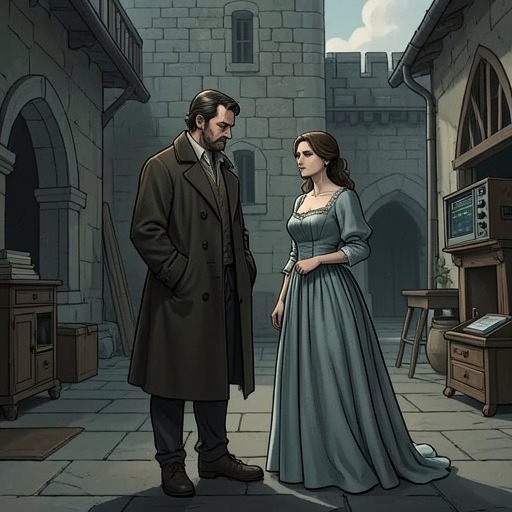
When Geraint reaches the town, he does not know anyone there and has nowhere to spend the night. At a ruined palace, he finds Ynywl seated on a marble bridge in worn clothes. Ynywl invites the stranger inside and promises him the best hospitality he can provide. In the upper chamber, Geraint meets Ynywl’s wife, now old and wearing tattered satin, and their daughter, whose vest and veil are also worn. The scene presents a household of diminished means, but one that still receives a guest with courtesy.
The contrast between the palace’s former grandeur and its present decay is made explicit through Ynywl’s account of its history. He says that he built the palace and once owned not only it but also the city and its castle. He had also possessed a great earldom. His losses are therefore not a minor reversal of fortune: the entire estate that once defined his authority has passed out of his hands.
The Cause of His Dispossession
Ynywl explains that the downfall began with his nephew, the son of his brother. Ynywl took the nephew’s possessions for himself and continued to withhold them even after the young man came of age and demanded his property. The nephew then made war on Ynywl and wrested away everything he possessed. Ynywl does not disguise the cause of the conflict: his refusal to relinquish another person’s inheritance preceded the military defeat that stripped him of his own holdings.
The episode gives this history a pointed reversal. The nephew’s claim is first denied by Ynywl, who uses his position to retain property that was not rightfully his. When the nephew has the strength to challenge that decision, the balance of power turns, and Ynywl loses his estate. The text does not describe the war in detail, but it makes the relationship between the original seizure and the eventual loss unmistakable. His present poverty is tied to an earlier abuse of possession, rather than presented as an unexplained misfortune.
Hospitality and Aid to Geraint
Despite his reduced circumstances, Ynywl welcomes Geraint and his horse. His daughter is the only person available to attend them: she tends the horse, obtains food and drink from the town, and serves the meal. The provisions are modest—mead, a quarter of a young bullock, white bread, and manchet—but Geraint accepts them. Ynywl’s household has little to offer, yet makes what it can available to its guest.
Their conversation turns to the preparations for the Sparrow-Hawk tournament. Ynywl explains that the contest will be held in a meadow, where a sparrow-hawk will be set upon a silver rod between two forks. Knights may joust for it only with the lady they love beside them. Geraint wants to challenge the knight who has insulted him and Gwenhwyvar’s maiden, but he has no lady to accompany him. Ynywl cannot readily advise him on that difficulty; he can, however, offer his own horse and arms. Geraint keeps his accustomed horse and accepts the arms, then asks permission to challenge for Ynywl’s daughter. He promises to love her if he survives the tournament.
After Geraint wins, Ynywl’s household is again involved in the consequences of the contest. The young earl provides clothing for Ynywl, his wife, and his daughter, but Geraint insists that the daughter remain in her vest and veil until she reaches Arthur’s court, where Gwenhwyvar can choose her dress. Ynywl’s family attends the meal with Geraint and the young earl; they are received among the company and given gifts. The episode thus moves the daughter from the service of a poor household toward the public setting of the court, without having Ynywl determine her eventual place there himself.
Restitution and Narrative Role
Geraint refuses the young earl’s invitation to stay at his castle the following day. He says he will return to Ynywl’s lodging and makes clear that he intends to help restore Ynywl’s maintenance. When the young earl agrees to accept Geraint’s judgment in their dispute, Geraint asks him to return what Ynywl had lost and what should have been paid to him from the time of the dispossession. The young earl agrees. Those who owe homage to Ynywl perform it there, and the settlement restores his castle, town, and possessions, down to the smallest jewel.
Ynywl then offers his daughter to Geraint, connecting the knight’s tournament victory with the renewal of the household’s fortunes. Geraint does not treat the offer as a private arrangement to settle immediately: he says that the daughter will go with him to Arthur’s court, where Arthur and Gwenhwyvar will decide what becomes of her. The party leaves for the court the next day. Ynywl’s own arc, meanwhile, has reached a clear reversal: the man who once withheld an inheritance has had his losses repaired through a public agreement that restores the property and its associated homage. His hospitality gives Geraint entry into the circumstances behind that loss, and Geraint’s intervention turns the ruined palace from the setting of Ynywl’s dispossession into the place where his estate is recovered.