Luned
MabinogionLuned is the hand-maiden and confidante of the Countess of the Fountain, but her role reaches far beyond service within the household. She recognizes that the Countess’s authority depends on a knight capable of defending the Fountain, and she identifies Owain son of Urien as that protector. Through practical intelligence, courage, and unwavering loyalty, Luned saves him, arranges his marriage to the Countess, and later becomes the person whose peril brings him back from his long absence.
Identity and Position
Luned serves the Countess of the Fountain, who has made her rich and whose confidence she can challenge directly. The narrative presents her as a woman with access to the Countess’s private grief and political decisions, as well as the composure to act on her own judgment. Her standing is not merely ceremonial: she can move between the Countess’s chamber, Owain son of Urien’s refuge, and the affairs of the earldom, using that access to alter what happens in each.
Her first encounter with Owain son of Urien occurs after he has defeated the Knight who guards the Fountain and pursued him to the Castle. The portcullis traps Owain son of Urien between the gates and cuts his horse in two, leaving him unable to escape when the Castle’s people come to kill him. Luned approaches the gate and judges him by his conduct toward women: she describes him as faithful in their service, sincere as a friend, and devoted as a lover. On that basis, she decides he deserves help, even though his arrival has brought down the husband of her mistress.
Rescue and Counsel at the Castle
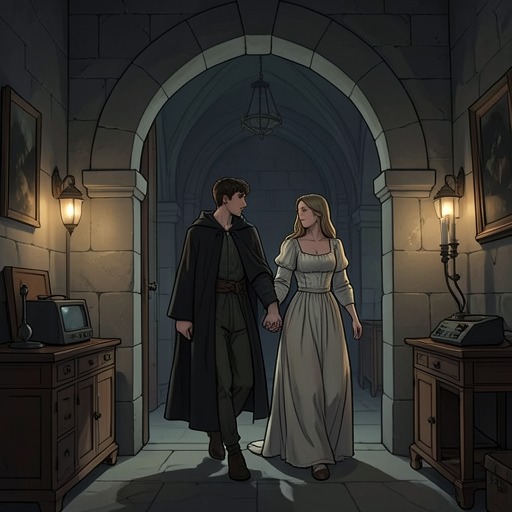
Luned gives Owain son of Urien the Invisibility Ring and explains how to use it: he must conceal the stone in his closed hand, and the ring will conceal him in turn. She anticipates that the Castle’s people will return to put him to death, tells him where she will wait, and arranges a way for him to follow her unseen. When the searchers find only the remains of his horse, Owain son of Urien vanishes from their sight, finds Luned, and follows her to a richly decorated chamber. The rescue depends on her forethought as much as on the ring: she has supplied both the means of escape and a precise route to safety.
The next day, Luned returns to the Countess of the Fountain, who is overwhelmed by grief for her dead husband and initially refuses to answer her. Luned does not flatter or simply console her. She argues that mourning cannot restore what is gone, and presses the Countess to consider what she still needs. The Countess responds angrily, threatening to have Luned executed or banished; Luned accepts the possibility of exile rather than abandon her judgment. When the Countess follows her and signals for her return, Luned agrees to explain what can be done.
Her advice connects the Countess’s personal future to the security of her lands. The earldom, Luned insists, cannot be preserved without warfare, arms, and a capable defender. Since the Fountain can be guarded only by a knight of Arthur’s court, she promises to find one. She says she will travel to Arthur’s court, but instead returns to Owain son of Urien and remains with him for as long as the journey would have taken. This calculated deception gives the Countess time to accept the prospect of a new marriage while allowing Luned to bring the right knight directly to her.
The Marriage and the Earldom
Luned presents Owain son of Urien to the Countess of the Fountain as the champion she has found. The Countess quickly suspects his identity: he does not look like a traveller, and she recognizes that he is the man who killed her husband. Luned does not deny what happened. Instead, she turns the fact of his victory into an argument for his fitness, reasoning that he could not have overcome the former defender unless he were stronger. The Countess withdraws to take counsel rather than immediately accepting or rejecting him.
The following day, the Countess assembles the people of the earldom and explains that her lands are undefended. She asks them to choose whether one of their own should marry her or whether they will allow her to marry someone from elsewhere who can defend the dominions. They agree to the second course. Bishops and archbishops then celebrate the nuptials of the Countess of the Fountain and Owain son of Urien, and the people of the earldom do him homage. Luned’s matchmaking has thus secured not simply a husband for her mistress but a recognized defender for the territory.
Owain son of Urien proves the practical value of the arrangement by defending the Fountain with lance and sword. He defeats each knight who comes against him, sells the defeated challengers for their full worth, and distributes the proceeds among his barons and knights. His subjects come to love him, and his rule continues in this manner for three years. Luned’s intervention therefore sets in motion a period in which martial protection, political recognition, and popular affection reinforce one another.
Imprisonment and Owain’s Return
Owain son of Urien eventually leaves the Countess of the Fountain and returns to Arthur’s court. During his absence, two pages in the Countess’s chamber call him a deceiver. Luned defends him, telling them that neither of them is a match for him alone. They retaliate by imprisoning her in a stone vault and threatening to put her to death unless Owain son of Urien comes to deliver her by a specified day. Her defense is grounded in loyalty to the man she regards as the best friend in the world, but it also exposes her to a danger that she cannot resolve by her own influence.
Years later, Owain son of Urien hears Luned’s sighs while camping in the woods with the lion that has become his companion. She tells him from confinement who she is, why she has been imprisoned, and that her execution is near. Owain son of Urien asks whether she believes he would come if he knew her situation; Luned is certain that he would. The scene makes her confidence consequential: having learned of the danger, Owain son of Urien acts to save her.
When Owain son of Urien reaches the place where Luned is held, two young men are leading her toward a fire, claiming that the deadline has passed and that he has failed to rescue her. He offers to fight in Owain son of Urien’s place. The lion assists him, despite the young men’s objection that they agreed to fight one opponent alone. Owain son of Urien puts the lion away and tries to meet the challenge without it, but the young men press him hard; the lion breaks through the wall and kills them. Luned is saved from burning, and she returns with Owain son of Urien to the Countess’s dominions. He then takes the Countess with him to Arthur’s court, and she remains his wife for the rest of her life.
Narrative Role and Significance
Luned’s actions repeatedly turn knowledge into intervention. She reads Owain son of Urien’s character at the gate, gives him a means of escape, understands the political vulnerability created by the Countess’s bereavement, and devises a path from private grief to a public decision about marriage and defense. Later, her imprisonment tests the loyalty she had earlier recognized in him: the man she helped establish as protector must now return to protect her. The recurring exchange of rescue gives their bond a reciprocal shape, while Luned’s ability to act decisively makes her an essential agent in the story’s movement between the Fountain, the earldom, and Arthur’s court.