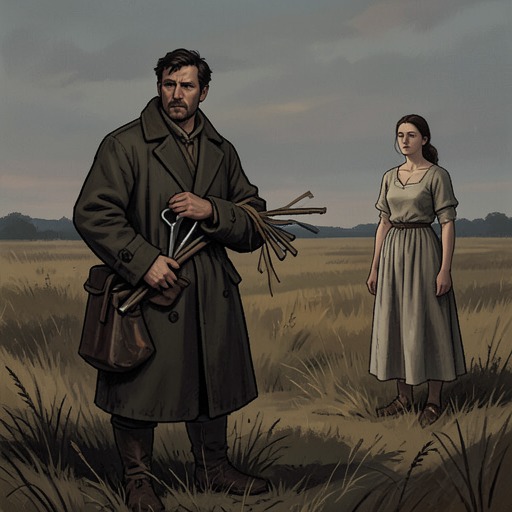
Helen Luyddawc
MabinogionHelen Luyddawc stands at the point where Maxen Wledig’s dream becomes a marriage, a grant of British territory, and a lasting account of roads made in her name. First encountered as the woman sought by an emperor who says he has seen her in his sleep, she is not only the destination of his journey: she asks him to come to her, specifies what she will receive as her marriage portion, and later recognizes the British force that helps him recover Rome.
Identity and Introduction
Helen appears in a hall at Aber Sain, seated on a chair of gold. The messengers who have followed the landmarks of Maxen Wledig’s dream find her there with Kynan and Adeon, who are playing chess, and Eudav son of Caradawc, carving chessmen beside a pillar. The dream’s remembered details have led the envoys across the sea and through Britain to this particular hall; Helen is presented as its central figure, but also as part of a household with its own members and setting.
The messengers address her as the future Empress of Rome and explain that Maxen has seen her in his sleep and is so consumed by love that he can scarcely live. They offer her a choice: travel with them to become empress, or have Maxen come to seek her and take her as his wife. Helen neither accepts the envoys’ account without reservation nor dismisses it. She tells them that if the emperor loves her, he should come in person. Her response makes the dream’s fulfillment depend on Maxen’s journey to her, rather than on her simply being carried away to his court.
Marriage and the Marriage Portion
The messengers return to Rome, and Maxen sets out with an army, using them as guides. His campaign brings him to Aber Sain, where he recognizes the castle and hall from his dream. There he finds Helen in the golden chair, with Kynan and Adeon playing chess and Eudav carving the pieces. He greets Helen as the woman he has sought, embraces her, and marries her that night. The scene repeats the dream’s arrangement closely: the recognizable hall and its occupants confirm that the journey has reached the place Maxen had seen.
The next morning, Helen asks for her marriage portion and is invited to name what she wishes. She requests the Island of Britain, from the Channel to the Irish Sea, together with three adjacent islands, to be held under the Empress of Rome for her father. She also claims the right to choose the sites of three principal castles. Her first choice is the highest castle, at Arvon; two others are subsequently built at Caerlleon and Caermarthen. The account thus gives her requests both a territorial scale and a material form: her marriage is followed not just by a title, but by dominion and the construction of royal strongholds.
At Arvon, earth is brought from Rome so that the emperor will have healthier ground on which to sleep, sit, and walk. This small, concrete detail makes the castles more than marks on a map: Roman soil is transported into the British setting for Maxen’s comfort. Helen’s marriage portion joins the two places through land, architecture, and the emperor’s own daily life.
Castles, Roads, and a British Legacy
Helen’s connection to Britain continues beyond the choice of castles. While Maxen is hunting at Caermarthen, he reaches the summit of Brevi Vawr and pitches his tent there; the encampment is remembered as Cadeir Maxen. Caermarthen is also associated with a castle built by a myriad of men. These details place Maxen’s presence within a landscape whose names and structures preserve the events of his stay.
Helen, meanwhile, has high roads made from one castle to another throughout the Island of Britain. They are called the roads of Helen Luyddawc because she was descended from a native of the island; the narrative adds that the Britons would not have made these great roads for anyone else. This explanation gives her British descent public consequence. The roads connect the castles she chose, but their reach extends across the island, making her name part of a story about infrastructure and collective labor. The tale attributes their construction to her initiative while grounding that exceptional honor in her local ancestry.
Separation and the Campaign for Rome
Maxen remains in Britain for seven years. The narrative explains that Roman custom treated an emperor’s stay in foreign lands for more than seven years as a danger: he could be overthrown and never return to Rome. After Maxen has spent those seven years on the island, the Romans appoint another emperor, who sends him a threatening letter. Maxen answers with a similarly defiant message and marches toward Rome, conquering France and Burgundy and other lands along the way before laying siege to the city.
Helen is not described as directing this campaign, but her family becomes essential to its outcome. After Maxen has spent a year before Rome without taking it, Helen goes to inspect a newly arrived force and recognizes the standards of her brothers. Kynan and Adeon then come to greet Maxen, who embraces them. Her recognition establishes the connection between the British newcomers and the emperor’s wife, bringing her natal family into the military crisis that follows.
The brothers’ force proves decisive in the assault. Kynan proposes a more effective attack, and the Britons use the Romans’ regular midday pause for their meal to scale the walls with ladders and enter the city. The new emperor is killed, and the Britons spend three days and nights subduing the defenders and taking the castle. Helen’s recorded action in this episode is precise and limited: she identifies her brothers by their standards. Yet that act marks the moment when her family’s arrival becomes legible to Maxen and links the marriage that brought him to Britain with the force that helps him regain Rome.
Narrative Role
Helen’s story moves from recognition to negotiation and then to recognition again. At first, Maxen’s dream defines her as the woman he desires, but she answers the envoys by requiring him to come himself. Once married, she uses the invitation to name her portion, choosing territory, islands, castles, and the sites of those strongholds. Later, she recognizes the standards that announce her brothers’ arrival. Across these episodes, her actions connect personal union to land, construction, kinship, and imperial conflict.
The tale’s portrayal of her agency is specific rather than expansive: it records her condition to the messengers, her marriage request, her choices of castle sites, the roads attributed to her, and her recognition of her brothers. It does not assign her command of Maxen’s army or of the siege. Her importance instead lies in how these recorded acts join the story’s British and Roman settings. The roads bearing her name and the arrival of her brothers make Helen more than the object of a dream: they show her as a link through whom the emperor’s private pursuit acquires a public and dynastic consequence.