Gwenhwyvar
MabinogionGwenhwyvar is Arthur’s wife and a prominent figure at his court, where her judgments affect both the treatment of guests and the rewards bestowed on others. Her authority appears less through formal commands than through attentive intervention: she rebukes Kai for discourtesy, welcomes Peredur after he has answered an insult to her, and ensures that the stag’s head is held until Geraint can return with the woman he has defended. Across these episodes, she helps make courtesy, restitution, and public honor practical concerns of court life.
Identity and Place at Court
At Caerlleon upon Usk, Gwenhwyvar sits with her handmaidens at needlework while Arthur, Owain, and Kynon are in his chamber. The scene places her within the court’s domestic and social life, but not at its margins: she is present for the conversation that sends Owain toward the adventure Kynon has described, and she intervenes when Kai answers Owain’s suggestion with a discourteous challenge. Her rebuke makes clear that a knight’s speech, as well as his deeds, is subject to judgment at court.
Her conduct repeatedly joins hospitality to discernment. When Peredur returns with Gwalchmai, she and her attendants are glad to see him and welcome him into the company. The welcome follows a troubled first encounter: Peredur had arrived at court poorly equipped, and Kai had treated him with contempt. Gwenhwyvar’s response belongs to the court’s larger recognition that Peredur has proved himself through action, while her welcome helps mark his return as a reconciliation rather than merely another arrival.
Advocacy and the Court’s Obligations
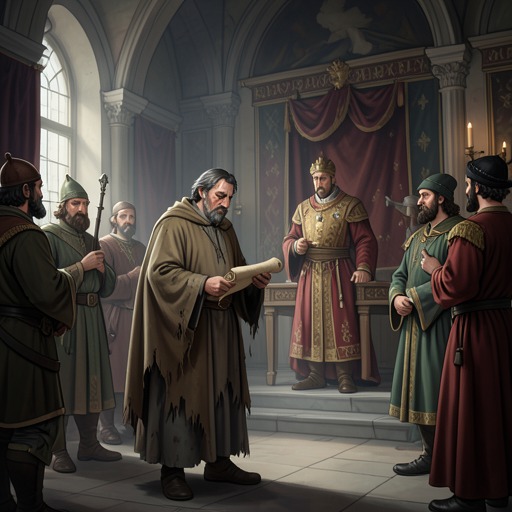
Gwenhwyvar is herself the target of a public affront when a knight enters Arthur’s hall, throws the drink intended for her upon her, and strikes her. The assembled household is reluctant to answer the challenge that follows, fearing the stranger’s apparent power. Peredur arrives during this humiliation and soon pursues the offender. Afterward, he asks Owain to return the goblet to Gwenhwyvar and to tell Arthur that he will serve him, though he will not come to court until he has avenged the insult to the dwarf and dwarfess. His action thus answers two wrongs at once: the treatment of the queen and the earlier abuse of the court’s silent visitors.
When Peredur later returns with Gwalchmai, Arthur receives him with honor and connects his deeds to the dwarf and dwarfess’s prediction. Gwenhwyvar and her attendants share in the welcome. Her response gives the courtly gathering a human counterpart to Arthur’s formal recognition: the woman who was publicly insulted receives back a knight who has acted on her behalf, and the once-ridiculed newcomer is received as a worthy member of the company.
The Hunt and the Stag’s Head
Before Arthur’s hunt for the white stag, Gwenhwyvar asks permission to witness it. Arthur agrees. Gwalchmai proposes that whoever brings down the stag may give its head to the lady of his choice, whether his own beloved or the beloved of a friend; Arthur accepts the rule. Gwenhwyvar’s interest in the hunt therefore coincides with a decision that makes its prize an instrument of personal recognition, not simply a trophy for the hunter. The court spends the night in entertainment, and the next morning Arthur and his company set out.
Arthur’s party pursues the stag with hunting dogs, including Cavall, Arthur’s favorite. After the stag is brought down, the company disputes over which lady should receive its head. Gwenhwyvar proposes that it remain unawarded until Geraint returns from his errand, and tells Arthur what that errand concerns. Arthur agrees. The decision suspends the competing claims rather than allowing the prize to be settled by preference or argument alone. Gwenhwyvar then has a watch posted on the ramparts so that Geraint’s return will not pass unnoticed.
Geraint, Enid, and Public Recognition
Earlier, Gwenhwyvar and Geraint had encountered a maiden and a knight accompanied by a dwarf. When Gwenhwyvar asks the dwarf to identify the knight, he refuses and declares that the maiden is not of sufficient standing to address his lord. The dwarf then attacks her when she turns to question the knight herself. Geraint approaches to ask the same question, is also rebuffed and struck, and considers his response before withdrawing. Gwenhwyvar’s presence makes her more than a distant witness to the affair: the incident begins with an insult to her companion, and Geraint’s decision to pursue the knight grows from the affront he has seen.
When the party later comes into view, the watch reports a small man, a woman, and a large knight in damaged armor. Gwenhwyvar recognizes the knight as the one Geraint pursued and understands that he has been brought back against his will. When Geraint arrives with the maiden, Gwenhwyvar goes out with the women to welcome them. She praises the success of his pursuit and accepts his account that the maiden is the person for whom he sought redress. Arthur and the court welcome her as well; he gives her to Geraint in marriage, and she receives fine clothing from Gwenhwyvar’s own apparel. Her reception restores the maiden’s standing as the earlier attack had denied it.
Gwenhwyvar then returns to the question of the stag’s head. She presents Enid, daughter of Ynywl, as the fitting recipient, and the company agrees. The prize that had occasioned sharp disagreement is thus attached to the outcome of Geraint’s errand: Enid is welcomed as his bride and publicly honored by the court. Gwenhwyvar’s interventions do not replace Arthur’s decisions, but they shape what those decisions recognize. Her presence links the hunt’s ceremonial rule to the resolution of a wrong, and turns the stag’s head into a visible sign of Enid’s new place among the court’s favored women.