Kynon son of Clydno
MabinogionKynon son of Clydno is an adventurous courtier and storyteller whose account of a humiliating defeat at the Fountain becomes the pattern for Owain son of Urien’s own quest. His importance rests not on a victory but on the journey he dares to recount: what Kynon could not overcome becomes the challenge that draws Owain away from Arthur’s court and, years later, prompts Arthur to go looking for him.
Identity and Ambition
At Arthur’s court in Caerlleon upon Usk, Kynon sits among Arthur, Owain, and Kai while Gwenhwyvar and her attendants work at needlework. When Arthur retires to sleep and Kai asks for the promised story, Kynon acknowledges that Owain is older, has seen more marvels, and is the better teller; he asks Owain to begin instead. Owain returns the obligation, and Kynon accepts the invitation to tell his own adventure. The exchange introduces him as a participant in a courtly culture where telling a tale is itself a social debt, and where experience gives a story its authority.
Kynon presents himself as the only child of his parents, exceptionally aspiring and daring. He believed no enterprise too difficult for him, and, after exhausting the adventures available in his own country, equipped himself to travel through deserts and distant regions. His self-portrait is defined by restless confidence: he sets out not because he is compelled, but because he imagines that the world must still contain trials proportionate to his ambition.
The Journey and the Fountain
Kynon’s route leads through a beautiful valley, beside a river and a path that he follows from midday until evening. At the far end of a plain stands a large, lustrous castle by a torrent. Two youths near it wear yellow satin, gold frontlets and clasps, and carry elaborately made weapons: ivory bows strung with stag sinew, whale-bone arrows with peacock-feather flights and golden heads, and golden daggers. A courteous, newly shaven man in yellow satin receives Kynon’s greeting and accompanies him inside. There, four-and-twenty damsels embroider satin at a window; Kynon stresses that even the least beautiful surpasses the finest women he has seen at Arthur’s court. The abundance and refinement of the castle establish a world that is at once hospitable and strange, a threshold before the ordeal outside it.
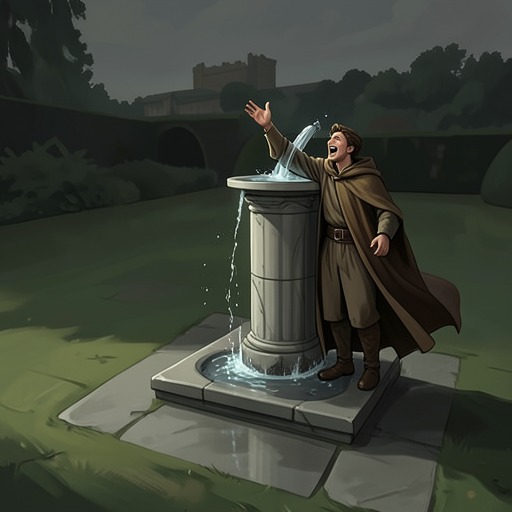
The narrative’s account of Kynon’s failure reaches the reader through his own recollection and through the parallel adventure Owain later undertakes. Kynon’s return from the Fountain is marked by defeat and shame: the black man’s derision overwhelms him with embarrassment, and he comes back to the castle without having succeeded. The rider who has taken his horses does not imprison him or strip him of his arms. That limited punishment makes the humiliation more pointed: Kynon is left free to return, carrying the knowledge that he has failed rather than the excuse of captivity.
The castle receives him again, and the contrast with the public failure is striking. Kynon is entertained even more agreeably than on the previous night, feasted better, and speaks freely with its inhabitants. No one mentions his expedition, and he does not raise it himself. In the morning, he finds a dark bay palfrey ready-saddled. He rides home on it and says that he still possesses the horse and would not exchange it for the best palfrey on the Island of Britain. The gift does not erase his defeat; it becomes the durable, material remainder of an adventure he admits was discreditable to him.
A Failure That Becomes a Challenge
Kynon’s candor gives the story its force. He calls attention to how extraordinary it is that no one else has told him of this adventure, or encountered it, despite the place lying within Arthur’s dominions. He does not present himself as a victor or conceal the shame of his return; instead, he makes the unexplained existence of the adventure the reason to pursue it. Owain responds by proposing that they go and discover the place. Kai dismisses the proposal as an example of Owain saying what he would not do, and Gwenhwyvar rebukes Kai for speaking discourteously to him. Kynon’s tale thus changes the courtly conversation into a dispute about action, courage, and the treatment of a fellow knight.
Owain soon acts on the account. He travels to the valley Kynon described, recognizes the castle and the same youths, and receives the same hospitality from the yellow-clad host. When Owain explains that he seeks the Knight who guards the Fountain, the host says that he is as reluctant to direct him toward the adventure as he had been to direct Kynon. Owain then reaches the Fountain and triggers the storm by pouring water onto the slab. The thunder, violent shower, newly bare tree, and returning birds lead to combat with the black Knight. The sequence confirms the pattern Kynon’s story had opened, while making clear that Owain’s encounter becomes a different test: he fights, wounds the Knight, and pursues him toward the castle. Kynon’s story is therefore not simply background information; its failure is the point of departure for another knight’s action.
Guide to Arthur’s Search
Kynon’s tale eventually has a consequence beyond Owain’s departure. Three years after Owain has been lost from court, Gwalchmai sees Arthur grieving for him. Arthur says that he fears losing Owain permanently if another year passes and connects the loss to the story Kynon told. Gwalchmai proposes that Arthur and his household can find out whether Owain is dead, imprisoned, or alive, without summoning the whole of the dominions. Arthur agrees, and a company of three thousand men, besides attendants, sets out with Kynon as guide.
Kynon thus returns to the role his tale first gave him, but with a changed purpose. At first he was the solitary adventurer who could describe the route to an uncanny place; now he leads Arthur and a large company along that route. They revisit the castle of the yellow-clad host, where even the great retinue is scarcely noticed amid the building’s vastness. The next morning Kynon guides Arthur to the black man, the wooded steep, the valley, the green tree, and the Fountain with its bowl and slab. Kai asks permission to pour the water and meet the adventure first. Arthur grants it; the storm follows, and the black Knight defeats Kai. Kynon’s knowledge makes the place reachable, but it does not control what happens there: his remembered route brings the court to the challenge, while the next encounter belongs to Kai and Arthur’s company.
Narrative Role
Kynon occupies a distinctive position between the adventure and its retelling. His first-person recollection supplies the account that Owain hears at court; Owain’s subsequent journey turns that account into enacted repetition; and Arthur’s later expedition returns to Kynon as a guide. The movement from teller to guide gives his experience a continuing practical use even though his own encounter ended in defeat.
The tale also preserves a tension between embarrassment and generosity. Kynon does not hide the episode that makes him look foolish, and the court receives his account as a challenge rather than dismissing him for failing. His restraint at the castle—neither raising the subject nor being forced to defend himself—contrasts with his frankness before Arthur’s company. By recounting what he could not master, Kynon makes the unknown adventure legible to others, and his failure becomes the first link in a chain of journeys that draws Owain away and sends Arthur after him.