Gwawl
MabinogionGwawl is a powerful and wealthy suitor whose bid to marry Rhiannon turns on a promise Pwyll makes before knowing what boon will be requested. Rhiannon redirects the resulting danger into a calculated reversal: at the feast prepared for Gwawl, Pwyll uses an inexhaustible bag to capture him. Gwawl survives, but the humiliation and grievance attached to that defeat later motivate Llwyd son of Kilcoed’s magical attack on Dyved.
Identity and Suit
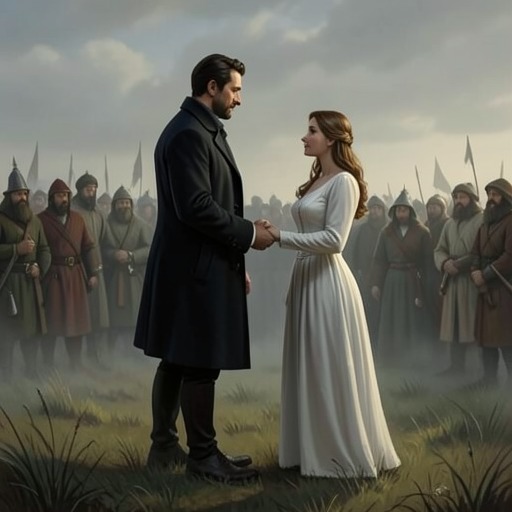
At the feast held at Heveydd Hen’s palace, a tall, auburn-haired youth of royal bearing enters and asks Pwyll for a boon. Pwyll has already promised to grant whatever he can, and Gwawl invokes that promise to ask for the lady he loves as his bride that very night. The request concerns Rhiannon, who tells Pwyll that Gwawl is the man to whom others would have given her against her will. She identifies him as a man of great power and wealth, making clear both the stakes of his suit and the force behind it.
Pwyll’s predicament arises from his own unqualified promise, not from any prior agreement to give Rhiannon away. He falls silent, recognizing that his word has placed him in a bind; Rhiannon rebukes his poor judgment but does not accept Gwawl’s claim as a settled marriage. Instead, she asks Pwyll to bestow her on Gwawl for the time being and devises a plan to ensure that she will never become his bride. Her response makes Gwawl’s apparent success the first stage of his defeat.
Capture in the Enchanted Bag
Rhiannon’s plan brings Pwyll back to the feast a year later, when Gwawl is being celebrated as her intended bridegroom. Pwyll arrives in coarse, ragged clothes and old, clumsy shoes, carrying the small Enchanted Bag and posing as a man in need of food. Gwawl agrees that the request to fill it is reasonable. Yet however much food the attendants put inside, the bag appears no fuller than before.
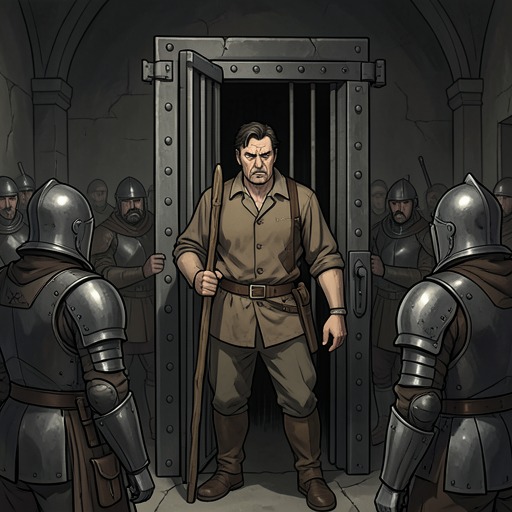
Gwawl asks whether it will ever be full. Pwyll says it will not, unless a person of land, domains, and treasure stands on the food with both feet and declares that enough has been put in. At Rhiannon’s prompting, Gwawl rises and steps into the bag. Pwyll turns its sides up over Gwawl’s head, knots the thongs, and blows his horn as the signal for his hundred knights. They descend on the palace, seize Gwawl’s accompanying household, and put the men in Gwawl’s own prison.
Pwyll then casts off his disguise. His knights strike the bag with their feet or staves, asking what it contains; the answer is a badger, and the mockery becomes the Game of Badger in the Bag. The scene turns Gwawl’s feast, wealth, and expectation of marriage into the setting for his public humiliation: he has been induced to supply the very status and action that make his capture possible.
Release and Settlement
Gwawl appeals from inside the bag, saying that he does not deserve to be killed there. Heveydd Hen urges Pwyll to hear him, and Rhiannon proposes a punishment and settlement rather than a killing. Gwawl must satisfy suitors and minstrels in Pwyll’s place and give a pledge that he will never seek revenge for what has been done to him. Gwawl accepts those terms, as does Pwyll, and Heveydd and the other sureties secure the agreement.
Once the covenant is settled, Gwawl is released and his liegemen are freed. He says he has been badly hurt and bruised and asks permission to leave for anointing, leaving nobles behind to answer for him. Pwyll allows him to go, and Gwawl returns to his own possessions. The ending is therefore neither his death nor a marriage to Rhiannon: he survives, but departs injured, deprived of his suit, and bound by a pledge against retaliation.
Grievance and Narrative Role
Gwawl’s defeat has consequences beyond the feast. Llwyd son of Kilcoed later identifies himself as the one who cast a charm over the seven cantrefs of Dyved, explaining that he did so to avenge Gwawl because of his friendship with him. Llwyd presents the enchantment as retaliation for the Game of Badger in the Bag that Pwyll played on Gwawl at Heveydd Hen’s court. In this later account, Gwawl is the injured friend whose treatment supplies the reason for a new conflict, though the evidence does not show him carrying out the enchantment himself.
Gwawl’s role links a courtship plot to a chain of consequences. His request exposes the danger in Pwyll’s careless promise; Rhiannon’s ingenuity turns that danger into a trap; and the settlement prevents immediate vengeance without erasing the humiliation. The later revenge by Llwyd reveals the limit of that settlement: a pledge obtained from Gwawl does not prevent his ally from seeking redress. Gwawl thus remains consequential after his departure, not through further action on the page, but as the grievance that gives the enchantment of Dyved its stated cause.