Lludd
MabinogionLludd is a king of the Island of Britain whose authority is defined both by public generosity and by practical action in crisis. When three plagues threaten his people, he seeks counsel from his brother Llevelys, then personally carries out the measures that end them. The story presents kingship as a combination of wise consultation, careful preparation, and a ruler’s willingness to keep watch and act for himself.
Identity and Kingship
After his father’s death, Lludd inherits the kingdom as its eldest son. He rules prosperously, rebuilds the walls of London, surrounds the city with numerous towers, and has houses built there to a standard unmatched in other kingdoms. Of his castles and cities, London is his favorite residence, and he spends most of the year there. Its successive names preserve the story’s account of the city’s identity: it is first associated with Lludd, later known as London, and also called Lwndrys after the arrival of a foreign people.
Lludd is also described as a mighty warrior and a generous host, freely providing food and drink to those who seek them. These traits anticipate the different demands of his story: he must defend the kingdom against threats, but also protect the provisions on which its people and court depend. His prosperous rule is not presented as effortless; its stability is tested by afflictions whose causes are initially unknown.
The Plagues and Llevelys’s Counsel
The first plague is the arrival of the Coranians, whose hearing is so acute that no one in the kingdom can speak without their knowing what is said. The second is a terrifying cry heard throughout the Island of Britain on every May Eve. It robs people of strength and senses and leaves people, animals, trees, land, and water barren. The third affliction is the repeated disappearance of provisions from the king’s courts: however much food and drink is stored, only what is consumed on the first night remains. Lludd grieves because he cannot discover how to free his kingdom from these troubles, and, on the nobles’ advice, turns to Llevelys, king of France, renowned for wisdom and counsel.
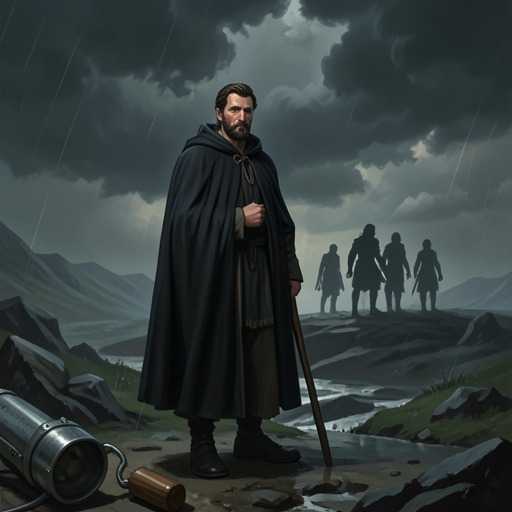
Their meeting is shaped by caution as well as affection. Lludd secretly prepares a fleet so the Coranians will not learn the purpose of his journey. When Llevelys approaches with a large fleet, Lludd leaves the ships at sea and goes out in a single vessel; Llevelys likewise comes in one ship. They embrace and welcome one another as brothers. To discuss the crisis without the wind carrying their words to the Coranians, Llevelys has a long brass horn made. A demon distorts their speech through it, so that each hears harsh and hostile words. Llevelys pours wine into the horn to drive the demon out, and the brothers are then able to speak freely.
Llevelys explains that each plague has a different cause and prescribes a distinct remedy. For the Coranians, he gives Lludd insects: some are to be kept for breeding in case the affliction returns, while others are to be crushed in water. He says that the water will destroy the Coranians without harming Lludd’s own people. The May Eve cry, he reveals, comes from two dragons of different peoples fighting; Lludd must trap them in a cauldron of mead and bury them together. The theft of provisions is the work of a powerful magician who uses enchantments to put watchers to sleep, so Lludd must remain awake and keep cold water nearby to resist drowsiness.
Ending the First Two Plagues
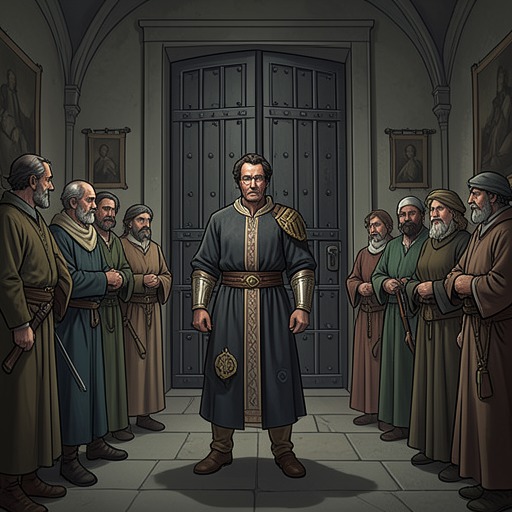
Back in his kingdom, Lludd gathers the Coranians and his own people together under the appearance of a conference to make peace. Following Llevelys’s instructions, he casts the prepared water over the gathering. It destroys the Coranians while leaving the Britons unharmed. The remedy both identifies the danger as a people capable of being removed from the kingdom and averts the damage to Lludd’s own subjects.
Lludd next has the Island measured in length and breadth to locate its exact centre. He finds it at Oxford, digs a pit there, places inside a cauldron filled with the best mead he can obtain, and covers it with satin. Keeping watch in person, he sees the dragons fight, tire, and fall onto the covering in the form of pigs. They sink into the cauldron, drink the mead, and fall asleep. Lludd wraps them in the covering and buries them in a secure place in Snowdon. The cry ceases, and the place is thereafter called Dinas Emreis, having previously been known as Dinas Ffaraon. The scene turns the apparently vast and inescapable disturbance into something that can be contained by a carefully prepared trap and a watchful king.
The Magician and the Restoration of Peace
To confront the third plague, Lludd prepares a great banquet and watches over the provisions himself, with a vessel of cold water beside him. Enchanting music and songs press him toward sleep, but he repeatedly plunges into the water to remain alert. During the third watch of the night, an enormous man in heavy armour enters carrying a hamper and begins loading it with the court’s food and drink. Lludd challenges him rather than letting the provisions disappear again. They struggle, and Lludd overcomes him by strength and might.
The defeated magician asks for mercy and promises to make atonement for everything he has taken, never to repeat the theft, and to become Lludd’s faithful vassal. Lludd accepts the pledge. Unlike the remedies for the Coranians and the dragons, this resolution ends not with destruction or burial but with restitution and submission. Having freed the Island of Britain from all three plagues, Lludd rules in prosperous peace until the end of his life. The conclusion completes a pattern established throughout the story: he learns the nature of each threat, adapts the remedy to its cause, and personally sees the work through.