Yspaddaden Penkawr
MabinogionYspaddaden Penkawr is a giant lord whose daughter Olwen’s marriage sets the terms of Culhwch’s quest. He turns a request for her hand into a chain of formidable conditions, resisting the match until Arthur’s company completes them. His eventual death marks the end of his authority over Olwen and his castle, while the marriage that follows brings the quest to its conclusion.
Identity and Household
Yspaddaden is Olwen’s father and the lord of a castle described as exceptionally fair. The approach to it is marked by its scale and distance: Arthur’s company crosses a vast plain, yet for days the castle seems scarcely nearer. At its edge stretches an immense flock of sheep, watched by Custennin, a herdsman who identifies the castle as Yspaddaden’s and says that his brother has oppressed him over his possessions. The household’s reach thus includes both a great estate and the dispossession of a relative.
Custennin’s account also establishes the danger surrounding the marriage quest before Yspaddaden appears. He warns the visitors that those who came seeking Olwen had not returned alive. His own household provides a contrast to the giant’s power: Custennin keeps the sheep, but describes himself as someone his brother has wronged. When Culhwch gives him a gold ring, Custennin carries it home concealed in his glove; his wife recognizes it as evidence of a visitor and learns that Culhwch has come to seek Olwen. She is glad to see her nephew, yet fears for him because previous suitors have not survived the quest.
The Suit and Its First Encounters
Culhwch’s claim to Olwen begins with a pronouncement by his stepmother: he will not find a suitable wife until he obtains Yspaddaden’s daughter. Although Culhwch has never seen Olwen, he falls in love with her on hearing this, and his father directs him to ask Arthur for help. At Arthur’s court, Culhwch identifies himself as Arthur’s cousin and asks for Olwen as his boon. Arthur pledges assistance, turning a private marriage request into a collective expedition.
When the company reaches Yspaddaden’s castle, Olwen advises Culhwch to ask her father for her hand and to grant whatever he demands. She has pledged not to leave without her father’s counsel, and she warns that refusing his conditions would put Culhwch in danger. The suitors enter after passing the castle’s nine gates without alerting its porters or watchdogs. In the hall, Yspaddaden asks that supports be raised beneath his heavy eyebrows so he can see the man seeking his daughter. He postpones his answer until the following day.
That delay becomes a pattern of confrontation. On successive visits Yspaddaden throws poisoned darts at the company; the suitors catch and return them, leaving him with worsening complaints about the consequences. His attacks make the danger he represents immediate, while his repeated postponements keep the marriage unresolved. On the fourth visit the company warns him not to attack again and demands that he either give Olwen or face the consequences. Yspaddaden then has Culhwch seated opposite him and asks directly whether he is the suitor. Culhwch confirms it and promises to meet the conditions named.
The Conditions for Marriage
Yspaddaden’s demands expand the proposal into a chain of linked feats. One requires a vast hill to be uprooted, its roots burned for manure, and the land ploughed and sown so that the grain ripens in a single day. He names Amaethon as the only farmer able to prepare the land, while insisting that Amaethon will not come willingly and cannot be compelled. The demand is not simply for wedding provisions: its precise deadline and the unwilling specialist make its completion an extraordinary test.
Other conditions gather rare objects, difficult services, and the cooperation of people who are said not to yield willingly. Yspaddaden requires the cauldron of Diwrnach, steward to Odgar son of Aedd, to cook the wedding meat. He demands the tusk of Yskithyrwyn Benbaedd, pulled while the animal is alive, to shave himself; Odgar alone can remove it, and Gado is to keep it. He also requires warm blood from a sorceress associated with Pen Nant Govid, and containers capable of preserving that blood’s heat over a journey. Fresh milk must be provided in vessels in which no liquid turns sour. For his hair, he insists on the comb and scissors between the ears of Twrch Trwyth, adding that the hunt cannot be undertaken without Drudwyn, the whelp of Greid. Each demand opens onto another dependency, so that the proposed wedding rests on a widening network of challenges.
Culhwch repeatedly answers that the tasks will be easy to accomplish, even when Yspaddaden says otherwise. This exchange gives the giant’s resistance its recurring form: he names an apparently prohibitive condition, and Culhwch accepts it without withdrawing his claim. Yspaddaden’s conditions delay the marriage and define the work Arthur’s company must undertake; their eventual fulfillment removes the grounds on which he has withheld Olwen.
Defeat and Narrative Role
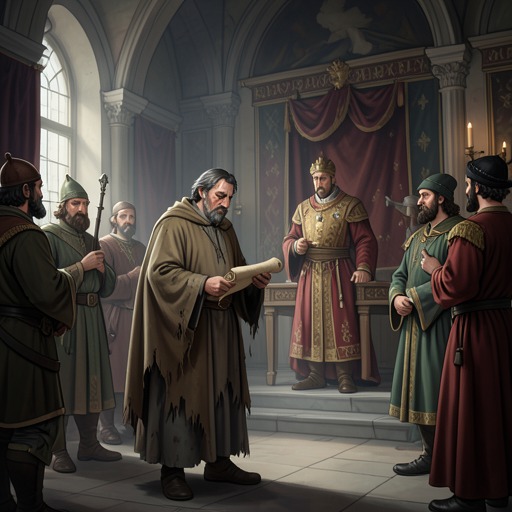
After the marvels have been brought to Yspaddaden’s court, Kaw of North Britain shaves him as required. Asked whether he is shaved, Kaw answers that he is. Yspaddaden then concedes that Olwen belongs to Culhwch, but denies that the suitor deserves his gratitude: he says Arthur accomplished the work and that Yspaddaden would never have given his daughter willingly, since her marriage means his own life will end. The statement makes explicit the cost he attaches to the match, although it does not turn his earlier attacks or demands into a stated explanation of that fate.
Goreu, Custennin’s son, takes Yspaddaden away and kills him; his head is set on a stake on the citadel. The company takes possession of the castle and its treasures. That night Olwen becomes Culhwch’s bride, and she remains his wife for the rest of her life. Yspaddaden therefore stands at the center of the quest as both the father whose consent is sought and the antagonist whose conditions organize the adventure. His defeat resolves the marriage plot, transfers control of his stronghold, and brings his resistance to a definitive end.