Pryderi
MabinogionPryderi is the son of Pwyll, Chief of Annwvyn, and Rhiannon, whose recovery ends the punishment imposed after she was falsely accused of killing and devouring him. Raised for a time by Teirnyon Twryv Vliant and his wife, he returns to his parents, receives his lasting name, and grows into a capable and popular ruler. His life joins two markedly different scenes: the restoration of a child to a grieving family and the death of a lord who refuses to let others fight in his place.
Identity and Naming
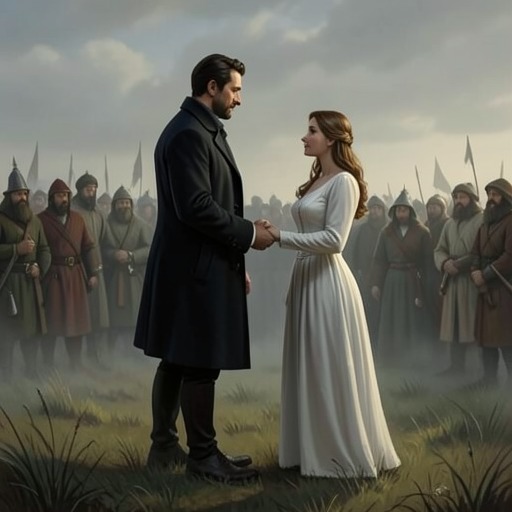
At his return, Teirnyon identifies the boy as Pwyll and Rhiannon’s son, and the assembled company agrees that his resemblance makes his parentage plain. His foster parents had named him Gwri Wallt Euryn. Pendaran Dyved proposes Pryderi instead, and Pwyll argues that the boy should take a name from the words Rhiannon spoke when she received the joyful news of his recovery. The name thus belongs to the public recognition of his return as much as to his family identity: the child whose disappearance caused Rhiannon’s suffering is formally acknowledged in the gathering that ends it.
The boy’s recovery also closes the false accusation that had defined Rhiannon’s life. When Teirnyon presents him at the palace, Rhiannon is still performing her penance, offering to carry visitors on her back while explaining that she is punished for killing her own son. Teirnyon and the boy refuse to accept this service from her. Their arrival precedes the revelation at the feast, where Teirnyon recounts how he and his wife had nurtured the child as their own and declares that the boy is Pwyll’s son. Rhiannon’s response makes the personal consequence immediate: if the account is true, her trouble has ended.
Fosterage and Upbringing
Pwyll acknowledges Teirnyon’s care and promises to support him and his possessions for as long as he can preserve his own. Teirnyon, however, emphasizes that his wife nursed the boy and suffers most at their separation. Pwyll proposes that the child be brought up from then on by Pendaran Dyved, with Pendaran and Teirnyon both regarded as his foster fathers. The nobles approve, and the boy is entrusted to Pendaran in the company of the land’s nobles.
Teirnyon returns home with affection and gladness, declining the jewels, horses, and choice dogs offered to him. The exchange gives the reunion a lasting human cost without undoing the bond formed during the child’s absence: Teirnyon’s wife must part from the boy she raised, while Pwyll’s promise recognizes the care their household provided. Pryderi’s childhood is then described as careful and fitting to his station. He becomes handsome, comely, and highly skilled in games, qualities that mark the transition from recovered child to accomplished young man.
Rule and Marriage
After Pwyll’s death, Pryderi rules the seven cantrefs of Dyved prosperously. The account stresses not only his possession of the territory but his standing among its people: he is beloved by them and by those around them. He enlarges his domain by adding the three cantrefs of Ystrad Tywi and the four cantrefs of the Cardigan Region, which together are called the Seven Cantrefs of Seissyllwch. The narrative presents this expansion as a change in the scale of his rule, extending beyond the inheritance he already held.
Once these lands have been added, Pryderi seeks a wife and chooses Kicva, daughter of Gwynn Gohoyw, a noble of the Island. His marriage follows his consolidation of power and is reported as part of his establishment as ruler. The account gives her lineage and his choice, but does not develop their married life further in the material recorded here.
Kinship and Generosity
After the burial of Bendigeid Fran’s head in the White Mount in London, Pryderi notices Manawyddan’s grief and asks what troubles him. Manawyddan says he has nowhere to rest that night and cannot be content living where another occupies the place of his brother. Pryderi answers not with consolation alone but with an offer of land and family: he will give Manawyddan the seven cantrefs where Rhiannon, his mother, lives, and invites him to enjoy them with her. He adds that Manawyddan can take further possessions if he later wants them.
Pryderi’s offer treats his inheritance as a means of providing his kinsman a home. Manawyddan accepts the friendship and agrees to go with him to see Rhiannon and the territory. The scene recalls Pryderi’s own place within a network of care: once raised by foster parents and returned to his birth family, he now offers his mother and inherited lands as the basis of another household. The text also gives Rhiannon a presence in this new arrangement, describing her as still fair in aspect though past her prime.
Conflict and Death
Pryderi’s final conflict with Gwydion grows out of a wrong that Pryderi attributes to him. Seeking peace on the journey, Pryderi gives hostages, including Gwrgi Gwastra and twenty-three other sons of nobles. When fighting threatens to resume, he asks Math son of Mathonwy to restrain his people and leave the matter between himself and Gwydion. Through messengers, he makes his position explicit: the man responsible for the wrong should face him personally, while the people remain unharmed. Math agrees that he will not compel his subjects to fight for him; Pryderi likewise insists that he will demand his rights himself.
The two men arm and meet in combat. Pryderi is killed by Gwydion, whose strength and fierceness are joined by magic and enchantments. He is buried at Maen Tyriawc, above Melenryd. His death turns a dispute framed as a personal contest into a wider loss: the men of the South return in sorrow because they have lost their lord, many of their best warriors, and most of their horses and arms. After victory, Gwydion asks Math to release the hostages rather than imprison them, and Math orders their freedom. Pryderi’s ending therefore preserves the distinction he had sought between the claims of leaders and the safety of their people, even as the battle brings severe losses to his side.
Narrative Role and Legacy
Pryderi’s life is shaped by repeated acts of recognition and responsibility. His return establishes his identity after a wrongful accusation has separated him from his parents; his upbringing makes room for both his birth family and his foster family; and his rule is associated with prosperity, popularity, and territorial growth. In the later scene with Manawyddan, he uses his inheritance generously, offering security to a displaced kinsman rather than guarding his holdings narrowly.
The contrast at his death is stark. In life, Pryderi can enlarge his realm and give its lands to others as a refuge; in battle, he refuses to delegate the defense of his own rights. That decision is consistent with his stated insistence that the wrongdoer oppose him directly, but it does not spare his people the consequences of the conflict. The narrative remembers him both as a beloved ruler and as the lord whose personal combat ends in death, bereaving the South and leaving his adversaries victorious.