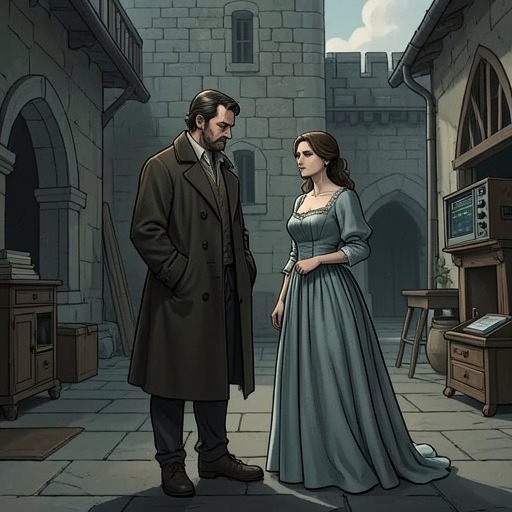
Edeyrn
MabinogionEdeyrn, son of Nudd, first appears as a formidable stranger and a discourteous challenger; after Geraint defeats him, he becomes the means by which the insult to Gwenhwyvar’s maiden is brought before Arthur’s court. His change from proud aggressor to wounded petitioner makes his encounter with Geraint both a test of martial standing and a dispute over how honor is to be repaired.
Identity and Introduction
Edeyrn is introduced at a distance, among a striking company: a dwarf on a powerful, prancing horse, a lady dressed in gold brocade and riding a beautiful white horse, and a knight whose size and equipment astonish Gwenhwyvar and Geraint. Edeyrn’s warhorse is large, and bright, heavy armour covers both rider and mount. The display establishes him as a figure of unusual physical and martial presence before either observer knows his name; his armour also conceals his face, making him at first an imposing appearance rather than a recognized person.
The group’s hierarchy is made plain by the dwarf’s conduct on Edeyrn’s behalf. When Gwenhwyvar’s maiden asks who the knight is, the dwarf refuses to answer and bars her from approaching his lord. He then strikes her across the face and eyes with his whip, drawing blood. Edeyrn does not intervene in the episode; the dwarf likewise strikes Geraint when he seeks an answer directly. These assaults turn Edeyrn’s imposing arrival into a public challenge, and give Geraint a cause to demand redress beyond the mere desire to test an unknown knight.
The Duel and His Defeat
The confrontation becomes a sustained test of force rather than a brief exchange. Geraint’s first heavy charge splits Edeyrn’s shield, damages his armour, breaks his girths, and throws him from his horse. Both men then fight on foot with swords, striking so fiercely that sparks flash from their arms; blood and sweat eventually cloud their sight. The struggle is watched as a contest between opposing households: the old man, his wife, and daughter rejoice when Geraint gains the advantage, while the Earl and his company favour Edeyrn. When Geraint receives a severe stroke, the old man recalls the earlier affront to the maiden and to Gwenhwyvar, prompting Geraint to summon his strength and strike Edeyrn on the crown. The blow breaks his head-armour and cuts through flesh and skin to the skull.
Edeyrn falls to his knees, drops his sword, and asks for mercy. He acknowledges that his excessive daring and pride have brought him to this appeal, but asks first for time to confess his sins and speak with a priest. Geraint grants his life on a specific condition: Edeyrn must go straight to Gwenhwyvar and submit to whatever satisfaction Arthur’s court judges appropriate for the injury inflicted by the dwarf. Geraint declares himself content with the punishment he has already dealt Edeyrn for the insult directed at him; the remaining grievance belongs to Gwenhwyvar, whose maiden was struck. Edeyrn accepts the condition willingly. Asked to identify himself, Geraint names himself as the son of Erbin, and Edeyrn answers that he is the son of Nudd. His name thus emerges only after the defeat has stripped away the anonymity created by his armour and his retinue’s hauteur.
Atonement at Arthur’s Court
Edeyrn complied with the condition of his release and came before Gwenhwyvar in the broken armour, its bloodstains more visible than its original colour. The dwarf accompanied him, as did the lady who had ridden with them. Though Gwenhwyvar pitied Edeyrn’s injured state, he did not present himself as an innocent victim: he acknowledged that Geraint had met him at the jousting and that his own conduct had brought him to this pass. He carried Geraint’s greeting and explained that he had been compelled to come and submit to Gwenhwyvar’s judgment over the blow the dwarf had dealt her maiden. Geraint, he said, had forgiven the insult to himself after putting Edeyrn’s life in danger, but had required him to make amends for the wrong done to her.
Edeyrn’s account also revealed the circumstances of the contest that preceded their duel. At the Sparrow-Hawk tournament in the town now called Cardiff, Geraint had arrived with only three companions: an aged man, his wife, and their poorly dressed daughter. Geraint jousted because he maintained that the young woman had a better claim to the Sparrow-Hawk than the lady accompanying Edeyrn. Edeyrn’s injuries therefore brought not only the dwarf’s assault before Arthur’s court, but also the cause for which Geraint had risked himself on behalf of Earl Ynywl’s daughter. The court heard Edeyrn’s own account of the challenge rather than relying solely on the wounded maiden’s complaint or Geraint’s victory.
Arthur recognized Edeyrn and, after hearing what had happened, supported Gwenhwyvar’s authority to grant mercy. She treated an insult to her maiden as an offence against Arthur as well as herself, while Arthur ordered that Edeyrn receive medical care until it became clear whether he would survive. If he recovered, the court would determine the proper satisfaction and require sureties; if he died, Arthur judged that death would be too severe a penalty for the insult. Arthur himself stood surety, and directed the chief physician to give Edeyrn care as attentive as he would receive if wounded, while barring others from his chamber. The injured knight who had first appeared behind an intimidating retinue was thus placed under the protection of the very court whose honor his conduct had challenged. Gwenhwyvar also received the maiden into the care of her own attendants, bringing the original victim within the household empowered to judge the injury.
Narrative Role and Significance
Edeyrn’s episode separates victory in combat from the settlement of a wrong. Geraint’s defeat of him answers the challenge between the two knights, but does not itself resolve the dwarf’s assault on Gwenhwyvar’s maiden. Geraint therefore makes release conditional on Edeyrn submitting to Gwenhwyvar’s judgment, redirecting the matter from personal vengeance to an obligation owed at court. Edeyrn’s standing as a knight does not exempt him from that process; it is precisely his submission that allows the injured household’s claim to be heard.
The ending also refuses to make punishment automatic. Arthur’s decision depends on whether Edeyrn survives his wounds: the court will set satisfaction if he recovers, while his death would exceed what the insult warrants. Medical care and sureties hold open the possibility of judgment without treating a near-fatal duel as a sufficient answer. Edeyrn’s narrative function is thus not simply to be overcome by Geraint, but to expose the limits of force: the encounter establishes who prevailed, while the court must still decide what justice requires.