Math son of Mathonwy
MabinogionMath son of Mathonwy is the lord of Gwynedd whose sovereignty is shaped both by an unusual bodily condition and by his command of transformative magic. His dependence on a maiden to hold his feet makes his court’s daily order vulnerable to abuse; when that abuse is exposed, he answers as ruler and magician, punishing the offenders and compensating the woman they wronged. The same capacity for enchantment later becomes creative: with Gwydion, he makes a bride from flowers and helps establish Lleu in a domain of his own.
Identity and the Conditions of Rule
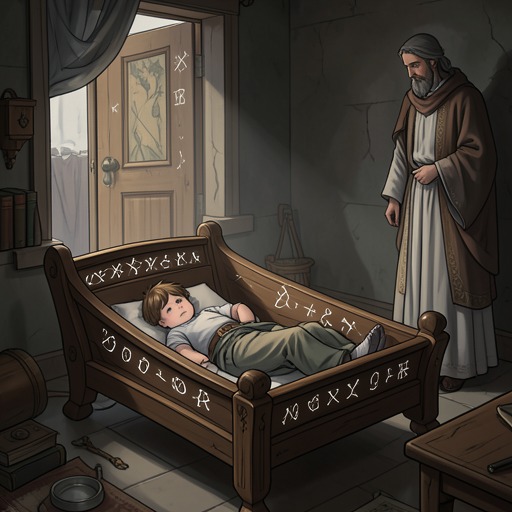
Math rules Gwynedd while Pryderi governs the twenty-one Cantrefs of the South, a division that situates Math’s authority within a wider political landscape. He dwells at Caer Dathyl in Arvon. The narrative presents his unusual physical requirement as a condition of existence: unless his feet rest in a maiden’s lap, he cannot live, except when the tumult of war prevents it. The exception makes war not merely a disruption of his rule but the one circumstance in which he can dispense with the intimate service on which his ordinary survival depends.
Because Math cannot make the circuit of his land, his nephews Gilvaethwy and Eneyd, sons of his sister, travel through it with his household in his stead. The arrangement separates the king’s fixed presence at court from the movement required to oversee his territory. Goewin, daughter of Pebin of Dol Pebin in Arvon, remains continually with Math as the maiden who holds his feet; she is described as the fairest maiden of her time known there. Her position is therefore not incidental to court routine: it is built into the conditions under which Math can remain alive and govern.
Goewin and the Disclosure of Abuse
Gilvaethwy’s desire for Goewin alters his appearance and spirits so markedly that he becomes difficult to recognize. His passion is thus shown first as a visible change in the man who serves Math’s court, before the underlying violence is disclosed. The account connects private desire to the political structure surrounding Math: Gilvaethwy is one of the nephews entrusted with the circuit of Gwynedd, while Goewin’s constant attendance on the king leaves her within that same household’s reach.
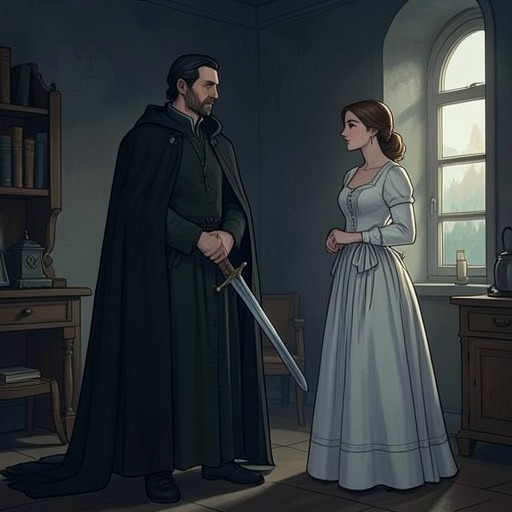
When Math returns to his chamber after the conflict, Goewin tells him that she is now a wife and asks him to find another to hold his feet. She explains that an attack was made on her unawares, that she did not keep silent, and that the court knew what had happened. She names both Gwydion and Gilvaethwy as those who wronged her and dishonoured Math. Her disclosure makes the offence at once personal and public: the assault violated Goewin, while its occurrence in Math’s own household also exposed a failure of protection and brought dishonour upon the lord whose service she performed.
Math’s response distinguishes the compensation owed to Goewin from the amends he intends to exact for himself. He promises compensation first, then says that he will take her as his wife and place the possession of his dominions in her hands. The response gives her an acknowledged place and authority after the assault, rather than treating the matter as a private quarrel between the nephews. It also reveals the limits of Math’s immediate redress: compensation and a new position for Goewin are promised, but they do not erase the offence that has already been committed.
Judgment and Animal Transformation
Gwydion and Gilvaethwy stay away from court, remaining in the confines of the land until food and drink are withheld from them; eventually they return and submit themselves to Math’s will. Their offer of submission does not settle the matter. Math says that they cannot compensate him for the warriors and arms lost, for his dishonour, or for the death of Pryderi. He then begins their punishment with his magic wand, converting each nephew into a deer and commanding them to live together in the nature of the animals whose forms they bear.
The punishment unfolds over successive years, with Math setting the transformed pair a return date beneath his chamber wall. At the first appointed reckoning, they appear as two deer accompanied by a fawn. Math takes the young animal to be baptized and names him Hydwn; the adults, meanwhile, are changed into wild swine for the next year. At the following reckoning, two wild hogs return with a well-grown young one. Math again takes the offspring, names him Hychdwn, and changes the adults into wolves. The repeated transformations make punishment an enforced duration rather than a single blow: the nephews must return to Math’s threshold, bear animal natures, and undergo a new imposed form. The account thus presents his wand as an instrument of judgment that acts on bodies as well as status.
Creation, Marriage, and the Grant of Land
Math’s magic also serves a purpose distinct from punishment. After Arianrod lays a destiny on the youth that he shall never have a wife from the race inhabiting the earth, Gwydion and Math turn to charms and illusion. They gather blossoms of oak, broom, and meadowsweet and form a maiden, described as exceptionally beautiful and graceful. They baptize her Blodeuwedd. Math’s role is collaborative: Gwydion proposes that a wife be formed from flowers, and Math joins him in producing and naming her.
At the feast after Blodeuwedd becomes the youth’s bride, Gwydion raises the practical question of how the young man can maintain himself without possessions. Math answers by granting him the Cantrev of Dinodig, identified in the account with the later names Eivionydd and Ardudwy. The youth dwells and rules at Mur y Castell, on the confines of Ardudwy, and both he and his governance are said to be beloved by all. The grant extends Math’s authority beyond enchantment: he can create a household through magical means and provide its male member with a territorial base. Across these episodes, Math’s power is most consequential when it changes the terms of another person’s life—through the punishment of his nephews, the making of Blodeuwedd, or the transfer of a domain to Lleu.