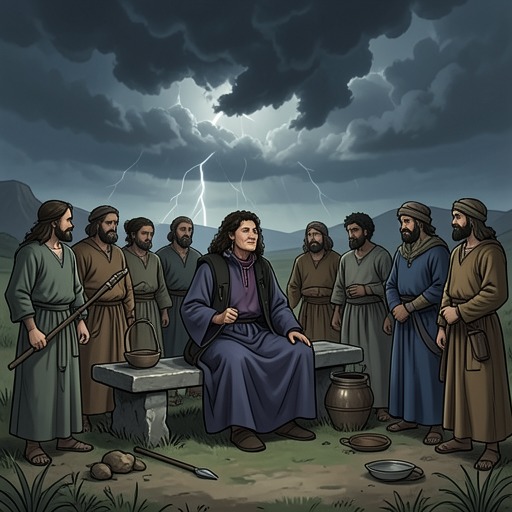
Gwythyr son of Greidawl
MabinogionGwythyr son of Greidawl is a chieftain whose story is shaped by two kinds of service: he protects vulnerable creatures and joins Arthur in the settlement of disputes and the pursuit of marvels. His betrothal to Creiddylad is disrupted when Gwyn ap Nudd takes her by force, setting in motion a conflict that Arthur ends not with a lasting marriage for either rival, but with a recurring contest that is to continue until the day of doom.
Identity and Deeds
Gwythyr appears both in a brief episode connected with Culhwch’s marriage quest and in the larger conflict over Creiddylad. In the first, he is walking over a mountain when he hears a distressing cry. He finds an ant hill threatened by fire and cuts it down close to the ground, allowing its inhabitants to escape. The episode presents a decisive act of protection: he responds to a cry for help and acts before asking for anything in return.
The ants answer with a blessing and a promise to give him what no man can give. They then fetch the nine bushels of flax-seed required by Yspaddaden Penkawr as one of the tasks imposed on Culhwch. Their delivery falls just one seed short until a lame ant brings the final one before nightfall. The quest’s exact requirement is thus met through a chain of aid that begins with Gwythyr’s intervention. His action does not directly complete the task; rather, it enables the ants to repay his kindness by accomplishing it themselves.
Betrothal and Conflict
Gwythyr is betrothed to Creiddylad, daughter of Llud Llaw Ereint. Before she becomes his bride, Gwyn ap Nudd carries her away by force. Gwythyr gathers a host and goes to fight Gwyn, an attempt to reclaim his betrothed through armed conflict. Gwyn defeats him, turning the struggle into a wider calamity for Gwythyr and his companions.
Among those captured are Greid son of Eri, Glinneu son of Taran, Gwrgwst Ledlwm and his son Dynvarth, Penn son of Nethawg, Nwython, and Kyledyr Wyllt, Nwython’s son. The conflict therefore reaches beyond the two rivals: Gwyn’s victory leaves several nobles imprisoned and exposes Kyledyr to a devastating act of coercion. Nwython is killed, and Kyledyr is forced to eat his father’s heart; the account links this ordeal to Kyledyr’s subsequent madness. The episode makes the cost of Gwythyr’s defeat collective, extending from the loss of his immediate contest to the suffering of those who fought or were caught up in it.
Arthur’s Settlement
When Arthur hears what has happened, he travels north and summons Gwyn ap Nudd before him. He frees the nobles Gwyn has imprisoned and makes peace between Gwyn and Gwythyr. The resolution releases the captives and stops the immediate hostilities, but it does not award Creiddylad permanently to Gwythyr or end the rivalry between the two men.
Instead, the settlement places Creiddylad in her father’s house, with neither claimant granted an advantage. From then on, Gwyn and Gwythyr are to fight for her every first of May, and whichever of them wins is to have her. The arrangement converts an unresolved dispute into a prescribed, recurring contest: the men’s claim remains unsettled from year to year, while Creiddylad’s place in the settlement is defined by remaining in her father’s home. Its duration is not limited to a human lifetime; the contest is to continue until the day of doom.
Counsel and Narrative Role
Gwythyr appears again in Arthur’s search for the remaining marvels. When the quest turns to the witch Orddu, Gwyn and Gwythyr advise Arthur to send Kacmwri and Hygwyd to confront her rather than entering the cave himself. Those two fail to overcome the witch, as do Hiramreu and Hireidil, and Arthur ultimately kills Orddu at the cave’s entrance. Gwythyr is not the one who undertakes the final confrontation, but he participates in the counsel surrounding it, alongside the same rival with whom Arthur had earlier made peace.
Taken together, these episodes place Gwythyr in a narrative of helpful intervention and unsettled claims. His rescue of the ants produces a concrete benefit for Culhwch’s quest, while his own effort to recover Creiddylad ends in a compromise that renews conflict on a fixed annual date rather than resolving it. Arthur’s intervention can free prisoners and impose terms, but those terms preserve the rivalry at their center. Gwythyr’s story consequently links a small act of compassion to an immense, formally bounded feud whose final outcome is deferred until the end of the world.