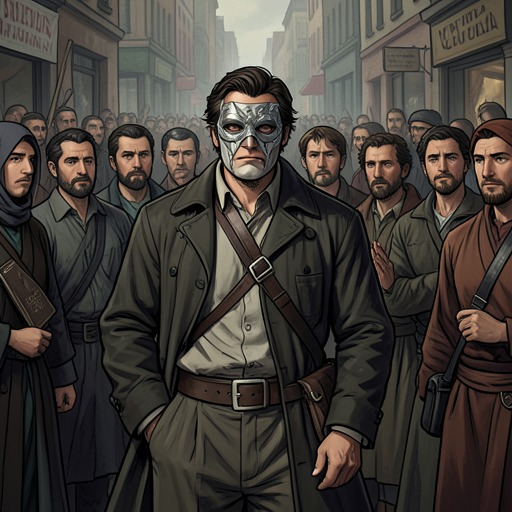
Gwrnach the Giant
MabinogionGwrnach the Giant is the formidable master of Gwrnach the Giant’s Castle, whose guarded sword becomes both the object of a quest and the means of his death. He will neither sell nor give the weapon, and the castle’s threshold is dangerous to strangers; yet Kai turns a conditional invitation into an opportunity to take the sword and strike down its owner. Gwrnach’s episode makes the quest’s obstacle literal: the required weapon is held by the one person who will not willingly yield it, and defeating him depends on entering his domain under false pretenses.
Identity and Position
Gwrnach is identified as a giant and the lord of an enormous castle, described as the largest in the world. Its ownership is common knowledge within the tale: when Arthur’s party asks a man coming from the castle whose it is, he treats the answer as something everyone ought to know. The stronghold’s scale and reputation establish Gwrnach as a powerful figure before he himself appears in the action.
His authority is enforced at the gate. A porter explains that no guest has ever returned alive and that entry is refused to anyone who does not bring a craft. The rule makes admission conditional rather than simply impossible: a stranger may cross the threshold by presenting a useful skill. Inside, Gwrnach is holding a feast, with meat, drink, and revelry in the hall. The contrast between celebration within and lethal danger for outsiders gives his castle the character of a closed household whose welcome is governed by his terms.
The Sword and the Quest
Gwrnach’s sword is one of the obstacles laid before the suitor seeking Olwen. It is not merely a valuable possession: the quest account specifies that Gwrnach can be slain only with this weapon. At the same time, he will not part with it of his own free will, whether for payment or as a gift, and the suitor is warned that force will not secure it. The task therefore joins acquisition and combat in a single problem: the sword must be taken from its owner, and it is also the instrument by which he can be killed.
Gwrnach’s possession of the blade makes him a barrier to the wider quest, but the means of overcoming him arises from his own practical need. When the porter reports that Kai is skilled at burnishing swords, Gwrnach agrees to admit him because he has been looking for someone to polish his weapon. He receives Kai in the hall, seats him opposite, and hands over the sword for the work. The scene turns on this exchange of trust: Gwrnach’s refusal to give the weapon away does not prevent him from placing it in the hands of a craftsman for a limited purpose.
Entry into the Castle
Kai does not enter with the whole party. He presents his skill at the gate, and Gwrnach accepts the arrangement through the porter. Once inside, Kai begins polishing the blade with a blue whetstone carried beneath his arm. He works on one half and gives it back for inspection; Gwrnach approves the result and says, in effect, that he would like the entire blade to match. The polishing is thus both credible service and the gradual preparation of the weapon that will be used against him.
Kai then uses the question of the sword’s appearance to bring Bedwyr into the castle. He tells Gwrnach that he has a companion who lacks his particular craft, but describes a distinctive feat of Bedwyr’s lance: its head leaves its shaft, draws blood from the air, and returns to the shaft. The porter is sent out, the gate is opened, and Bedwyr is admitted. Meanwhile, Goreu, the only son of Custennin the herdsman, gets inside by keeping close to his companions as they pass the castle’s three wards. His companions praise him for managing it, and from then on he is called Goreu, son of Custennin. The party then disperses to its lodgings with the intention of killing those staying there without Gwrnach’s knowledge.
Death and Narrative Significance
After finishing the blade, Kai hands it to Gwrnach, who declares himself satisfied. Kai shifts the conversation from the polished sword to its scabbard, suggesting that rust in the wooden sides has damaged the blade and offering to replace them. With the sword in one hand and the scabbard in the other, he stands before Gwrnach as though preparing to sheath it. Instead, he strikes and cuts off the giant’s head with a single blow. The instrument Gwrnach had entrusted to Kai for maintenance becomes the instrument of his death, fulfilling the quest’s stated condition.
The party strips the castle of goods and jewels, choosing what it wants, and returns to Arthur’s Court on the same day, at the beginning of the year, carrying Gwrnach’s sword. Gwrnach’s defeat therefore produces a concrete reward for the quest, while the means of that victory depends less on overpowering the castle openly than on reading its rules and exploiting its welcome. His episode is a compact reversal: the guarded threshold admits the enemy because he offers a valued craft, and the lord’s confidence in that craft gives Kai the opening to use the sword as a weapon.