Arthur
MabinogionArthur is presented as a ruler whose authority rests not only on military power but also on hospitality, judgment, and the ability to gather a fellowship around a promise. Across the tales, his court is a place where strangers may ask for help, his warriors undertake perilous quests in his name, and his decisions shape the fates of allies and opponents alike. His leadership is tested in both formal acts of mercy and expansive campaigns, while the stories also preserve a more elegiac image of him as a king whose age and company are measured against an earlier generation.
Identity and Court
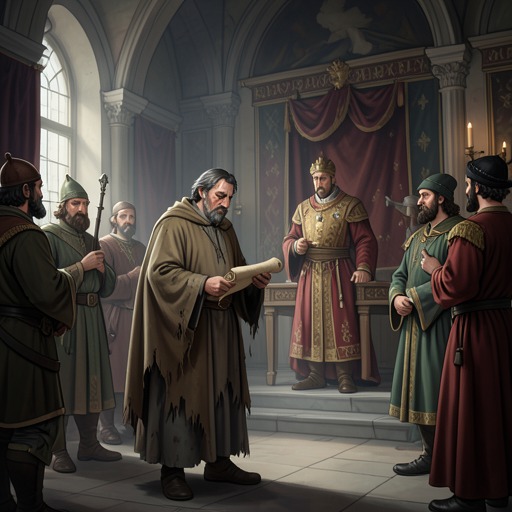
Arthur’s court is a center of public life, ceremonial welcome, and collective decision. At Caerlleon upon Usk, he receives guests with a generous display of rank and service; the court’s customs include attendants who guide visitors and explain its practices. At a Whitsuntide gathering, his household and tributary rulers assemble, and thirteen churches are assigned to different parts of the royal community. The arrangement gives Gwalchmai a place of distinction among the household’s leaders, showing how the court’s ceremony also expresses its internal hierarchy.
The court’s welcome is not merely a privilege for established nobles. When Culhwck arrives seeking a boon, Arthur has him admitted despite the gatekeeper’s hesitation. He directs that the newcomer be treated with honor, arguing that a court’s renown grows through its courtesy to visitors. Culhwck declines the offered entertainment and asks instead for assistance in winning Olwen, daughter of Yspaddaden Penkawr. Arthur promises to grant his request within stated limits, reserving his ship, mantle, arms, and wife from the pledge. He then combs Culhwck’s hair with a golden comb and silver-looped scissors, learns that the youth is his cousin, and confirms the promise before Culhwck names the warriors whose help he seeks. The scene joins kinship, ritual grooming, and political obligation: the boon becomes a public commitment that Arthur’s fellowship must help fulfill.
Arthur’s standing is also conveyed through the gatekeeper Glewlwyd Gavaelvawr, who recalls having traveled widely and witnessed Arthur’s victories and exploits. His account ranges across distant lands and past campaigns, presenting Arthur’s reputation as something accumulated through a long career. Yet the praise is not entirely untroubled. In the Dream of Rhonabwy, Arthur is seated beside a ford amid a vast host, and he responds to the small stature of the visitors with sorrowful reflection on the men who once guarded the Island of Britain. A ring on his hand contains a stone that allows Rhonabwy to remember what he sees. The dream thus frames Arthur both as an imposing ruler and as a figure set against the perceived decline of an earlier heroic age.
Promises, Quests, and the Fellowship
Arthur’s promises repeatedly turn individual needs into shared undertakings. When Culhwck asks for Olwen, Arthur accepts the request on behalf of his warriors as well as himself. Culhwck names a large company of allies, and the quest that follows tests the fellowship through a sequence of difficult tasks. Arthur’s contribution is not limited to granting permission: the story ultimately credits him with accomplishing the request, and after the required marvels are brought to Yspaddaden Penkawr’s court, Culhwck marries Olwen. Arthur’s role gives the quest its public authorization and connects its successful ending to the strength of the court around him.
The search for Mabon son of Modron shows Arthur converting a seemingly marginal appeal into a royal expedition. After his company identifies the prisoner’s location through an embassy that consults a succession of ancient animals, Arthur summons the warriors of the Island of Britain and travels to Gloucester. Kai and Bedwyr approach the prison with the aid of the Salmon of Llyn Llyw, while Arthur’s warriors attack the castle; Kai breaks into the dungeon and carries Mabon out during the fighting. Arthur returns home with the prisoner restored to liberty. The episode makes the search’s long chain of testimony matter: knowledge gathered through patient inquiry becomes action once Arthur commits the resources of his host.
A more expansive campaign follows the pursuit of Twrch Trwyth and his seven young pigs. Arthur assembles warriors from Britain and neighboring islands, as well as France, Armorica, Normandy, and the Summer Country, and leads them into Ireland. The Irish saints ask for his protection, which he grants; the people then bring him provisions. At Esgeir Oervel, the hunt begins with the Irish fighting the boar and continues with Arthur’s household, neither gaining an advantage. Arthur himself then confronts the animal for nine nights and nine days without killing even one of its young. When his warriors ask about the boar’s origin, Arthur explains that it was once a king, transformed into a swine by God for his sins. His account places the spectacular chase within a moral pattern of transformation and punishment, while the campaign demonstrates the scale of the coalition his kingship can command.
Judgment, Mercy, and the Uses of Authority
Arthur’s rule also appears in the judgments he makes when honor has been damaged. After Edeyrn son of Nudd returns wounded from his encounter with Geraint, Arthur hears the circumstances and considers Gwenhwyvar’s claim that an insult to her maiden was an insult to her. He orders that Edeyrn receive medical care and that sureties be taken for whatever satisfaction the court later judges appropriate. Arthur himself becomes one of those sureties, joined by other members of the court. The decision neither dismisses the offense nor treats Edeyrn’s defeat as sufficient punishment: it preserves the possibility of recovery and leaves the question of redress to collective judgment.
Arthur’s conduct toward Geraint and Enid is more ceremonial but likewise makes the court’s authority constructive. After Geraint returns with Enid, Arthur gives her to Geraint in marriage, arranges the customary bond, and provides her with the finest of Gwenhwyvar’s apparel. The celebration places their union within the court’s public life, among music, gifts, and games. Gwenhwyvar then awards Enid the stag’s head, a mark of esteem that Arthur and the assembled company approve. These acts turn welcome into recognition: Enid arrives as a maiden associated with a difficult contest and leaves the occasion honored within Arthur’s community.
The reception of Peredur offers another view of Arthur’s capacity to restore a relationship with the court. When Gwalchmai brings Peredur back after a long separation, Arthur welcomes him and acknowledges that the dwarf and dwarfess had foretold the young knight’s valor. The Queen and her attendants also greet him, and Arthur honors him before the company returns to Caerlleon. His response makes Peredur’s return more than a reunion; it recognizes the consequences of his actions and renews his place among Arthur’s people.
Loss, Memory, and Narrative Role
Arthur’s concern for absent companions is clearest when Owain has been away for three years. Gwalchmai finds Arthur grieving over the prolonged separation and fearing that the fourth year will pass without their meeting. He proposes that Arthur go with the men of his household to seek Owain, whether the purpose should be to avenge him, free him, or bring him home if he is alive. Arthur accepts the counsel and prepares an expedition of three thousand men, with Kynon son of Clydno as guide. The passage presents loyalty as reciprocal: Arthur’s court sends knights on adventures, but the king also mobilizes to recover a companion whose absence has become a source of sorrow.
Arthur’s appearances link otherwise distinct adventures without making every tale a story about him. Petitioners seek his aid; his warriors carry out tasks under his authority; and his court supplies a recurring standard of welcome, honor, and judgment. At times he leads the action directly, as in the campaign against Twrch Trwyth; elsewhere, the decisive work belongs to companions such as Kai, Bedwyr, Gwalchmai, or Geraint. This distribution gives his kingship a collective character. Arthur’s significance lies in the promises he makes, the people he gathers, and the social order his court offers—an order whose remembered greatness, in Rhonabwy’s dream, is already shadowed by loss.