Gilvaethwy
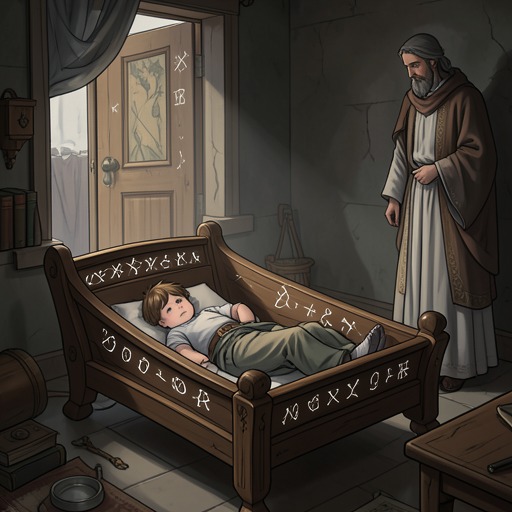
MabinogionGilvaethwy is a nephew of Math son of Mathonwy whose desire for Goewin becomes the trigger for a courtly crime, a costly war, and a prolonged magical punishment. His story moves from private longing to public violence: what begins as a change in his appearance and spirits ends with Math condemning him and Gwydion to successive animal forms, each imposed for a year.
Identity and Position at Court
Math son of Mathonwy rules Gwynedd from Caer Dathyl in Arvon. Because he cannot normally be without a maiden’s lap beneath his feet, he does not make the circuit of his land himself. Gilvaethwy, Gwydion, and their household go in his stead. The arrangement places Gilvaethwy close to the court’s workings, but also makes Goewin, the maiden who attends Math continually, a constant presence in his life.
Gilvaethwy is Gwydion’s brother and one of Math’s nephews, the sons of Math’s sister. The account first presents him as a member of the household entrusted with the circuit of Gwynedd; it then narrows to the private desire he conceals within that public role. His status does not protect him from the consequences of his actions. Instead, the family connection that gives him access to Math’s court makes his offense an injury to both Goewin and his lord.
Desire, Conspiracy, and Assault
Gilvaethwy falls in love with Goewin so intensely that his appearance and spirits change, until he is scarcely recognizable. Gwydion notices the change and draws out its cause. Gilvaethwy hesitates to confess because Math is said to hear even a whisper if the wind carries it to him; once Gwydion understands, however, he offers to provoke a rising across Gwynedd, Powys, and Deheubarth to get Goewin for his brother.
The ensuing war gives the brothers the opportunity to act while Math is with his host. At night they return to Caer Dathyl. Gilvaethwy takes Math’s couch and, after driving the other maidens from the room discourteously, makes Goewin remain against her will. The narrative later identifies both brothers as responsible for the attack on her. Gilvaethwy’s desire is thus not presented as a courtship or an attempt to win Goewin’s consent: it culminates in coercion, made possible by a military crisis Gwydion has promised to bring about.
That crisis carries a price beyond the assault. Pryderi brings the forces of the South against Math’s men; the fighting in Arvon causes heavy losses on both sides and ultimately forces the men of the South to flee. Pryderi gives hostages to secure peace, but skirmishing continues as the armies travel. Math’s side releases the hostages, yet the conflict has already cost warriors, arms, and, as Math later declares, Pryderi’s life. The text links Gilvaethwy’s private objective to public devastation without treating him as the sole architect of the scheme: Gwydion has explicitly undertaken to create the rising, and both brothers are named in Goewin’s accusation.
Exposure and Judgment
When Math returns to his chamber, Goewin tells him she can no longer serve as the maiden beneath his feet because she is now a wife. She discloses the assault and identifies Gwydion and Gilvaethwy as the perpetrators, saying that they wronged her and dishonoured Math. Her testimony transforms what the brothers had hidden beneath the war into a matter openly known at court.
Math promises to provide Goewin with compensation before exacting amends for himself. He takes her as his wife and places the possession of his dominions in her hands. These measures recognize her injury and change her position at court; they also make plain that the offense has violated the ruler’s household as well as Goewin herself.
The brothers do not immediately submit. They remain in the confines of the land and stay away from court until food and drink are withheld from them. At last they come before Math and place themselves at his will. Math refuses to treat their submission as adequate payment: he says their actions cannot restore the warriors and arms lost in the conflict or undo the dishonour, and he also invokes Pryderi’s death. He therefore begins their punishment at once.
Animal Forms and the Shape of the Punishment
Math strikes Gilvaethwy with Math’s magic wand, changing him into a deer; he changes Gwydion into a deer as well and binds them to go together as companions, living according to the nature of the forms they bear. Their first sentence lasts a year. When the court hears dogs barking beneath Math’s chamber, he finds the two deer with a fawn. He takes the young animal to be baptized and names him Hydwn, then changes the brothers into wild swine for another year.
At the end of that year, the two return with a well-grown young boar. Math again has the young animal baptized, naming him Hychdwn, and changes Gilvaethwy and Gwydion into wolves for a further year. The repeated pattern makes the punishment more than a single transformation: each return reveals that the brothers have lived as a pair and produced offspring, while Math separates the young from their animal existence by taking them for baptism. The passage’s final recorded change leaves Gilvaethwy and Gwydion in wolf form, ordered to return beneath the chamber wall after another year.
Narrative Role
Gilvaethwy’s episode turns a private passion into a test of political and familial authority. The threatened disclosure of his desire initially seems to be the obstacle; Gwydion’s plan to create a rising appears to solve it, but the war multiplies the harm and cannot conceal the assault from Goewin. Her account, rather than the brothers’ submission, brings the concealed crime into the open and prompts Math to answer both the personal injury and the public losses.
The animal transformations extend judgment through time. The brothers are made companions, compelled to share each changed nature and return at yearly intervals with offspring, while Math controls the terms and names the young. The account supplied here stops with the wolf transformation and the next year’s summons, so it establishes the repeated structure of Gilvaethwy’s punishment without relating its later course or final release.