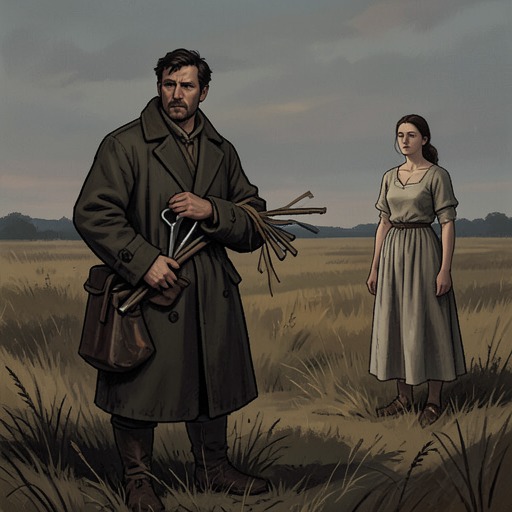
Maxen Wledig
MabinogionMaxen Wledig is the emperor of Rome whose dream of a woman in a distant land becomes the turning point of his rule. His longing carries him from the Roman court to Britain, where he wins the maiden as his bride; seven years later, that marriage and his prolonged absence from Rome lead into a struggle for his imperial position.
Identity and Imperial Position
The narrative introduces Maxen as a comely, good, and wise emperor, superior in these qualities to his predecessors. His authority is visible in the council of kings he convenes and in the thirty-two crowned kings who serve as his vassals. When he takes them hunting, the expedition is not simply recreation: he joins them, the account says, to place himself on equal terms with them. His standing thus depends on both sovereignty and the careful management of relations with powerful subordinates.
The dream begins during this public exercise of rule. At midday, in the heat, Maxen falls asleep in the river valley while his attendants shield him from the sun with shields raised on spear shafts. They place a gold-enamelled shield beneath his head. The scene sets the protected emperor apart from his company just before his dream carries him far beyond the familiar reach of his court.
The Dream and Its Hold on Him
In the dream, Maxen journeys up the river to the highest mountain in the world, which seems to reach the sky. Beyond it lie vast and beautiful regions, great rivers, and a harbour filled with an immense fleet. One ship stands apart for its size and beauty: the visible planks alternate between gilded and silvered surfaces, and a bridge made from a whale’s bone connects it to land. Maxen boards, crosses the sea, and traverses a rugged island from shore to shore before reaching another country and a castle at a river’s mouth.
The castle’s open gate leads to a hall that seems built from gold and precious stones, furnished with golden seats and silver tables. Two youths play chess with golden pieces on a silver board, while a richly dressed maiden sits opposite them in a chair of ruddy gold. Her appearance is described through the brilliance of her clothing and ornaments, and her beauty overwhelms the dreamer. She rises; Maxen embraces her, and they sit together in the golden chair. The dream ends not by choice but through the clamor of the hunting party: dogs strain at their leashes, shields clash, spears knock together, and horses neigh and prance, waking him.
Awake, Maxen feels that neither spirit nor existence remains to him because of the maiden; love has filled his whole being. He returns toward Rome in deep sadness. For a week, he withdraws from the ordinary life of his household: he does not join them for wine and mead or for songs and tales, and he can be persuaded to do nothing but sleep. In sleep, he sees the maiden again; awake, he has no knowledge of where she is. His private fixation becomes a public failure when his chamber page, who is also king of the Romans, tells him that people revile him because they receive neither messages nor answers from their lord. Maxen then summons Rome’s wise men to explain the cause of his sorrow.
Finding the Maiden and Crossing to Britain
Maxen sends messengers to follow the landscape from his dream. Their search carries them past a mighty river, a great city, and a harbour with a remarkable fleet; they cross to the Island of Britain and travel toward Snowdon, Anglesey, and Arvon. At Aber Sain, they find the castle and hall he described. Inside are two youths playing chess, a hoary-headed man carving chessmen, and the maiden seated in a chair of ruddy gold. The correspondences turn Maxen’s dream from a private vision into a map that can be followed.
The messengers kneel and hail the maiden as empress of Rome. They explain that Maxen has seen her in sleep and is so overcome that he has lost his spirit and life to longing. They offer her a choice: she may travel with them to become empress, or Maxen may come to take her as his wife. She will neither dismiss their claim nor trust it fully. If the emperor loves her, she says, he must come to seek her himself. Her answer sets the terms of their meeting: Maxen must make the journey rather than have his envoys bring her to him.
The messengers ride back to Rome, changing horses when theirs fail, and offer to guide Maxen to the woman they have found. He immediately sets out with an army. Crossing the sea, he conquers the Island of Britain from Beli and his sons, driving them to the sea, and continues to Arvon. Recognizing the landscape, he identifies the castle at Aber Sain as the place from his dream. In its hall he finds Kynan and Adeon playing chess, Eudav son of Caradawc carving chessmen in an ivory chair, and the maiden in a golden chair. He greets her as empress of Rome, embraces her, and marries her that night.
Seven Years Away and the Struggle for Rome
Maxen remains in Britain for seven years. The account gives his absence political force through a Roman custom: an emperor who stays in foreign lands for more than seven years is expected to remain there, lose his position, and never return to Rome. As the limit passes, the Romans make a new emperor, who sends Maxen a letter of threat. Maxen answers with a letter of his own, matching its conditional challenge rather than conceding the title.
He then marches toward Rome, conquering France, Burgundy, and every land along the way, and besieges the city. The siege lasts a year without bringing him closer to taking Rome than he was on the first day. At this impasse, a small force arrives from the Island of Britain: Helen Luyddawc’s brothers have brought an army whose warriors, the narrative stresses, are better than twice their number of Romans. Helen recognizes her brothers’ standards, and Kynan and Adeon come to meet Maxen. He rejoices and embraces them. The dream has brought him a marriage and drawn him away from Rome; the return campaign now brings his wife’s family into the conflict over the imperial city.