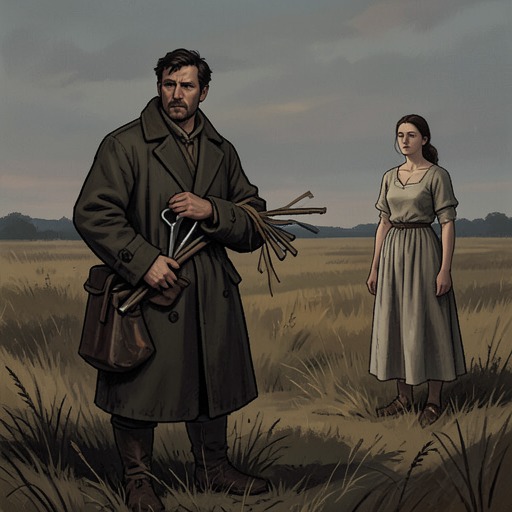
Kynan
MabinogionKynan, brother of Helen Luyddawc and Adeon, becomes the chief strategist and eventual settler among the Britons who help Maxen Wledig recover Rome. His arc moves from a courtly introduction in Maxen’s dream to an ingenious assault on the city, then to a choice that divides the returning expedition and supplies the tale with an origin story for the Britons of Armorica. The narrative presents him less through private history than through the consequences of his decisions: military success carries his company far from the Island of Britain, and his final decision to stay makes that separation lasting.
Identity and Introduction
Kynan first appears at the castle of Aber Sain, where Maxen recognizes the place from his dream of the woman he loves. In the hall, Kynan and Adeon are playing chess; their father, Eudav, is carving chessmen, while Helen sits nearby. This domestic scene places Kynan within Helen’s family before the story gives him a military role. Maxen greets Helen as the woman from his dream, embraces her, and makes her his bride; the marriage connects Kynan and Adeon to the emperor whose return to Rome will become the occasion for their expedition.
The story identifies Kynan as one of Helen’s brothers, but gives little account of his life before Maxen reaches Aber Sain. His characterization instead takes shape through public action. When Helen’s brothers later arrive in Italy with a small force, their standards allow her to recognize them. Their conspicuous arrival turns the kinship established at the castle into direct aid for Maxen: Kynan’s family connection is also a source of military strength.
The Assault on Rome
Maxen’s army has spent a year outside Rome without coming closer to taking the city. Helen’s brothers then arrive with a small host described as having warriors better than twice its number of Romans. The contrast is not simply between a large besieging army and a smaller relief force; the narrative emphasizes the newcomers’ quality, bearing, and standards, making their presence a turning point in an otherwise stalled campaign.
Kynan proposes a different method of attack after watching the Romans’ assault. By night, he and his brother measure the height of the wall, and they have carpenters make a ladder for every four men. The plan uses the city’s daily routine against its defenders. Each day at midday, the emperors and their forces stop fighting to eat; meanwhile the Britons take their own meal in the morning and drink until invigorated. While the opposing emperors are at table, Kynan’s men bring their ladders to the walls and enter the city. The tactic depends on preparation and timing rather than a direct repetition of the unsuccessful assault they had observed.
The surprise leaves the new emperor no time to arm himself. The attackers kill him and many others, then spend three days and three nights subduing the city and taking its castle. Their hold is secured while other members of the host prevent Maxen’s forces from entering before the city has been brought under their control. Kynan’s contribution is therefore part of a collective victory, but the narrative singles out his practical judgment as the change that makes the breach possible.
Maxen’s Restoration and the Overseas Conquest
When Maxen wonders why the city has not been conquered for him, Helen advises him to go and ask her brothers for it. Kynan and Adeon answer that no one has taken the city and no one can give it to Maxen except the men of the Island of Britain. The gates are then opened; Maxen takes the throne, and the people of Rome submit. The episode gives the British force a distinct claim in the recovery: Maxen regains his capital, but the narrative makes clear that the brothers’ host has won the city and controls the terms on which it is yielded.
Maxen rewards Kynan and Adeon by giving them the host to conquer whatever region they desire. The brothers set out with their men and take lands, castles, and cities. The campaign is described in stark terms: they kill all the men and keep the women alive. The expedition continues for so long that the young men who first accompanied them grow grey-haired. Kynan’s military success thus expands into prolonged conquest, with a human cost that the narrative states plainly rather than disguising as an incidental detail.
Kynan’s Choice and the Britons of Armorica
After the long campaign, Kynan asks Adeon whether he would rather remain in the conquered land or return to the land from which they came. Adeon chooses to go home, and many go with him; Kynan stays behind with the rest. The division is consequential: Adeon and his companions restore a connection with their homeland, while Kynan’s decision establishes a continuing British presence abroad. The story gives no further account of Kynan’s personal life there, but makes his choice the hinge between the conquest and the community that follows it.
The account then describes how Kynan’s group tried to prevent the women they had captured from changing the men’s speech. They took counsel and cut out the women’s tongues, and the narrative attributes the name Britons for the men of Armorica to the women’s enforced silence. It also explains that the language of the Island of Britain continued to arrive there. This origin story binds Kynan’s settlement to linguistic continuity, but does so through an act of violence against the women whose speech the conquerors feared would alter their own. The tale’s explanation of cultural transmission is therefore inseparable from the coercion it records.
Narrative Role
Kynan’s story is embedded in the Dream of Maxen Wledig, whose movement from dream to expedition links personal desire, dynastic marriage, military recovery, and settlement. Kynan first belongs to the family Maxen encounters in the dreamed-of land; later, his strategy helps restore Maxen to Rome, and his decision to remain carries a branch of that family’s world beyond the Island of Britain. The sequence gives Kynan a consequential but sharply bounded role: the narrative records the tactical means of his victory and the political and linguistic consequences of his settlement, while leaving his life after that founding act untold.