Olwen
MabinogionOlwen is the daughter of Yspaddaden Penkawr, whose expected death at her betrothal makes her marriage the hinge of Culhwch’s quest. First known to Culhwch through a prophecy, she becomes a living presence when he finds her, and her advice directs him to seek her father’s consent. Her story joins a carefully composed portrait of beauty to a courtship governed by family authority, perilous conditions, and the completion of extraordinary tasks.
Identity and the Marriage Prophecy
Olwen enters the narrative before Culhwch has ever seen her. After his stepmother tells him that he will not find a suitable wife until he obtains Olwen, daughter of Yspaddaden Penkawr, Culhwch blushes and falls in love with her despite their having never met. His father directs him to ask for help from his cousin Arthur, turning the prediction into the purpose of a formal appeal. Olwen is therefore introduced not through her own actions but as the destined focus of a quest set in motion by another character’s declaration.
The prophecy is bound to her father’s fate. When Culhwch finally meets her, Olwen explains that she has pledged not to leave without her father’s counsel and that his life will last only until the time of her espousals. Her marriage is consequently more than a union sought by Culhwch: it marks the point at which Yspaddaden’s life is expected to end. That condition gives the courtship its unusual urgency, placing a family threshold and a prospective death at the centre of the quest.
Appearance and First Meeting
Olwen is described in a formal, cumulative portrait. She wears flame-coloured silk and a gold collar set with emeralds and rubies. Her golden hair, pale skin, hands, eyes, and cheeks are compared with flowers, water, birds, and the white swan. The description moves from the richness of her clothing to the exceptional qualities of her appearance, making the natural world a measure of her distinction. The narrative adds a marvel that turns that beauty into a sign: four white trefoils spring up wherever she walks, and this is given as the reason for her name.
Her appearance has an immediate effect within the scene. She comes to the house where Culhwch and Arthur’s companions are staying, after the companions have obtained a promise that they will not harm her. She sits beside Culhwch on the foremost bench; on seeing her, he recognizes her as the woman he has loved. His declaration that he has loved her for many days recalls the prophecy that preceded their meeting, although his feeling began before he had seen her. The scene thus joins the foretold match to the physical encounter without making her beauty the only fact that determines what follows.
Counsel and Her Father’s Authority
Culhwch asks Olwen to leave with him, but she refuses to go without her father’s counsel. Her answer states both a limit and a route forward: she cannot simply depart, yet she advises Culhwch to ask her father for her and to grant whatever he demands. She warns that refusing any requirement will mean losing her and may cost Culhwch his life. Rather than leaving the decision to an impulsive escape, she directs him toward the negotiation on which her marriage depends.
That counsel gives Olwen a consequential, though bounded, role in the courtship. Yspaddaden controls the terms and has the power to set dangers before the suitor; Olwen identifies the procedure Culhwch must follow. Her promise to advise him does not erase her prior pledge to her father, and the narrative does not present her as free to settle the marriage independently. Instead, her intervention helps Culhwch approach the authority that governs her future, while making clear that the outcome will depend on whether he can meet the demands placed before him.
The Quest and Its Outcome
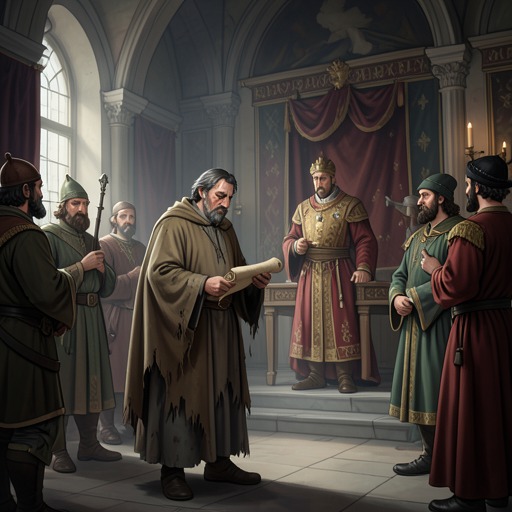
Culhwch takes Olwen’s advice and formally asks Yspaddaden for her hand. The first answer is deferred until the next day. On returning, the company renews its request, offering her dower and maiden fee and insisting that the marriage be granted. Yspaddaden claims that he must consult his living great-grandparents, continuing to delay the decision. These encounters establish that the match is negotiated against her father’s resistance, not simply concluded when Culhwch and Olwen meet.
The narrative ultimately makes the suitor’s success depend on the marvels he must obtain. Once they have been brought to Yspaddaden’s court, the father concedes that Olwen is Culhwch’s, while crediting Arthur with accomplishing what he himself would never willingly have allowed. Yspaddaden’s death follows, and Culhwch and Olwen marry that night. The conclusion fulfils the prophecy attached to her betrothal: her marriage is achieved, and her father does not survive it.
Narrative Role and Significance
Olwen’s part in the story is concentrated in a few decisive moments: the prophecy that names her, the encounter that confirms Culhwch’s pursuit, her explanation of her father’s condition, and the advice that sends the suitor to negotiate. The quest gives her importance as its desired bride, but also lets her shape its course through counsel. Her influence operates within the limits the story establishes—especially her pledge to her father—rather than through an independent journey of her own.
The floral marvel associated with her name and the anticipated end of her father’s life place wonder and family consequence side by side. Her marriage is at once the fulfilment of a prediction, the reward for a quest, and the event that brings Yspaddaden’s life to its appointed limit. After the wedding, Olwen remains Culhwch’s wife for the rest of her life; Arthur’s company then disperses, and the account gives no further episode of their married life. That concise ending closes the quest by confirming the lasting marriage rather than extending the narrative beyond its achievement.