Earl Owain
MabinogionEarl Owain is the lord of a town hidden behind a hedge of mist and the master of its enchanted games. His court offers hospitality to noble visitors, but the games place them in mortal danger: Geraint enters the mist alone, defeats the knight who challenges him, and makes Earl Owain agree to abolish the custom. The Earl’s part in the episode turns a perilous, seemingly inescapable trial into a conflict resolved by a bargain and a public act that lifts the enchantment.
Domain and Court
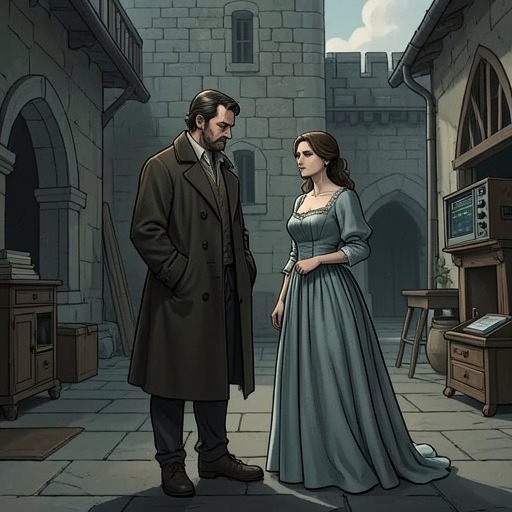
Earl Owain rules the town within the mist, where ordinary access is restricted by a courtly custom: people of gentle birth may not lodge there unless they stay at his court. When Geraint and his companions arrive intending to spend the night in town, a young man directs them to the Earl’s hall. Earl Owain receives them gladly and orders a feast, asserting the court’s authority over the hospitality offered to visitors.
The games are inseparable from the landscape around the town. A hedge so tall that its top cannot be seen encloses the approach, and nearly every stake bears a man’s head. Earl Owain says no one may accompany a challenger into the mist. The display of heads and the warning that no one who has gone there has returned make the challenge appear not merely ceremonial but deadly, even before Geraint crosses the boundary.
The Games and Geraint’s Challenge
At the feast, Earl Owain notices that Geraint is not eating and recognizes that he may be troubled by the games. The Earl says that Geraint need not take part and offers to prevent anyone else of Geraint’s rank from doing so. His offer reveals both the Earl’s power to suspend the custom and his reluctance to lose a promising guest to it. Geraint, however, says he wants to face the challenge, and Earl Owain agrees to show him the way.
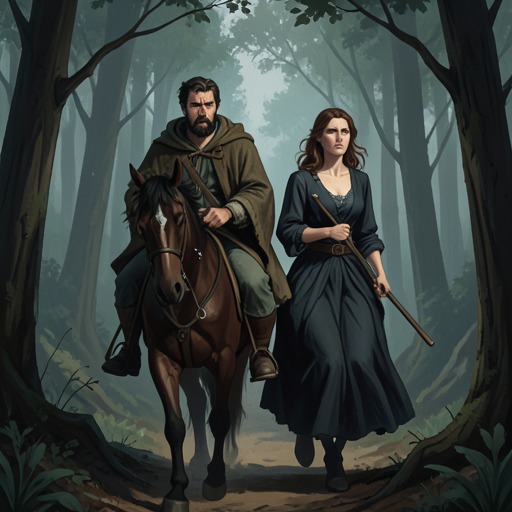
Earl Owain accompanies the company to the hedge but does not dictate how Geraint must enter. Geraint rides alone into the mist and emerges in an orchard, where a red-satin tent stands beside an apple tree. A huge hunting horn hangs from one of its branches. Inside the tent, Geraint sits in an empty golden chair despite a maiden’s warning that its owner will regard this as an insult. Earl Owain’s game thus combines the perilous passage through the mist with a challenge governed by courtly affront and combat.
The knight whose chair Geraint has taken confronts him. They break three sets of lances before Geraint’s final charge splits his opponent’s shield, pierces his armour, breaks his girths, and throws him from his horse. Defeated, the knight asks for mercy and offers Geraint whatever he wants. Geraint’s demand is not a prize for himself: he requires the end of the games, the hedge of mist, and the magic and enchantment associated with them. Earl Owain’s authority over the custom is made tangible in the defeated knight’s ability to grant that demand.
Abolition and Aftermath
The mist does not vanish by itself. The defeated knight explains that the horn must be sounded by the person who defeated him; Geraint blows it, and the mist disappears at the first blast. The mechanism makes the games’ release depend on victory in the very contest that sustains their danger. With the barrier gone, the assembled hosts come together and are reconciled.
Earl Owain invites Geraint and Gwiffert Petit to remain at his court for the night. They separate the next morning, and Geraint returns to his own dominions, where he reigns prosperously. Earl Owain’s final significance lies in the reversal of his enchanted court’s terms: a system that bars ordinary passage and sends challengers into the mist ends when its own champion is beaten and the victor uses his reward to free the place from its rules.