Coranians
MabinogionThe Coranians are presented in the story of Lludd and Llevelys as the first of three plagues to afflict the Island of Britain. Their defining power is an ability to learn any speech that the wind carries, however quietly it is spoken; because this knowledge makes them impossible to injure, the danger they pose is not simply their arrival but the difficulty of acting against them without their discovery. The episode turns a seemingly ordinary element of the landscape into a means of surveillance, and makes secrecy a necessary condition of resistance.
Identity and Place in the Story
The account identifies the Coranians as a people, or race, who come to the Island of Britain after Lludd has become king. It supplies no named Coranian individual, account of their origins, or description of their society. Their presence is instead defined by a collective capacity: any discourse can become known to them if the wind meets it. The story does not specify that they deliberately listen to every conversation or explain how they acquired this ability; it presents the power itself as the reason they cannot be harmed by ordinary means.
Their appearance is one of three afflictions described as unprecedented in the islands. The other two are a shriek that crosses the island every May-eve, bringing widespread loss of strength and fertility, and the mysterious disappearance of provisions from royal courts after the first night. These other calamities are not attributed to the Coranians. Their distinct place among the three is important: they are the plague whose cause can be identified and whose remedy can be planned, while the causes of the other two are initially unknown.
The Threat of Wind-Borne Knowledge
The Coranians’ power changes how Lludd and Llevelys can seek counsel. Lludd, distressed because he does not know how to free his kingdom from its afflictions, consults the nobles and then resolves to seek his brother Llevelys, king of France, renowned for wisdom. The journey is arranged secretly, with a fleet prepared in silence so the Coranians will not learn the reason for it. When Llevelys approaches with a large fleet, Lludd leaves the other ships at sea and goes to meet him in a single vessel; the brothers greet one another before Lludd explains his purpose.
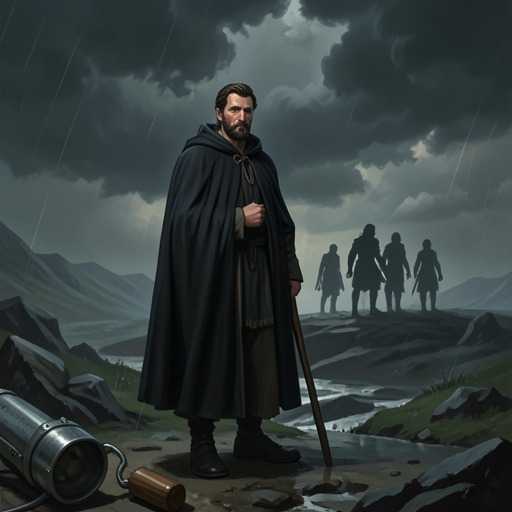
Even their conversation requires a workaround. Because ordinary speech might be carried by the wind, the brothers use a long brass horn to speak. Yet a demon interferes with the horn, turning their words into sounds they experience as harsh and hostile. Llevelys recognizes the obstruction and washes the horn with wine, driving the demon out so they can confer without that interference. This incident does not make the Coranians responsible for the horn’s disturbance; rather, it shows the wider difficulties surrounding the consultation. A device meant to secure privacy can itself fail, and the brothers must identify and remove a separate supernatural impediment before their counsel can proceed.
Lludd’s Countermeasure
Llevelys gives Lludd a remedy designed to distinguish the Coranians from the king’s own people. He supplies insects for two uses: some are to be kept and bred in case the affliction returns, while others are to be crushed in water. He instructs Lludd to convene the Britons and Coranians together as though they were gathering to make peace, then cast the prepared water over the assembled people. According to Llevelys, it will poison the Coranians but neither kill nor harm the Britons.
Back in his kingdom, Lludd follows that plan. He summons both peoples, crushes the insects in water, and casts the mixture over them together. The intended discrimination is decisive: the remedy destroys the whole tribe of Coranians without injuring any of the Britons. The story gives no intervening battle or Coranian counterstrategy. Instead, the king’s success depends on concealing the purpose of the gathering and on using Llevelys’s knowledge to make a measure that affects one group but spares the other.
Narrative Significance and Limits
The Coranians’ role is brief but structurally essential to Lludd’s restoration of order. Their wind-borne knowledge first makes speech and planning precarious; the brothers respond by seeking secrecy, adapting their means of communication, and finally disguising a decisive action as a peace conference. The episode thus moves from a threat that seems to defeat ordinary resistance to a remedy based on counsel and a carefully staged encounter. The insects are also retained for breeding, so Lludd’s response addresses the possibility that the same affliction might return rather than treating the victory as a reason to discard the means of protection.
The narrative gives the Coranians no individual voice or motive and does not describe their experience of the meeting. They appear through the danger they pose to the kingdom and through the remedy that ends that danger. That narrow perspective makes the episode less a portrait of a people than an account of how a ruler confronts an enemy whose advantage lies in knowing what others say. The ending is unambiguous within the story: the Coranians are destroyed, the Britons are unharmed, and the first of the three plagues is removed.