Gwalchmai
MabinogionGwalchmai is Arthur’s nephew, a renowned knight whose reputation rests on bringing his chosen adventures to completion. In the romances he is both a champion in arms and a trusted member of Arthur’s household: he undertakes a dangerous rescue, answers a charge of murder without evasion, counsels Arthur during a kinsman’s long absence, and recognizes when loyalty is best expressed through discretion rather than force.
Identity and Place at Arthur’s Court
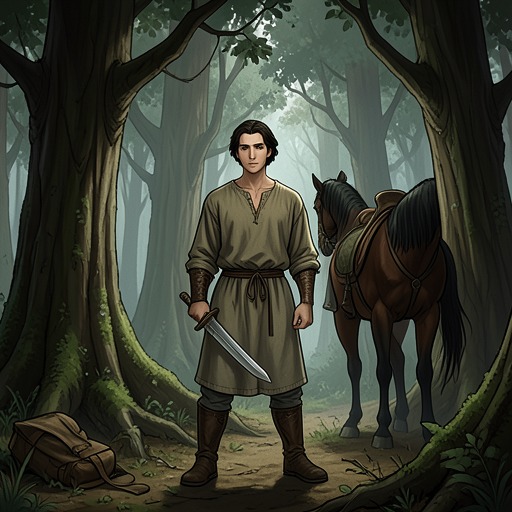
Gwalchmai is identified as the son of Arthur’s sister, and therefore Arthur’s nephew and cousin. His standing is expressed through practical virtues rather than rank alone: he is called the best of footmen and the best of knights, and is said never to return home without accomplishing the adventure he went to seek. The description makes follow-through central to his chivalric identity. His fame is not simply a matter of prowess; it depends on the expectation that a quest accepted will be carried through.
At Arthur’s principal palace, Caerlleon upon Usk, Gwalchmai sits on a velvet carpet in the middle of the hall with Owain son of Urien, Howel son of Emyr Llydaw, and Peredur. This placement presents him among the court’s notable knights, in a gathering that precedes a new sequence of challenges. He is not merely an adventurer who happens to visit Arthur’s hall: he belongs to its central fellowship and acts within its obligations.
The Rescue Quest and the Accusation
When a black maiden comes before Arthur’s household, she reproaches Peredur for failing to ask about the wonders at the Lame King’s court. She then describes a captive maiden in a castle on a high mountain, whose rescue would bring the rescuer the highest fame. Gwalchmai immediately declares that he will not rest until he has proved whether he can free her. Many of Arthur’s household join him, while Peredur sets out on a separate purpose: to discover the meaning of the bleeding lance. The two friends thus leave the court together in fellowship, but pursue distinct questions and travel by different routes.
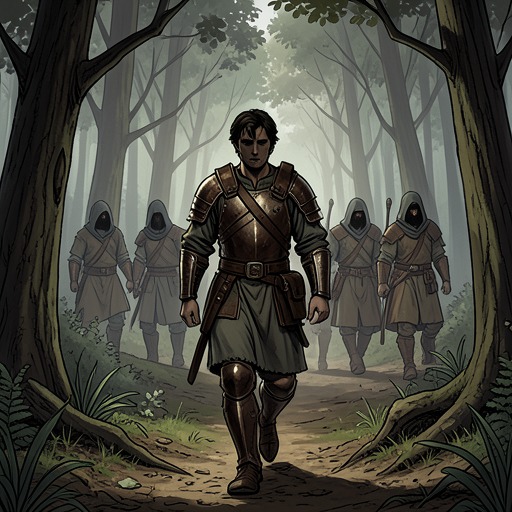
Their departure is interrupted by a knight who arrives at Arthur’s gate and accuses Gwalchmai of killing his lord through treachery and deceit. Gwalchmai answers the challenge directly, offering to prove that he is neither traitor nor deceiver, and accepts the knight’s demand that their encounter take place before the king he serves. He refuses neither combat nor the prospect of a public reckoning. He equips himself in his own armor, declining the abundance of other armor offered to him, and sets out after the challenger with Peredur. Their paths soon separate, preserving their fellowship without making the two quests identical.
Gwalchmai’s route brings him to a fortress where the dead lord’s family receives him. A maiden welcomes him to the tower, but an elderly, white-haired man warns the household that she is entertaining the man who killed her father. The Earl then confronts Gwalchmai with the same accusation. Gwalchmai does not claim innocence, but neither does he confess: he says he has come on a mission from Arthur and asks for a year to complete it, promising to return and then either acknowledge or deny the charge. The Earl grants the time willingly. The account records no later resolution of this adventure, leaving the question open while making Gwalchmai’s promise to return its decisive outcome.
Fellowship, Counsel, and Loyalty
Gwalchmai’s loyalty to Arthur also appears in counsel rather than combat. When he sees Arthur grieving over the three-year absence of Owain son of Urien, he asks what has happened. Arthur fears that Owain has been lost through the adventure related by Kynon and says he may die if another year passes without seeing him. Gwalchmai discourages a full mobilization of Arthur’s dominions. He argues that Arthur and the men of his household can go themselves: if Owain is dead, they can avenge him; if imprisoned, they can free him; and if alive, they can bring him back. Arthur accepts this plan. Gwalchmai responds to the king’s distress with a focused course of action, matching the scale of the response to the uncertain possibilities.
His companionship with Peredur is tested again after their separate travels. When Peredur reaches a castle in a valley, he finds Gwalchmai beside a lame, grey-headed man; the horse taken from Peredur by the black man is stabled beside Gwalchmai’s. The two are glad to see one another. The meeting briefly reunites the companions and reconnects their diverging journeys, without suggesting that either has completed the other’s task.
The Recognition of Geraint
Gwalchmai’s encounter with Geraint shows a more responsive, personal side of his conduct. After Kai reports seeing a wounded knight in battered armor in the wood, Gwalchmai takes his spear and shield and rides to investigate. Geraint refuses to identify himself or visit Arthur. Gwalchmai insists that he will not leave until he learns who the knight is, and charges; his spear breaks against Geraint’s shield. Looking closely, he recognizes Geraint, who has denied his identity even after recognition.
Gwalchmai does not force the injured knight into an immediate reconciliation with Arthur. He welcomes Enid, then quietly sends a page to tell Arthur that Geraint is wounded and unwilling to come, and recommends moving the king’s tent beside the road. The arrangement lets Geraint meet Arthur without requiring him to make the journey to the existing camp or be compelled while in a difficult state. Gwalchmai leads him onward, while keeping the message discreet. The scene contrasts his earlier willingness to meet an accusation with his care not to turn another man’s shame and injury into a public confrontation.
Narrative Role and Characterization
Across these episodes, Gwalchmai serves as both an active knight and a stabilizing figure within Arthur’s fellowship. His reputation for completing adventures is tested by an unfinished rescue journey and an accusation whose final answer the tale withholds. At the same time, the stories show him committing to action before knowing how a challenge will end, keeping his word when granted time, and helping others without insisting that they submit to his preferred course.
The contrast between force and restraint gives his chivalry its particular shape. He is prepared to fight when challenged, but advises against summoning an entire realm for a search that a smaller party can undertake. He presses Geraint for recognition, yet once he understands the situation, he arranges a gentler meeting with Arthur. His episodes therefore make reliability more than martial success: it includes accepting obligations, remaining answerable for unresolved claims, and adapting his conduct to the needs of companions and king.