Peredur son of Evrawc
MabinogionPeredur son of Evrawc is the youngest son of Earl Evrawc, whose death in combat, along with that of six of his seven sons, shapes the circumstances of Peredur’s upbringing. Kept from the world of arms by a protective mother, he enters it without the knowledge or training expected of a knight. His early adventures repeatedly expose the distance between his instinctive courage and his incomplete understanding of courtly conduct.
Identity and Background
Earl Evrawc held the Earldom of the North and relied heavily on tournaments, wars, and combats. He and six of his sons were killed in such encounters. Peredur, the youngest, was not yet old enough to take part; had he been, he might have shared their fate. His mother, now focused on her only surviving son and his possessions, chose to leave settled country for the wilderness rather than raise him among warriors.
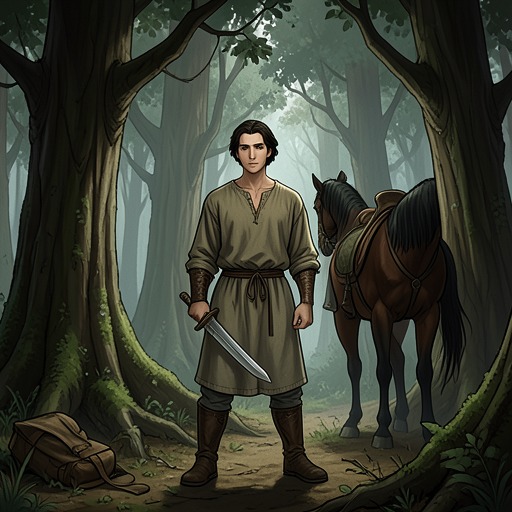
She brought with her women, boys, and men considered unsuited to fighting, and allowed no one to bring horses or weapons near Peredur, lest he become drawn to them. The separation protected him from immediate danger but also denied him ordinary instruction in the equipment, customs, and skills of knighthood. He played in the forest by slinging sticks and staves, learning through solitary activity rather than formal training.
His first glimpse of the wider world came when he saw three knights travelling along a road at the forest’s edge: Gwalchmai, Geneir Gwystyl, and Owain son of Urien. Peredur mistook them for angels and told his mother he would go and become one of them. When Owain asked whether he had seen a knight, Peredur did not even know what the word meant. He questioned Owain about the saddle, the men’s equipment, their horses, and their arms; Owain explained each item and its use. Only then did Peredur understand that these strangers were knights, and he offered to guide them toward the man they sought.
His decision unsettled his mother so greatly that she fainted. Once she recovered, Peredur asked leave to ride out. She did not simply forbid him: she directed him toward Arthur’s court, describing it as a place of the best, bravest, and most generous men, and gave him rules for how to behave on the road. He was to say his prayers whenever he saw a church, take food if he needed it and no one offered it, answer a woman’s cry for help, and give a beautiful jewel to someone else after finding it. Her advice also urged him to court a beautiful woman whether or not she welcomed his advances, a lesson that reflects how little preparation he had received for judging the finer demands of courtesy.
Peredur set out on a bony piebald workhorse, using a pack as a makeshift saddle and twisted twigs to imitate the trappings he had seen. He carried sharp-pointed forks rather than proper arms and travelled for two days and two nights through wilderness without food or drink. At a tent in a forest glade, he mistook the open dwelling for a church and said his prayers there. Seeing food, wine, and a gold ring, he followed his mother’s instructions literally: he took half the provisions, leaving the rest for the maiden who welcomed him, and took the ring before continuing his journey.
Arrival at Arthur’s Court and First Tests
Peredur reached Arthur’s court with no practical knowledge of knighthood, and Kai’s treatment of two dwarfs turned that inexperience into a lasting grievance. When the dwarfs greeted Peredur as a future champion, Kai struck the dwarf and kicked the dwarfess, then directed Peredur to pursue a knight who had left the court and take his horse, armour, and goblet. Peredur accepted the challenge literally. Though the knight first struck him, Peredur brought him down with one of the sharp-pointed forks he carried, then struggled to remove the man’s armour. Owain son of Urien helped him free it and offered him a horse, proper arms, and a place at court. Peredur declined the invitation: he sent the goblet back to Gwenhwyvar, pledged service to Arthur, and said he would not return until he had confronted Kai for insulting the dwarfs. His first victory therefore established both his courage and the personal purpose that would govern his return.
A meeting with his maternal uncle began the education that his mother’s retreat had withheld. At a lakeside castle, the older man tested Peredur’s fighting ability by having him spar with one of his sons. Peredur’s forceful success led the uncle to identify himself and offer instruction in the customs of different countries, courtesy, gentleness, and noble bearing, as well as preparation for knighthood. He also gave Peredur a rule that would shape a later failure: if something caused wonder, Peredur should not ask what it meant; if no one explained it, the fault would be the teacher’s, not the pupil’s. The advice trained him to defer to authority, but it also left him silent before scenes whose meaning demanded a question.
The cost of his departure soon became explicit. Peredur’s foster-sister told him that his mother had died from anguish after he rode away against her wishes. She also revealed that the dwarfs he had vowed to avenge had belonged to his parents, and that she herself was his foster-sister. Her husband had been killed by a knight in a forest glade; despite her warning that the same opponent might defeat him, Peredur buried the dead man and went to seek the knight. He overcame him and required him to marry the widow, honour her, and report the defeat to Arthur’s court, while renewing his own refusal to return before settling his grievance against Kai. The episode links Peredur’s growing capacity to protect others with the consequences of his impulsive departure: he accepts responsibility for the bereaved woman even as he learns that his absence has caused grief at home.
Defense, Restitution, and Further Tests
Peredur’s protection of a dispossessed young woman turned his skill in combat toward restoring what another ruler had taken. Her father had died leaving her the family’s dominions, and she had refused a suitor who sought her against her will. He answered by making war and seizing all her possessions save one fortified house. Its defenders had held out, but their provisions were exhausted; even the nuns who had supplied them were running short. The woman asked Peredur either to take her to safety or defend her home. He promised not to leave before attempting to help.
When the earl’s forces arrived, Peredur rode out alone. He defeated the first challenger, then overcame the earl’s Master of the Household and required him to return a third of the woman’s lands and profits, provide food, drink, horses, and arms for a hundred men, and remain her captive unless she chose to spare his life. The next day Peredur defeated more of the host and compelled the Steward of the Palace to restore another third of her possessions and provide provisions and equipment for two hundred men. Rather than treating victory as an end in itself, he made the defeated officers’ authority serve the woman whose inheritance had been taken; the restoration of supplies also gave her household immediate means to endure.
At another besieged dwelling, Peredur offered protection to a lady threatened by the nine Sorceresses of Gloucester, who had already laid waste to the surrounding country. He stayed after learning of the danger, then rose at daybreak when he heard an alarm and confronted one of the sorceresses. She recognized him as the person destined to bring her harm and offered him a horse, armour, and instruction in their use. Peredur granted mercy on the condition that she pledge never again to injure the Countess’s dominions. With the Countess’s permission, he went with the sorceress to the sorceresses’ palace, remained there for three weeks, chose a horse and arms, and then continued on his way. Across these encounters, his strength increasingly serves as a means to impose limits on oppression: restitution in one case, and a binding promise against renewed harm in the other.
Reflection, Silence, and Return to Arthur’s Court
After leaving the sorceresses, Peredur’s progress is marked not only by combat but also by the inward attention that can draw him out of the world around him. At a hermit’s cell, he saw a hawk kill a wild bird on newly fallen snow. A raven settled beside it, and Peredur read the contrast of white, black, and red as an image of the woman he loved: her pale skin, dark hair and eyebrows, and two red spots on her cheeks. The scene gives his affection a contemplative form; for once, he is not acting on a challenge or a command, but absorbed in a comparison drawn from what he sees.
Arthur and his household, searching for Peredur, sent a youth to learn who stood by a brook. Peredur was so deep in thought that he did not answer. When the youth thrust at him, Peredur knocked him from his horse; he then brought down the twenty-four youths who came after, one by one. Kai approached in anger and suffered a severe defeat. The contrast between the attacks and Gwalchmai’s later approach is decisive: Gwalchmai came without hostility and asked to speak, acknowledging that the earlier messengers had rudely interrupted Peredur’s reflection. Peredur explained the image of snow, raven, and blood, and Gwalchmai accepted that his thought deserved respect.
Their meeting also brought Peredur’s old grievance into the open. When he learned that Kai was the man he had just defeated, Peredur said that he was glad to have begun avenging the insult to the dwarf and dwarfess. He identified himself as Peredur son of Evrawc and asked for Gwalchmai’s fellowship, which Gwalchmai gladly granted. Together they returned to Arthur. Arthur welcomed Peredur, honoured his courage, and recognized that the dwarfs’ prediction had been fulfilled; the court’s welcome completed the return that Peredur had postponed until he could confront Kai.
At a later point, Peredur remained at Arthur’s court but was known as the Dumb Youth. When Angharad Law Eurawc said that she loved him despite his inability to speak, Peredur answered her, and his identity became known. He then renewed his fellowship with Gwalchmai, Owain son of Urien, and the rest of the household. The episode reverses his earlier silence: once imposed by inexperience and the injunction not to question marvels, silence becomes a condition others associate with him, until Angharad’s declaration draws speech from him and restores his name within the court.
The Black Oppressor and the Addanc
Peredur’s next encounters test both his capacity to oppose injustice and the limits of the training he has received. At the Black Oppressor’s court, he hears of a serpent hidden in a cairn on the Mound of Mourning. A stone on the serpent’s tail is said to grant its holder as much gold as desired. The Black Oppressor had lost an eye fighting the serpent, but his name arose from another kind of harm: he admitted that he had oppressed everyone around him and done justice to none. Peredur defeats him and kills him, ending his power; when offered the dead man’s wealth and a choice among the court’s maidens, he declines both, saying in effect that he came to pursue his quest, not to acquire treasure or a bride.
Peredur then reaches the Palace of the Sons of the King of the Tortures, where the women of the household welcome him. He sees riders return with their bodies on horseback, but the women wash and treat them with precious balsam, and the men rise alive again. The household explains that the Addanc of the Lake kills them each day. The young men set out to face it, refusing Peredur’s request to join them because, unlike them, he has no one who could restore him to life. He follows after them regardless.
A woman seated on a mound recognizes Peredur’s purpose and warns him that the Addanc relies on concealment rather than open combat. It watches the entrance of its cave from behind a stone pillar and attacks visitors with poisoned darts, while remaining unseen itself. She offers him a stone that will let him see the creature without being seen, in return for his pledge to love her above all women. Peredur accepts, and she places the stone in his hand before vanishing. The promised advantage turns the coming encounter into a test of perception as much as courage.
The route onward presents Peredur with another unexplained marvel: beside a river, white and black flocks change color as sheep cross between them in response to one another’s cries. Nearby, one half of a tree burns from root to crown while the other remains green and full of leaves. A youth of strikingly royal bearing sits on a mound with two leashed greyhounds, as hounds sound in the wood opposite. The scene recalls the wonders Peredur was taught not to question, but the account leaves its meaning unstated.
The Unasked Questions and the Limits of Instruction
At his maternal uncle’s castle, Peredur son of Evrawc encountered two tests that framed his future as a warrior. In the first, he struck an iron staple with a sword: the blade and staple broke together, and twice the pieces reunited when he fitted them together. On the third blow they remained broken. His uncle judged that Peredur had reached two-thirds of his strength, with the final third still to come, and predicted that no one would be able to contend with him once he attained it. The marvel offered a measure of power, but not a lesson in how to interpret what he saw.
That distinction became consequential at the second uncle’s hall. Two youths carried in a spear whose point streamed blood, and the assembled company wailed. Then two maidens brought a man’s head on a salver, surrounded by blood, and the lamenting began again. Peredur’s host continued speaking with him instead of explaining the sights; bound by his uncle’s instruction not to ask about anything that caused wonder, Peredur stayed silent. The scenes were not merely strange interruptions: their unexplained recurrence became the test of whether courtesy toward a teacher should outweigh the duty to seek meaning. The account leaves the immediate significance of the spear and head undisclosed, making Peredur’s failure to inquire an unresolved hinge in his adventures.
His later encounter with the household threatened by the Addanc shows a change in that habit. When riders returned dead and were restored to life by the women, Peredur asked why it happened; the household explained that the creature killed them once each day. He also accepted a woman’s warning about the Addanc’s concealed position and poisoned darts, taking the special stone she offered so he could see the creature without being seen. The contrast is precise: where silence had left the bloody spear and head uninterpreted, questions and attention to another person’s knowledge now helped him prepare for a danger that could not be met by courage alone.
The Black Oppressor’s Court and Peredur’s Judgment
Peredur’s confrontation with the Black Oppressor begins in a household where danger is announced before its host appears. The Black Oppressor’s daughter warns Peredur that her father kills anyone who enters without permission, though she persuades him to spare the visitor for the night. During the meal, Peredur asks how so powerful a man lost an eye. The question itself carries a risk: the Black Oppressor says that anyone who asks it will not leave alive, but the daughter invokes his promise to spare Peredur until morning. The next day, the threat becomes a formal challenge. Peredur asks either to fight on equal terms or to be given arms; the daughter brings him the weapons he chooses, and he forces his opponent to ask for mercy.
Peredur makes that mercy conditional on an account of the Black Oppressor’s identity and injury. The answer joins the two strands of the encounter: he lost his eye fighting the serpent at the Mound of Mourning, while his title reflects his admission that he had oppressed everyone around him and done justice to no one. Peredur then refuses to let the confession remain merely a story about the past. He tells the Black Oppressor that he will allow him to oppress no longer and kills him. The sequence distinguishes Peredur’s use of force from a contest pursued for its own sake: he demands an explanation, hears the accused man acknowledge his injustice, and ends the authority that sustained it.
The Dumb Youth at Arthur’s Court
While Arthur and his household were going to church, a knight raised the signal for combat, and Arthur prepared to ride out against him. Peredur intercepted the attendants carrying Arthur’s horse and arms, took them, and went to the meadow in the king’s place. He unhorsed the challenger with a spear-thrust, then returned the horse and equipment and went back to the palace on foot. From then on he was known as the Dumb Youth. This episode places his proven fighting ability beside a new silence: he acts decisively when a challenge appears, but the court does not yet know who he is. Angharad Law Eurawc’s declaration that she loved him despite his inability to speak drew an answer from him and revealed his identity, restoring Peredur to fellowship with Gwalchmai, Owain son of Urien, and Arthur’s household.