Gronw Pebyr
MabinogionGronw Pebyr is the lord of Penllyn whose arrival at Llew Llaw Gyffes’s court turns a hunt into a conspiracy over love, succession, and land. His brief ascent is built on a secret learned from Llew himself: Gronw helps Blodeuwedd discover how her husband can be killed, strikes him under the conditions he has disclosed, and takes control of his territory. But the victory is temporary. Llew returns, reclaims his rule, and kills Gronw with a spear that pierces the stone Gronw raises between them—a wound in the stone that preserves the defeated lord’s name.
Lord of Penllyn and Arrival
Gronw first appears as a territorial ruler identified as the lord of Penllyn. While Llew is away visiting Math son of Mathonwy, Blodeuwedd hears a horn and sees the signs of a hunt pass through the court: a tired stag, dogs and huntsmen, and then a larger company on foot. Her servant learns that the hunting party belongs to Gronw. He has pursued and killed the stag by the Cynvael River, and the work of flaying it and tending to his dogs delays him until night approaches.
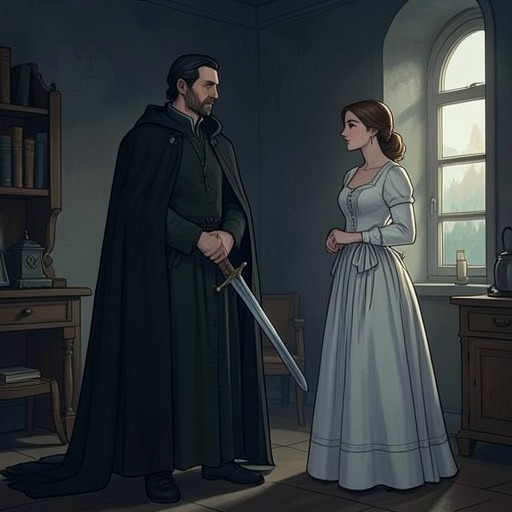
When Gronw reaches the court, Blodeuwedd argues that it would be improper to let a chieftain depart for another land at that hour without offering him hospitality. Messengers invite him in; he accepts, and Blodeuwedd greets him. The ordinary courtesies of a host and guest open the way to a much more consequential encounter. At this point Gronw is a visiting lord, not yet an enemy openly contesting Llew’s position.
Blodeuwedd and the Conspiracy
The attraction between Gronw and Blodeuwedd is immediate and mutual. The narrative says that, as they looked at one another, each became filled with love for the other; Gronw declared his feelings, and their conversation that evening centered on the affection that had arisen between them. When he tries to leave the following day, Blodeuwedd asks him to stay. They spend another night together and consider how they might remain together beyond this brief visit.
Gronw proposes that Blodeuwedd learn from Llew the manner of his death, presenting the inquiry as concern for her husband. His suggestion gives the new attachment a specific political and violent purpose: rather than simply leave or conceal their relationship, they begin working toward Llew’s death. When Gronw again prepares to depart, Blodeuwedd persuades him to remain, despite his recognition that the owner of the palace might return. Llew does return, and Blodeuwedd draws from him the elaborate conditions under which he could be killed.
The means of attack require patience and exact preparation. Llew explains that the spear must take a year to make, with work on it restricted to Sundays. He also describes an unusual position involving a bath beside a river, a covered cauldron, and a buck: he cannot be killed indoors or outdoors, on horseback or on foot, but says that a blow delivered while he stands with one foot on the buck and the other on the bath’s edge would kill him. Blodeuwedd passes this information to Gronw. He labors on the spear, which is ready a year later, turning Llew’s own account of his protections into a plan for overcoming them.
The Attack and Seizure of Land
Blodeuwedd arranges the opportunity as carefully as Gronw prepares the weapon. She has a bath and roof made ready and sends Gronw to lie in ambush on the hill now called Bryn Kyvergyr, beside the Cynvael River. She also has the goats from the cantrev gathered on the opposite bank, so that a buck can be brought to Llew. When Llew comes to inspect the bath, he enters it, anoints himself, and then steps out. At Blodeuwedd’s prompting, he identifies the animals as the bucks he had described; one is caught and brought over. He places one foot on the bath’s edge and the other on the buck’s back.
From the hill, Gronw rises, rests on one knee, and hurls the poisoned spear. It strikes Llew in the side, but the account does not describe a conventional death: Llew takes the form of an eagle, cries out, and disappears from sight. Gronw and Blodeuwedd go together to the palace that night. The next day Gronw takes possession of Ardudwy; after overcoming the land, he rules it, bringing both Ardudwy and Penllyn under his sway. His attack thus becomes an attempted transfer of power, not merely the removal of a rival from the household.
Defeat and the Stone at the River
Llew survives, returns, and takes possession of the land a second time. When Gronw is told that he must face him, he asks whether one of his faithful warriors, household members, or foster-brothers will take the blow in his stead. None agrees. The refusal is remembered in the tale’s account as the reason they are called the third disloyal tribe; Gronw ultimately has to meet Llew himself. The episode places the loyalty owed to a lord beside the limits of that loyalty: his followers’ refusal leaves him exposed to the consequence of the plot he helped carry out.
The two men return to the banks of the Cynvael River and take the positions they had occupied at the first encounter, now reversed. Gronw explains that a woman’s wiles were involved in what he did to Llew and asks permission to place a stone between himself and the blow. Llew grants the request. Gronw sets the slab between them, but Llew throws his spear through it and into Gronw, killing him. The slab remains on the riverbank in Ardudwy, pierced through, and is called Llech Gronw. The attempted shield does not save Gronw; instead, the stone makes the defeat a visible and named feature of the landscape.
Narrative Role and Outcome
Gronw’s role is defined by a sharp reversal: he enters the story as a guest welcomed into another ruler’s court, becomes the lover and co-conspirator of that ruler’s wife, and briefly holds the lands he has seized. His central advantage is not independent knowledge but information obtained through Blodeuwedd’s performance of concern for Llew. The plot’s careful conditions—a year’s work on the spear, the riverside bath, the buck, and the ambush—make his success depend on turning Llew’s explanation of his own vulnerability against him.
Yet Gronw’s victory cannot endure. Llew’s return restores the displaced ruler, while Gronw’s retainers neither prevent the reckoning nor accept his request to suffer it for him. His final appeal for the stone acknowledges the means by which the first attack was arranged, but the concession he receives changes nothing about the outcome. He dies at the same river where his attack began, and the pierced slab carries his name forward after his rule has ended.