Branwen
MabinogionBranwen is the daughter of Llyr and the sister of Bendigeid Fran and Manawyddan. Her marriage to Matholwch, king of Ireland, begins as a proposed alliance between kingdoms, but an insult to Matholwch in Cambria turns her life in Ireland into a punishment. After years of confinement and humiliation, she finds a way to send news to her brother; the response brings the two kingdoms into war. Her story ends not with restoration but with grief for the devastation and her death on the return journey.
Identity and Marriage
At the opening of her story, Branwen is presented as one of the three foremost ladies of the Island of Britain and as exceptionally beautiful. Matholwch comes to Bendigeid Fran seeking her hand, proposing that Ireland and the Island of the Mighty be joined in an alliance and thereby strengthened. Bendigeid Fran receives the request and, after counsel, agrees to the marriage. The match is thus both personal and political: Branwen's union is the bond through which the two rulers hope to connect their realms.
The wedding is celebrated at Aberffraw. Matholwch and his company travel by ship, while Bendigeid Fran and his followers make the journey overland; the assembled hosts feast beneath tents rather than in a hall, since no house could contain Bendigeid Fran. Branwen sits beside Matholwch at the banquet, and that night she becomes his bride. The ceremony's public scale makes the later reversal especially stark: a marriage intended to unite courts instead leaves her isolated within the Irish one.
Life in Ireland and Punishment
Branwen's first year in Ireland is marked by honor and welcome. She receives visitors of rank and gives them clasps, rings, and royal jewels, so that they depart bearing gifts. During this period she becomes pregnant and gives birth to Gwern, the son of Matholwch, who is sent to be fostered among Ireland's leading men. For a time, her place at court appears secure, and her generosity makes her a visible source of prestige and hospitality.
In the second year, resentment over the earlier insult Matholwch received in Cambria—and the compensation paid for his horses—erupts among his foster-brothers and close companions. They openly blame him and demand vengeance for the disgrace. The punishment falls on Branwen: she is removed from Matholwch's chamber, required to cook for the court, and subjected to a daily blow from the butcher. The account shows the political grievance being enforced through her, though she was not responsible for the insult. Matholwch's men then restrict contact with Cambria, ordering that ships and ferry craft not travel between the lands and that arrivals from Cambria be imprisoned to prevent news from getting back. These restrictions last three years.
The Starling and the Message
Cut off from ordinary communication, Branwen raises a starling in the cover of a kneading trough and teaches it to speak. She teaches the bird who her brother is, writes a letter describing her suffering and treatment, ties it to the bird's wing, and sends it toward her homeland. The method is small and painstaking against the scale of the political blockade: a domestic bird carries the message that ships and travelers have been prevented from bearing.
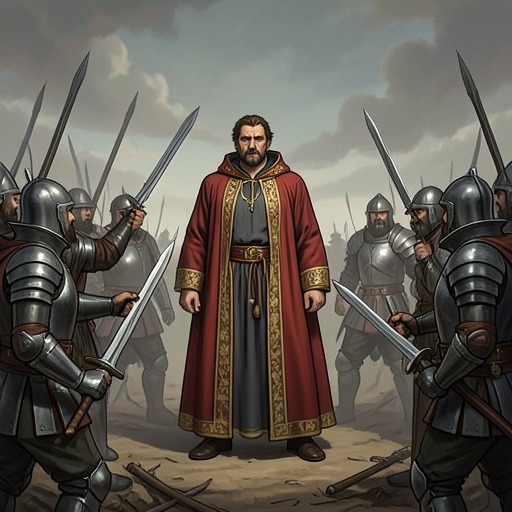
The starling reaches Bendigeid Fran at Caer Seiont, where he is conferring with others. It settles on his shoulder and ruffles its feathers, exposing the letter. Recognizing that the bird has been raised among people, those present understand that it bears a message. When Bendigeid Fran reads Branwen's account, he grieves and summons the island's forces. He gathers the representatives of 174 countries, tells them of his sister's distress, and takes counsel with them; they resolve to go to Ireland. Her act of communication therefore changes her private suffering into a public cause and sets the expedition in motion.
Return, Death, and Narrative Significance
After the conflict in Ireland, Branwen travels back with the surviving company bearing Bendigeid Fran's severed head. At Aber Alaw in Talebolyon, the group stops to rest. Looking toward Ireland and the Island of the Mighty, Branwen laments that two islands have been destroyed because of her. She groans, her heart breaks, and her companions bury her in a four-sided grave on the bank of the Alaw. The narrative gives no return to her former status or reconciliation with Matholwch: her journey home ends in death.
Branwen's arc binds intimate harm to public consequence. The marriage begins as a diplomatic promise; a dispute about the treatment of Matholwch's horses becomes the pretext for punishing her; and her letter carries that punishment beyond the court that imposed it. Yet the rescue she makes possible does not undo the losses. Her final lament presents the catastrophe through her own sense of responsibility, while the story's sequence makes clear how a political grievance was visited upon her and then widened into conflict. She is at once the intended bridge between kingdoms, the target through whom an insult is avenged, and the messenger whose ingenuity makes her plight known.