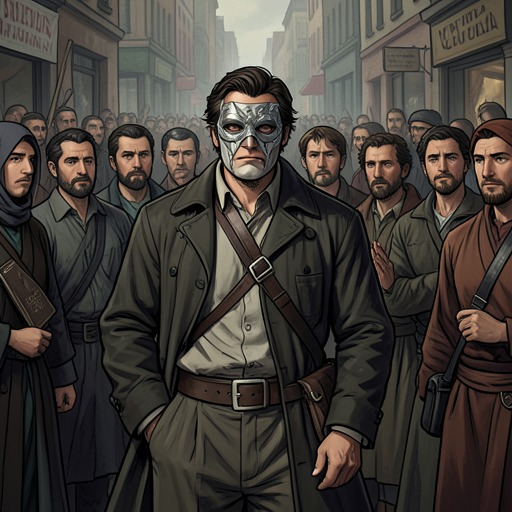
Iddawc Cordd Prydain
MabinogionIddawc Cordd Prydain is the former messenger who admits that, through his own appetite for battle, he turned Arthur’s appeal for peace into an insult and helped bring about the Battle of Camlan. In Rhonabwy’s dream he appears as a guide through Arthur’s crowded encampment, explaining its people and customs; his role as interpreter is set against the consequential failure of interpretation for which he has spent years doing penance.
Identity and Introduction
Rhonabwy first encounters Iddawc in a dream of travel across the plain of Argyngroeg toward the ford of Rhyd y Groes on the River Severn. A fierce rider on a chestnut horse overtakes the party: the horse’s legs are grey in sharply described sections, while the rider’s green and yellow clothing recalls fir leaves and broom blossom. The horse’s breath seems to alter the distance between pursuer and travelers, drawing them close when it exhales and carrying them away when it inhales. Once the frightened party begs for mercy, the rider grants it and identifies himself as Iddawc, son of Mynyo, better known by his nickname, Iddawc Cordd Prydain.
The dream introduces him through a contradiction. His presence is initially frightening, and his horseman’s pursuit seems to place Rhonabwy and his companions at his mercy; yet he responds without harm and makes the travelers his companions. When Rhuvawn Pebyr asks for a share of the small company, Iddawc grants what is proper and accepts him as another companion. The scene establishes Iddawc as a person who can mediate between strangers and the company he leads, even as his explanation of his nickname reveals an earlier failure to mediate responsibly.
The Message That Led to Camlan
Iddawc explains that he served as a messenger between Arthur and Medrawd, Arthur’s nephew, before the Battle of Camlan. Arthur had sent him to reason with Medrawd: the message was to remind Medrawd that Arthur was both his foster-father and uncle and to seek peace, so that the sons of the kings and nobles of the Island of Britain would not be killed. Iddawc says Arthur entrusted him with the fairest words he could devise. Instead, because he desired battle, Iddawc delivered the harshest words he could invent and stirred anger between the two men.
He directly connects that distortion to the battle that followed, explaining that it was because of this act that he was called Iddawc Cordd Prydain. The account makes his offence more specific than a general taste for violence: he was entrusted with language meant to restrain a conflict, then deliberately made that language provoke one. His past is therefore recalled within a dream filled with martial spectacle, where the consequences of words are carried alongside the display of armies, weapons, and heroic reputations.
Iddawc also gives the consequence in personal terms. Three nights before the end of the Battle of Camlan, he left the combatants and went to Llech Las in North Britain to do penance. He remained there for seven years and then received pardon. The narrative does not describe the form of the penance, but its duration and its connection to the battle give his introduction the shape of a confession: the seasoned guide whom Rhonabwy meets has already lived through punishment for the reckless youth he describes.
Guide to Arthur’s Company
At the ford, Iddawc brings Rhonabwy before Arthur, who sits on a flat island with Bedwini the Bishop and Gwarthegyd son of Kaw beside him. Arthur asks where Iddawc found the travelers and remarks that he pities men of their stature for having the island in their keeping after the people who guarded it in earlier days. Iddawc does not leave Rhonabwy with that remark alone: he directs his attention to the ring on Arthur’s hand and explains that its stone will let him remember what he sees. Without seeing the stone, Rhonabwy would remember nothing of the dream.
This explanation makes Iddawc a guide not only to the company but also to the conditions under which the dream can be retained. Arthur’s encampment is crowded with marvels and extraordinary detail; the ring supplies a reason Rhonabwy can carry those impressions back with him. Iddawc’s guidance thus contrasts with his earlier misuse of a message. In the past he altered words to inflame a crisis; here he supplies information that helps another person understand and remember what is before him.
As further troops arrive, Iddawc identifies them and explains the standing of their members. Rhuvawn Pebyr’s company, he says, is honoured with mead and bragget and beloved by the daughters of the kings of the Island of Britain because its warriors have been in the front and rear in every peril. When Rhonabwy asks about the red-clad horseman who shines like a pillar of fire, Iddawc names Rhuvawn. Later, when Adaon’s horse is struck after its rider has splashed water over Arthur, the bishop, and their counsellors, Iddawc identifies Adaon as the island’s most eloquent and wisest youth, and Elphin as a youth of contrary nature. He supplies the reasoning behind the rebuke as well as the identities: the horse’s rider had behaved rashly toward Arthur and the consecrated bishop, and he accepts the blow as counsel.
Iddawc also recognizes the man who urges Arthur’s assembled host to proceed toward the battle of Badon, naming him Caradawc Vreichvras, Arthur’s chief counsellor and cousin. He then takes Rhonabwy behind him on his horse as the host moves toward Cevndigoll. Across these encounters, Iddawc’s work is interpretive: he makes a bewildering court legible by identifying people, explaining their standing, and clarifying the judgments passed among them.
Counsel, Judgment, and the Limits of His Authority
During the conflict between the ravens and Arthur’s men, Iddawc identifies the first three messengers who report losses to Owain son of Urien as Selyv, Gwgawn Gleddyvrudd, and Gwres. He describes them as companions and fellow-chieftains who grieve at Owain’s losses. He identifies the last three who bring Arthur news of the ravens’ slaughter as Blathaon, Rhuvawn Pebyr, and Hyveidd Unllenn, praising them as the best and bravest, men who would grieve deeply if Arthur suffered harm. His explanation distinguishes the loyalties and concern of each group within the larger scene of violence.
When Osla Gyllellvawr’s men ask for a truce, the court assembles to deliberate. Iddawc identifies Rhun son of Maelgwn Gwynedd as the auburn-haired man whom the counsellors approach, and explains that Rhun has the privilege of joining any council. He also explains why the young Kadyriaith is admitted among counsellors of high rank: no one in Britain is more skilled in counsel. After Kadyriaith proposes granting a truce and giving the gold and silver tribute brought from the Islands of Greece to the bards as payment for their stay and verses, Iddawc defends the young adviser’s place in the council. He asks Rhonabwy to consider whether it would be wrong to exclude a youth capable of such generous counsel from his lord’s councils.
That defense gives Iddawc’s present judgment a pointed relation to his past. He once received a commission to carry wise, conciliatory words and knowingly did the opposite; now he recognizes and supports sound counsel, even when it comes from a young man. The dream does not show him undoing the harm he associates with Camlan, and his advice does not make him the ruler of the court. It does show him valuing the very kind of deliberation he once betrayed.
Penance and Narrative Role
Iddawc is neither the dream’s central ruler nor its principal combatant. His importance lies in the conjunction of remembered guilt and present explanation: he tells Rhonabwy how a messenger’s words helped turn a proposed peace into conflict, then guides him through a vision whose people, customs, and episodes might otherwise remain a succession of dazzling but disconnected sights. His history gives the dream’s martial world a human measure. The armies are impressive, but the Battle of Camlan is also the consequence Iddawc associates with a choice made in speech.
The dream ends when the tumult following Kai’s challenge to Arthur’s followers wakes Rhonabwy, who discovers that he has slept three days and three nights on a yellow calfskin. The book’s closing account says that the dream cannot be known without a book, because of the many colors of its horses, arms, scarfs, and virtue-bearing stones. Iddawc’s attention to Arthur’s memory ring anticipates that problem within the dream itself: he gives Rhonabwy a means of remembering a world otherwise liable to vanish. The same character who confesses to having corrupted a message therefore helps preserve and explain another story, making him both a figure burdened by the past and the dreamer’s guide to its record.