Lame King
MabinogionThe Lame King is Peredur’s uncle, whose lameness links the marvels at his court to the sorceresses of Gloucester and to Peredur’s unfinished task of asking what they mean. Though he appears only briefly, his condition gives the missed question lasting consequences: the story says that inquiry could have restored the king and brought peace to his dominions.
Identity and Place in the Story
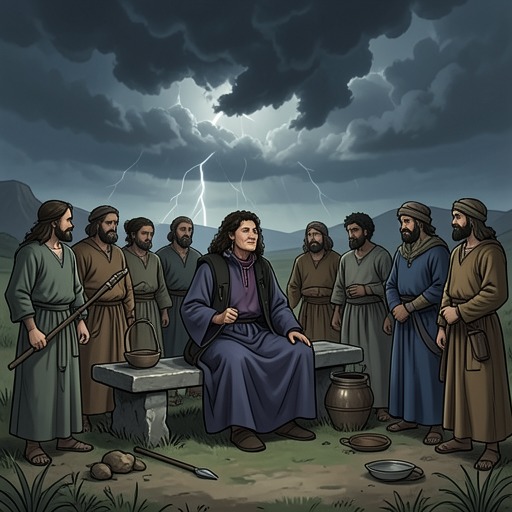
The Lame King appears as a lame, grey-headed man in a castle hall. When Peredur arrives, Gwalchmai is already beside him, and Peredur takes a seat on the other side. The later revelation that the king is Peredur’s uncle connects this brief encounter to the family history behind Peredur’s adventures.
The account does not give the king a personal name or describe his rule beyond the fate of his dominions. Instead, it identifies him through his title, his lameness, and the unexplained wonders at his court. Those details make him the focus of a question Peredur fails to ask and a wrong he will later be called to avenge.
The Missed Question
A black maiden rebukes Peredur for failing to inquire about the wonders he saw at the Lame King’s court. Among them was a youth carrying a spear that streamed with blood. She says that, had Peredur asked their meaning and cause, the king would have been restored to health and his dominions to peace. Because he did not ask, the king must endure further battles and conflicts, and his knights will perish while wives are widowed and maidens left without provision.
The king’s possible restoration is therefore made conditional on Peredur’s response to what he witnesses. The text makes the omission consequential not only for the king’s body but also for the people and political order associated with his dominion. The Lame King himself does not explain the marvels in the surviving scene; their meaning is disclosed through the maiden’s accusation and the later revelation about his family.
Family History and the Sorceresses
At the Castle of Wonders, a yellow-haired youth tells Peredur that the bloody head shown earlier belonged to Peredur’s cousin, who was killed by the sorceresses of Gloucester. The youth also identifies himself as that cousin and says that the sorceresses lamed Peredur’s uncle—the Lame King. He links these events to a prediction that Peredur is to avenge them.
The revelation turns the king’s lameness from an unexplained feature of a mysterious court into part of a family grievance. His injury and his cousin’s death share a cause in the sorceresses’ violence, while Peredur’s earlier failure to ask about the signs at court becomes one strand of a larger, foretold reckoning.
Aftermath and Narrative Role
After learning the identity of the head and the cause of his uncle’s lameness, Peredur and Gwalchmai consult together and send for Arthur and his household to join an attack on the sorceresses. During the fighting, a sorceress kills one of Arthur’s men; Peredur first orders her to stop, then repeats the warning after she kills another. When she kills a third man, he strikes her helmet. She recognizes him as the man who learned chivalry among the sorceresses and who, according to their fate, is destined to kill them. Arthur and his household then slay the sorceresses of Gloucester.
The Lame King is thus a largely offstage character whose condition organizes several parts of Peredur’s story: the courtly marvels that go unqueried, the later disclosure of family harm, and the revenge that culminates in the sorceresses’ deaths. The narrative presents lameness as both a bodily condition and a sign of unresolved wrong, while tying the prospect of restoration to Peredur’s ability to interpret and act on what he has seen.