Custennin
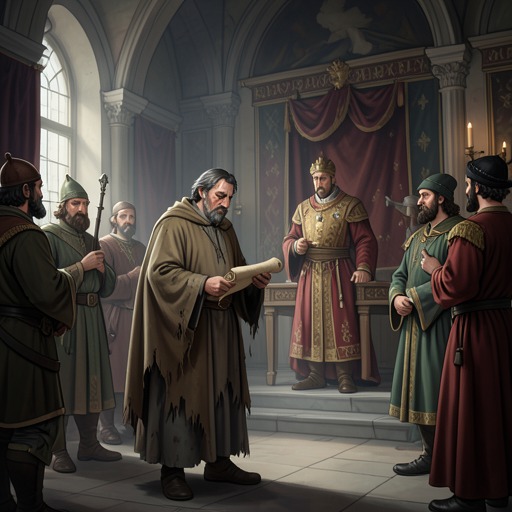
MabinogionCustennin is a herdsman whose household becomes a crucial refuge and point of entry for Culhwck’s embassy to Yspaddaden Penkawr’s castle. Yspaddaden is not only the tyrant who guards Olwen but Custennin’s brother, who has oppressed him over his possessions and killed twenty-three of his sons. Against that history, Custennin’s willingness to receive the questers—and the emergence of his one surviving son—turns a threatened family into an important part of the expedition.
Identity and Background
Custennin identifies himself as the keeper of the sheep and the brother of Yspaddaden Penkawr. He says that his brother oppressed him because of his possessions, placing his household under the power of the very lord whose daughter the visitors seek. The contrast is stark: Yspaddaden’s castle dominates the surrounding land, while Custennin’s family lives under the consequences of his rule.
Custennin’s connection to Culhwck is through his wife. She is the sister of Goleuddydd, Culhwck’s mother, making him the young man’s uncle by marriage. The visitors arrive as Arthur’s embassy, but they are also family arriving at a perilous threshold. Custennin’s identity as herdsman, dispossessed kinsman, and host gives the encounter its several stakes at once.
The Embassy at His Door
The approach is cautious. Kai and Gwrhyr Gwalstawt Ieithoedd go together to greet Custennin, while Menw promises to cast a spell on the dangerous dog so it will harm no one. On the mound, the herdsman answers their questions and identifies the castle as Yspaddaden’s. When the visitors disclose that they have come to seek Olwen, Custennin warns them that no one who has undertaken the quest has returned alive.
He nevertheless accepts the gold ring Culhwck gives him. The ring is too small for Custennin, so he places it on a finger of his glove and takes the glove home for his wife to keep. When she finds the ring, she challenges his explanation: he claims he found it on a beautiful corpse carried by the waves while seeking fish. He then tells her that the ring belongs to Culhwck, who is coming to seek Olwen as his wife. The lie gives way to the truth of the visitors’ arrival, and his wife’s response holds joy at seeing her nephew together with sorrow at the danger of the quest.
Custennin’s wife runs out to greet the party. Kai puts a billet of wood between her hands when she tries to embrace the visitors, and she squeezes it into a twisted coil. Inside the house the company is served, and the household’s private grief comes into view: she opens a stone chest by the chimney, revealing a youth with yellow curling hair. Custennin’s son has been kept hidden while Yspaddaden’s violence threatens the family.
Family Under Yspaddaden’s Rule
Custennin’s wife says that Yspaddaden has slain twenty-three of her sons and that she has little hope for this last one. The concealed youth is therefore not simply a new companion for the embassy; his appearance exposes the cost of Custennin’s brother’s power. The stone chest, tucked by the chimney-corner, embodies the household’s attempt to preserve a son whom open resistance might have endangered.
Kai offers to take the youth as his companion, promising that he will not be slain unless Kai is slain with him. The narrative subsequently names him Goreu, the son of Custennin. He passes the three wards of Gwrnach the Giant’s castle by keeping close to his companions, reaches its midst, and is praised by them as the best of all men. His passage from hiding to action marks a decisive change in the family’s position: the last surviving son is no longer merely concealed from danger but takes part in the expedition against powerful adversaries.
Custennin’s Household and Olwen
Custennin’s wife helps the embassy approach Olwen, but she first insists on a pledge that the visitors will not harm her. She explains that she will not betray those who trust her, and only sends a message after the party gives its word. Her caution echoes Custennin’s warning about the quest’s fatal record, while her decision turns the household from a place of shelter into the means by which the visitors can meet their goal.
The message brings Olwen to the house on the customary Saturday when she comes to wash her head. She leaves the rings from her hands in the washing vessel and does not send anyone to fetch them. The visitors’ access to this family routine depends on the trust Custennin’s household extends to them. In this way, the domestic space and its customs open a path that force alone could not provide.
Goreu and the Household’s Aftermath
Custennin’s son continues to be associated with the campaign after the first encounter. At the close of the quest, Goreu accompanies Culhwck and those who have taken the marvels to Yspaddaden’s court. After Kaw of North Britain shaves Yspaddaden’s beard, skin, and flesh to the bone, the giant concedes that Olwen is Culhwck’s. Goreu then seizes Yspaddaden by the hair, drags him to the keep, cuts off his head, and places it on a stake on the citadel. The company takes possession of the castle and its treasures; that night Olwen becomes Culhwck’s bride.
The account does not describe Custennin’s presence at this final confrontation, so Goreu’s deed should not be mistaken for an action by his father. Yet the outcome gives the family’s earlier danger a clear narrative consequence: the surviving son who emerged from the chest helps end the rule that destroyed his brothers and oppressed his father. Custennin’s household is therefore both a refuge for the quest and one of the places where Yspaddaden’s power begins to be undone.