André Rivière
DublinersAndré Rivière, a young electrician of Canadian birth, travels through “After the Race” in the company of Charles Ségouin, Jimmy Doyle, and Villona. A cousin of Ségouin and the prospective manager of his Paris motor establishment, Rivière embodies the story’s forward-moving promise of Continental enterprise. Yet the celebrations that surround him also draw Doyle toward a card game in which money changes hands faster than Doyle can keep track, making Rivière part of the glittering company against which the Irishman’s excitement and vulnerability are measured.
Identity and prospects
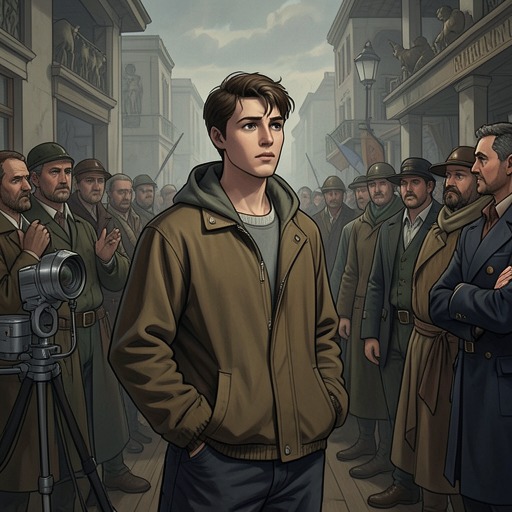
Rivière is introduced among the four young men in one of the blue cars returning toward Dublin after the motor race. He is described as a young electrician of Canadian birth, placing him between the French business world represented by Ségouin and the international circle assembled around the race. The story does not elaborate on his family or earlier life; it identifies him through his profession, his kinship with Ségouin, and the future role awaiting him in Paris.
That future is already taking shape. Ségouin is preparing to start a motor establishment in Paris, and Rivière is to be appointed its manager. The business prospect gives the pair a practical reason for their good spirits beyond the race itself: Ségouin has unexpectedly received orders in advance, while Rivière stands to take responsibility for the new enterprise. His appointment makes him more than a passing guest in the company. He is positioned to share in the commercial momentum represented by the motor cars speeding through Dublin.
In the returning car
The French team has finished strongly, placing second and third, while the winning German car is reported to have been driven by a Belgian. Spectators nonetheless cheer especially for the blue French cars, and their occupants answer with smiles and nods. Rivière rides in one of them as the party returns along the Naas Road, through a city whose poverty and inaction the narrative contrasts with the wealth and industry carried at speed by the Continent.
The car’s motion amplifies the party’s excitement. Ségouin and Rivière sit in front; Doyle and Villona are behind. The Frenchmen toss laughter and quick remarks over their shoulders, while Villona sustains a deep bass hum for miles. Doyle must strain forward to catch the conversation and guess at its meaning amid the wind and engine noise. Rivière is thus part of a group whose ease and speed are exhilarating to Doyle but whose language and social confidence leave him working to keep up.
The story gives Rivière a specific source of satisfaction within this general exhilaration: the expected management post and the promise of Ségouin’s business. The race’s success adds another pleasure, since the cousins welcome the strong showing of the French cars. Together, their prospects connect mechanical spectacle with commercial expansion; the car is both a racing machine and the sign of a business future.
Dinner, conversation, and display
Later, the party gathers for dinner at Ségouin’s hotel, joined by Routh, an Englishman whom Doyle has encountered at Cambridge. In the electrically lit dining room, the young men speak freely across their different interests. Villona praises the English madrigal and laments the loss of old instruments; Rivière takes up the achievements of French mechanicians. His contribution turns dinner conversation toward the engineering culture that complements his own profession and anticipated managerial work.
Ségouin redirects the discussion toward politics, a congenial subject for the whole table. The talk grows intense in the heat of the room, with the possibility of personal spite emerging as the young men argue. Ségouin eventually raises a toast to Humanity and opens a window. Rivière therefore appears not as a fully individualized political spokesman but as one participant in a lively, international exchange, where music, engineering, national accomplishment, and politics compete for the room’s attention.
The dinner also belongs to the wider performance of status that shapes Doyle’s experience. The meal is exquisite, and Doyle admires Ségouin’s command of the conversation, imagining the Frenchmen’s lively youth set within Routh’s more restrained English manner. Rivière’s confident account of French mechanical achievement contributes to that impression of Continental capability. The group’s social world is exciting to Doyle partly because it appears to unite cultural assurance, money, travel, and technical progress.
The yacht and the card game
After the dinner and an evening walk, the group joins Farley aboard his yacht. In the cabin, Villona plays a waltz while Farley dances with Rivière, acting as cavalier and Rivière as lady; the men then improvise a square dance. The scene briefly turns Rivière’s engineering and business identity into a role within the party’s play. He participates in the merriment, and Doyle takes part eagerly, treating the gathering as an experience of the worldly life he wants to see.
The group drinks to Ireland, England, France, Hungary, and the United States, and Doyle gives a long speech to applause. Cards follow. As game after game is played, money and IOUs pass across the cleared table. Doyle cannot tell precisely who is winning, but he understands that he is losing; he often misreads his cards, leaving the others to calculate his IOUs. Rivière is present within this convivial company, but the account does not specify his individual stake, winnings, or losses. The distinction matters: the narrative makes Doyle’s financial exposure clear without assigning Rivière an unsupported result.
The final game becomes a contest between Routh and Ségouin. Villona has gone up on deck, the piano has stopped, and the players rise to play the last tricks. Routh wins, after which the cards are gathered and the winners begin to collect their winnings. Farley and Doyle are the heaviest losers. Rivière’s role remains part of the group’s collective celebration rather than the focus of the financial reversal, but his presence links the night’s risk-taking back to the prosperous, internationally connected company that has captivated Doyle.
Narrative significance
Rivière’s characterization is economical and prospective: profession, birthplace, kinship, appointment, and a brief account of his conversation establish him without granting him an independent plot. The story uses that limited portrait to sharpen its contrast between the mobility of the visitors and the Dublin environment through which they pass. As an electrician destined to manage a Paris motor business, Rivière belongs to the world of technical skill and commercial opportunity that the racing cars make visible.
His connection to Doyle is indirect but consequential. Rivière is one of the young men whose company makes Doyle feel included in a cosmopolitan circle, from the return drive and refined dinner to dancing and late-night cards. The sequence moves from public acclaim for the French cars to private financial exposure at the yacht. Rivière is not identified as the cause of Doyle’s losses, and the text does not disclose his own outcome; his narrative importance lies in the company and promise he represents, against which Doyle’s excitement and inexperience come into view.