Eveline Hill
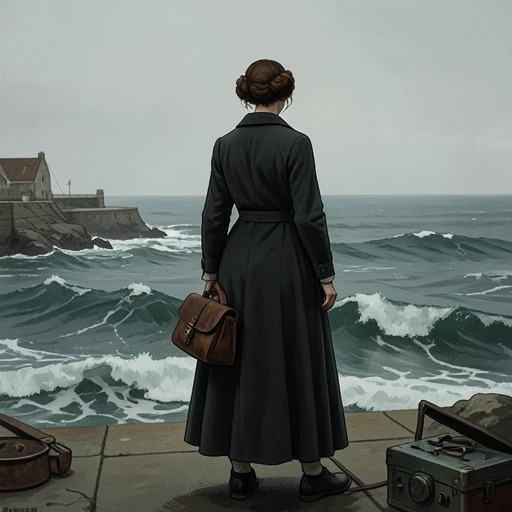
DublinersEveline Hill stands at the threshold of escape from a life of exhausting work and family responsibility, yet cannot leave when departure becomes real. Her planned journey with Frank to Buenos Aires promises marriage and a different future; at the North Wall, however, she remains behind, offering him no sign of recognition or farewell. The story makes that refusal neither a simple choice of safety nor a clear embrace of home: memory, fear, duty, and the uncertainty of the life beyond the harbor converge in her paralysis.
Identity and Background
Eveline is over nineteen and works at the Stores while also carrying much of the responsibility for her household. At the story’s opening, she sits by a window as evening settles over the avenue. Familiar surroundings prompt recollection of childhood: an open field where neighborhood children played has become a row of bright red houses, and the family and neighbors who once filled that landscape have changed or disappeared. Her mother is dead, Ernest is dead, and the Waters have returned to England. Eveline recognizes the passage of time as a force that has altered both the neighborhood and her prospects.
The house she may be leaving is made up of familiar objects she has dusted week after week. Among them are a broken harmonium, a religious print, and a yellowing photograph of a priest whose name Eveline has never learned. Her father’s only comment about him is that he is now in Melbourne. The detail captures the limits of Eveline’s knowledge of the home she has maintained: its furnishings are intimate through repetition, but even the history represented on its walls remains partly inaccessible to her.
Work, Family, and the Cost of Staying
Eveline considers what leaving would mean in practical terms. At home she has shelter and food, as well as the company of people she has known all her life, but she works hard both in the household and at the Stores. She expects that her departure with a man will be judged there, and that her position will be filled. Her employer, Miss Gavan, has repeatedly spoken sharply to her in front of other people, reminding Eveline that paid work has brought not only wages but public humiliation and little security.
At home, Eveline gives her entire weekly wage of seven shillings to her father. He accuses her of wasting money and resists handing over funds for the household; their recurring Saturday-night quarrels have worn her down. In the end he gives her money and asks whether she intends to buy Sunday’s dinner. She then rushes out to shop, carrying her purse tightly through the crowds and returning with provisions. Alongside this routine, she is expected to keep the household together and see that two younger children go regularly to school and receive their meals. The life is difficult, but as departure approaches she cannot regard it as wholly undesirable.
Her father’s behavior makes staying more than a matter of economic strain. Though he did not treat her as he treated her brothers when they were young, he has lately threatened her, invoking her dead mother as the reason he has not acted. Eveline knows that fear of his violence has brought on palpitations. Her brothers cannot offer dependable protection: Ernest is dead, and Harry, who works in church decorating, is usually away in the country. Yet recollection complicates her fear. Her father could be kind; when Eveline was once confined to bed, he read her a ghost story and made toast for her. She also remembers a family picnic on the Hill of Howth, where he put on her mother’s bonnet to amuse the children. Neither the threats nor the tenderness cancels the other.
Frank and the Proposed Escape
Eveline’s plan is to leave on the night boat with Frank, marry him, and live in Buenos Aires, where he says he has a home waiting. She remembers him as kind, manly, and open-hearted. When they first met, he was lodging on the main road and stood at a gate with his cap pushed back. Later he met her outside the Stores each evening and walked her home. He took her to see The Bohemian Girl, an outing that gave her the excitement of being with a suitor in an unfamiliar part of the theatre. Frank enjoyed music and sang; the public knowledge that they were courting, and his singing about a sailor’s sweetheart, left her pleasantly confused. He jokingly called her Poppens.
At first, having a boyfriend was an excitement in itself; affection developed afterward. Frank’s stories also made the relationship an imaginative opening onto distant places. He said he had gone to sea as a deck boy for a pound a month on an Allan Line ship bound for Canada, named vessels and routes he had sailed, and described the Straits of Magellan and the Patagonians. He claimed to have made his way in Buenos Aires and to have returned to Ireland for a holiday. The story presents these accounts as what Frank told Eveline, not as independently confirmed details. Her father discovered the relationship and forbade her to speak to him. After Frank quarrelled with him, Eveline had to meet her lover secretly.
The promised future has powerful attractions: Eveline expects that marriage will bring respect, and that she will not be treated as her mother was. She hopes Frank may give her a life, and perhaps love, as well as a way out of work, financial conflict, and fear. But the plan also asks her to leave the place and people on whom she has spent years of care. The contrast is not simply between an unhappy home and an ideal destination; the home contains affection and familiar shelter as well as danger, while the future rests on Frank’s promises and Eveline’s willingness to depart.
Her Mother’s Promise and the Decision
As evening deepens, Eveline sits with two letters in her lap, one addressed to Harry and one to her father. She notices that her father is getting old and thinks he would miss her. The recollections of his generosity make leaving harder even as his threats and the family’s money disputes make it understandable. Her memories do not resolve the question; they keep both attachment and escape present at once.
A street organ plays an air Eveline recognizes, and she associates it with the last night of her mother’s illness. Her father had ordered the organ player away and given him sixpence; afterward he returned to the sickroom complaining about Italians coming to Ireland. Against this remembered scene, Eveline recalls the promise she made her mother: to keep the home together for as long as she could. Her mother’s life, as Eveline understands it, was marked by ordinary sacrifices and ended in mental collapse. The words her mother repeatedly spoke, “Derevaun Seraun!”, return to Eveline without a settled explanation, intensifying the memory rather than supplying a clear instruction about what she must do.
Eveline rises in sudden terror and thinks of escape. She tells herself she has a right to happiness and imagines Frank taking her in his arms and saving her. The urgency of that resolve is immediately tested at the station. In the crowd at the North Wall, Frank holds her hand and repeatedly speaks about the passage. Soldiers with brown baggage fill the station; through the shed doors, Eveline sees the boat beside the quay, its portholes illuminated. The booked passage makes the choice concrete: if she goes, the next day she will be at sea with Frank, bound for Buenos Aires. She silently prays for God to show her her duty, while distress and nausea take hold. Her earlier declaration of escape has not settled what duty requires.
The North Wall and Narrative Significance
At the decisive moment, Eveline does not board. Frank goes beyond the barrier and calls for her to follow; although he is shouted at to move on, he continues calling. Eveline faces him with a white, passive expression, and her eyes show no love, farewell, or recognition. The story gives no account of what she does after the boat leaves, or of any later explanation between the two. What it does establish is the immediate result: Frank departs without her, and the future she had planned remains unrealized.
Eveline’s ending is shaped by the tension between motion and immobility. Her memories move across a transformed neighborhood, childhood, her mother’s illness, and the courtship that seemed to promise another country; the present narrows to a hand held at the barrier and a boat ready to sail. The repeated ordinary duties that bind her to home have accumulated into an obligation, while the prospect of leaving exposes how little certainty either course offers. Her final stillness does not prove that she freely prefers her existing life or that she has ceased to want happiness. It shows instead that, when the imagined escape becomes an immediate act, her conflicting fears and attachments leave her unable to answer Frank or cross the barrier.