Michael Furey
DublinersMichael Furey is the young man from Gretta Conroy’s Galway past whose memory transforms the final night of her marriage to Gabriel Conroy. Though he appears only through Gretta’s recollection, the song he once sang, his rain-soaked last visit, and his early death unsettle Gabriel’s sense of intimacy and mortality; in the closing snow scene, Furey’s grave becomes part of a landscape binding the dead to the living.
Identity and Background
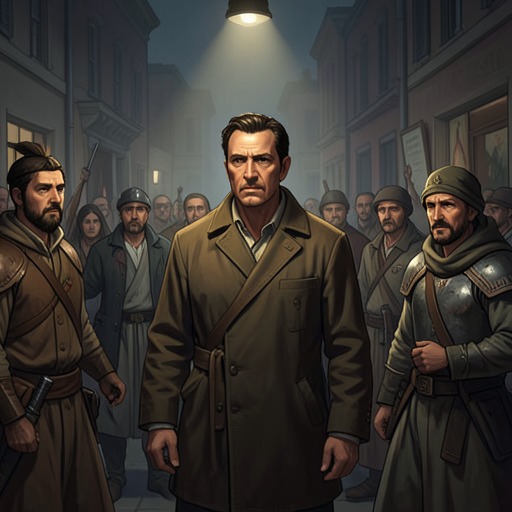
Gretta identifies Furey as a young boy she used to know, named Michael Furey. He was delicate, and she remembers his big, dark eyes and the expression in them. He worked in the gasworks. These few details make him specific without giving him an independent life in the present: the reader encounters him through the vividness and limits of Gretta’s memory.
Furey was seventeen when he died. Gretta’s recollection places him in Galway, where she knew him before leaving for Dublin and entering a convent. His family came from Oughterard, where he was buried. The brief biography that emerges is therefore shaped by separation and early death: a young man with a job and a local home, remembered years later through a song and one desperate night.
The Song and Gretta’s Recollection
At the close of the Morkan sisters’ dance, Bartell D’Arcy sings “The Lass of Aughrim.” The song brings Gretta to tears, and she cannot immediately explain why. When Gabriel asks what is wrong, she names the song as the source of her emotion. She breaks away, runs to the bed, and hides her face across its rail. Her response first appears to Gabriel as a private feeling he cannot read; the song gives that feeling a history.
Gretta explains that Furey used to sing the song. Its return makes the past audible in the present: the voice associated with a young man who has long been dead reaches Gretta through D’Arcy’s performance. Her memory is not a general regret but a set of sharply held impressions—Furey’s face and eyes, the garden, the rain, and the news of his death. The song acts as the thread connecting those separate recollections.
The Last Visit in Galway
Gretta recounts that, before leaving Galway for the convent, she wrote Furey a letter saying she was going to Dublin and hoped to return in the summer, when he might be better. The night before her departure, she was packing at her grandmother’s house on Nuns’ Island when she heard gravel thrown against the window. Because the wet glass prevented her from seeing outside, she ran downstairs, slipped out through the back, and found Furey shivering at the end of the garden.
Gretta implored him to go home, warning that the rain would bring about his death. Furey said he did not want to live. Gretta remembers him standing by the wall, near a tree, and says she can still see his eyes. He did go home. She recalls that, when she had been in the convent only a week, she heard that he had died. He was buried in Oughterard, the place from which his people came. The sequence places his final appearance just before Gretta’s departure and his death soon after it, while leaving the precise cause of death unstated.
Gabriel’s Encounter with Furey’s Memory
Before Gretta names Furey, Gabriel’s attention is caught between jealousy and desire. He asks ironically whether she had been in love with someone, and at first does not want her to think he is interested in the young man. As she tells the story, however, his possessive anger gives way to silence. He listens as Gretta’s grief exposes a part of her past that he had not known and cannot claim as his own.
When Gretta breaks down sobbing, Gabriel holds her hand briefly, then lets it fall and walks quietly to the window, reluctant to intrude on her grief. She soon falls asleep. Lying beside her, he thinks of the image she has kept for years: her lover’s eyes as he said he did not want to live. Gabriel recognizes that he himself has never felt such a passion for any woman, and understands that the feeling must be love. Furey’s story thus changes Gabriel’s understanding of Gretta and of the emotional distance within their marriage, without establishing that her present relationship with Furey’s memory is the same as a continuing romantic attachment.
Death, Memory, and the Snow
Furey is absent from the room, yet Gabriel imagines the form of a young man standing beneath a dripping tree. The image draws on Gretta’s account of Furey waiting in the garden and carries it into Gabriel’s own inward reckoning. As his sense of personal identity fades, he imagines himself approaching the vast company of the dead. Furey is not presented as a supernatural visitor; his presence is the imaginative force of a memory that has passed from Gretta to Gabriel.
Snow begins again outside the window. The closing vision extends from the central plain and the Bog of Allen to the Shannon and then to the churchyard where Furey lies buried. The snow falls on the crooked crosses and headstones, joining the specific grave of a young man to a countrywide image of shared exposure. Furey’s story therefore helps make the ending more than Gabriel’s sudden discovery of a rival: the living and the dead occupy the same field of vision, and the remembered passion that first seemed to exclude Gabriel becomes part of a wider meditation on loss, time, and human vulnerability.