Mrs Kernan
DublinersMrs Kernan is a capable, pragmatic wife and mother whose household labor absorbs the consequences of her husband’s drinking. After Tom Kernan is brought home helpless, she puts him to bed, tends to him, and turns to Martin Cunningham to handle a plan for his religious retreat; her steady care is accompanied by little expectation that her husband will fundamentally change.
Identity and Household Life
Mrs Kernan is a middle-aged woman who has kept house for Tom for twenty-five years. Her two eldest sons have left home: one works in a draper’s shop in Glasgow, the other as a clerk to a tea merchant in Belfast. They write regularly and sometimes send money, while the younger children remain at school. The family’s routines and support therefore rest largely on her continuing work at home.
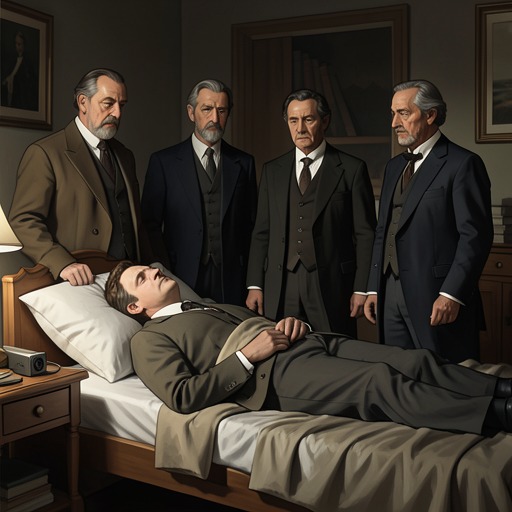
Her practical competence is evident in the aftermath of Tom’s fall. When the car brings him to their small house on the Glasnevin road, she puts him to bed. She then enters the kitchen and explains to Mr Power that Tom has been drinking since Friday. After the visitors depart, she empties her husband’s pockets, a small domestic action that underscores how closely she must attend to the immediate consequences of his condition.
Marriage and Care
The marriage holds both remembered affection and accumulated strain. Not long before the events of the story, Mrs Kernan celebrated the couple’s silver wedding and renewed their intimacy by waltzing with Tom to Mr Power’s accompaniment. She remembers him in their courtship as a gallant figure, smartly dressed when they left the Star of the Sea Church in Sandymount. Yet married life had become irksome to her after only three weeks, and later, as it grew unbearable, motherhood became another part of the life she had to manage.
Her account of the marriage is neither wholly idealized nor wholly rejecting. She accepts Tom’s frequent intemperance as part of the climate, nurses him when he is sick, and tries to ensure that he eats breakfast. She notes that he has not been violent since their sons grew up, and that he remains willing to walk to the end of Thomas Street and back to secure even a small order. These qualifications explain her continued care without erasing the burden his drinking places on the household.
Response to Tom’s Fall
When the friends disclose their plan concerning Tom, Mrs Kernan entrusts the matter to Mr Cunningham. Her confidence is practical rather than enthusiastic: after a quarter-century of marriage, she has few illusions and doubts that a man of Tom’s age will change much before death. She even sees a possible appropriateness in the accident, though she restrains the thought rather than voicing it to the men.
She nevertheless agrees to the proposed religious intervention. In her view, the plan might do good and could at least do no harm. Her response places domestic experience alongside the men’s scheme: she neither expects a transformation nor refuses an effort that might help. Tom’s fall thus brings her familiar work of managing his drinking into contact with the proposed Jesuit retreat.
Faith and Character
Mrs Kernan’s faith is habitual and bounded by everyday life, but it is not absent. She believes steadily in devotion to the Sacred Heart and approves of the sacraments; when pressed, she can also believe in the banshee and the Holy Ghost. The combination presents a religious outlook shaped less by theological argument than by domestic practice and the ordinary demands of family life.
Her steadiness is also marked by restraint. She has entrusted the plan to Mr Cunningham, tends her husband, and continues to manage the household without claiming that these actions will remake him. Mrs Kernan’s role gives the story a practical counterweight to the men’s discussion of reform: the proposed retreat is a new intervention, but the labor of living with Tom’s recurring drinking has long been hers.