Mr Henchy
DublinersMr Henchy is a canvasser in the political gathering depicted in “Ivy Day in the Committee Room,” a figure whose practical fluency makes politics sound less like principle than a sequence of usable arguments. He arrives announcing that there is no money, later claims credit for securing votes, and defends the king’s visit by appealing to capital and employment. His conduct links campaign opportunism to the economic anxieties and partisan talk of Dublin life.
Identity and Entrance
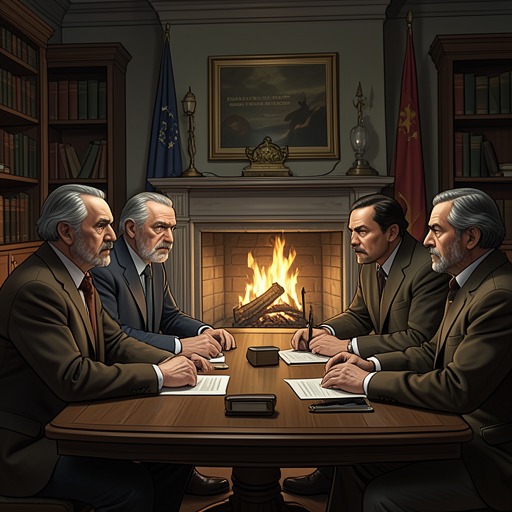
Mr Henchy enters after the room has fallen silent. He is described as a bustling little man with a snuffling nose and very cold ears; he crosses quickly to the fire, rubbing his hands as though trying to make a spark. His first announcement is that there is no money, a blunt reminder of the material limits surrounding the political gathering.
The old man offers him a chair. The scene places him among men who share cigarettes, drink, and political conversation, but his opening remark immediately gives the meeting a transactional edge: the canvassing has to proceed without funds.
Campaign Work and Suspicion
Mr Henchy suspects that Joe Hynes belongs to the opposing camp and may be acting as a spy for Colgan. He proposes that Joe go around to discover how the other side is doing, reasoning that they will not suspect him. His accusation is presented as private and candid opinion, not as established fact; Mr O'Connor counters that Joe is decent, and Mr Henchy concedes that Joe’s father, Larry Hynes, was a respectable man who had done many good turns.
That concession does not dispel Henchy’s distrust. He fears Joe is “not nineteen carat” and condemns what he sees as sponging, distinguishing being hard up from failing to show a “spark of manhood.” The exchange exposes the unstable boundary between political loyalty and personal judgment: Henchy can acknowledge the family’s good name while still treating Joe as a possible instrument of the rival campaign.
Canvassing and Political Argument
After drinks are distributed, Henchy says he has had a good day’s work. He reports that he secured one or two sure votes in Dawson Street with Crofton, but dismisses Crofton as a poor canvasser who cannot sustain conversation. Henchy presents himself as the active persuader: Crofton, he says, merely stands and looks at people while Henchy does the talking.
His account of winning over Ward shows the method. Ward is an old Conservative who asks whether the candidate is a Nationalist. Henchy sidesteps the distinction, describing the candidate instead as respectable, a substantial ratepayer, a property owner, a businessman, and a Poor Law Guardian who belongs to no party. The pitch converts political identity into civic respectability and financial self-interest, tailoring the candidate to an individual voter rather than defending a consistent platform.
When the conversation turns to the address to the King of England, Henchy again argues from practical benefit. He says the country needs capital and predicts that the king’s visit will bring money to Ireland and benefit Dublin’s citizens. He points to idle factories by the quays and names the mills, shipbuilding yards, and factories as industries that could be working. In this account, economic renewal is the central case for welcoming the visitor.
Nationalism, Opportunism, and Character
Mr O'Connor invokes Parnell against the proposed welcome. Henchy replies that Parnell is dead and shifts attention to the king as a living political visitor: he depicts him as a decent man who means well and frames the visit as friendly, making refusal seem like an insult. He then seeks Crofton’s agreement, turning his argument into a bid for assent from the men present.
The contrast between Henchy’s canvassing and his defense of the king gives the scene its political irony. He has just described winning a Conservative vote by suppressing the candidate’s Nationalist identity; now he urges accommodation with the English monarch in the name of investment and employment. The evidence does not establish that his economic case is insincere, but it shows how readily he makes political language serve persuasion. His defining skill is not doctrinal consistency but adaptation: he finds the appeal most likely to move a particular listener, whether that appeal is respectability, rates, industry, or a friendly royal visit.