Mahony
DublinersMahony is the narrator’s companion in the schoolboys’ day of truancy in “An Encounter,” a boy whose confidence and appetite for rough play help turn a carefully planned escape into a series of improvised adventures. He follows the outing through after Leo Dillon fails to appear, but the day dwindles short of its promised destination; when an old man unsettles the narrator, Mahony’s presence becomes a source of relief as well as companionship.
Identity and Background
The narrative identifies Mahony by name but offers little information about his family or life beyond school. He is one of two boys who join the narrator in planning a day away from lessons shortly before the summer holidays. The boys each save sixpence, agree to meet at ten on the Canal Bridge, and arrange excuses for their absences: Mahony’s big sister is to write one for him, while Leo Dillon is to have his brother report him sick. Their plan is to travel along the Wharf Road, cross by ferry, and walk out to the Pigeon House.
The narrator’s school world is associated with discipline and prescribed study, while the boys’ idea of escape is fed by stories of the Wild West and a hunger for “real adventures.” Mahony shares the practical plan, but the narrative distinguishes his direct, physical enthusiasm from the narrator’s more reflective account of what the outing means. He is introduced not through a description of his home or private thoughts, but through his readiness to set out and the objects and games he brings along.
The Outing and Its Improvised Adventures
The narrator reaches the Canal Bridge first and waits for the others. Mahony arrives in a grey suit, smiling, and climbs up beside him. From his inner pocket he produces a catapult, whose improvements he explains; he says he has brought it to have some gas with the birds. The weapon establishes the outing’s playful, mock-adventurous character before the boys have even left the bridge. Mahony also speaks freely in slang, calling Father Butler Old Bunser, and is at ease treating school authority as something remote from the day’s excursion.
After a further quarter-hour without Leo Dillon, Mahony decides to leave. He calls Leo a coward and says that his missing sixpence is forfeited, so the two boys have more money between them. Leo’s absence changes the plan: their proposed siege at the Smoothing Iron fails because, as they recognize, it needs at least three. They turn the disappointment into a joke at Leo’s expense, imagining the punishment he will receive from Mr Ryan at three o’clock. Mahony’s response to the failure is not to abandon the outing, but to adapt it around the companion who has actually arrived.
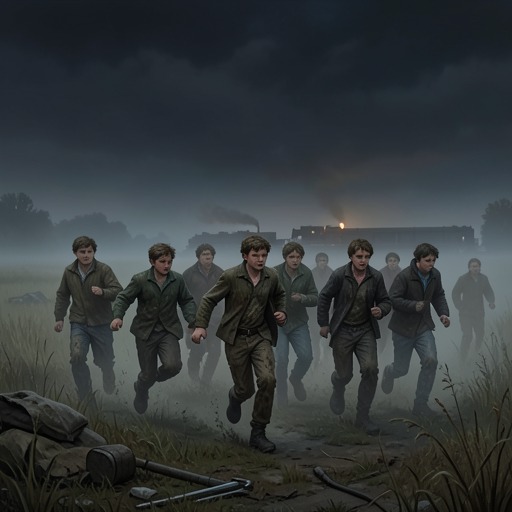
On the North Strand Road and Wharf Road, Mahony begins playing at being an Indian once the boys are out of public sight. He chases a crowd of ragged girls, brandishing his unloaded catapult. When two ragged boys throw stones at them, apparently out of chivalry, Mahony proposes that he and the narrator charge them. The narrator objects that the boys are too small, and they continue walking as the ragged group shouts “Swaddlers!” after them, mistaking them for Protestants because Mahony wears the silver badge of a cricket club in his cap. Their mock combat and the actual hostility of the roadside encounter sit side by side: the catapult is unloaded, while the stones are not imaginary.
The boys’ journey also brings them into contact with the working city. Near the river, they pass noisy streets enclosed by high stone walls, watch cranes and engines, and are shouted at by drivers whose carts groan past. At noon they buy two large currant buns and eat beside the river on metal piping. They watch the barges, the fishing fleet beyond Ringsend, and a large white sailing ship being unloaded. Mahony imagines running away to sea; for the narrator, the ships make the geography learned in school seem to take shape before his eyes. School and home seem to recede as the boys move through the waterfront, but this temporary freedom remains bounded by the need to return before their absence is discovered.
Ringsend and the Failure of the Plan
After crossing the River Liffey by ferry, the boys watch the same three-masted ship being unloaded from the opposite quay. They hear that it is Norwegian. The narrator tries unsuccessfully to decipher its name and studies the sailors, whose eyes are blue, grey, or black; one tall sailor repeatedly calls “All right!” as the planks fall. These details prolong the boys’ fascination with ships and foreign travel, the outward-looking promise that first made the outing feel larger than school routine.
In Ringsend, heat and fatigue begin to replace the morning’s excitement. The boys buy biscuits and chocolate from grocers’ shops and eat as they walk through the squalid streets where fishermen’s families live. Unable to find a dairy, they buy a bottle of raspberry lemonade each from a huckster’s shop. Mahony briefly revives the game by chasing a cat down a lane, but it escapes into a wide field. The episode repeats the day’s pattern in diminished form: pursuit and play remain available, yet they do not deliver the destination or transformation the boys had imagined.
By the time they reach the field, they are too tired and it is too late to carry out their plan to visit the Pigeon House. They must be home before four, so the secret excursion cannot be extended without risking discovery. Mahony looks regretfully at his catapult. The narrator suggests taking the train home, and this practical proposal restores some cheerfulness to Mahony. The ending of the outing is not a dramatic return from an achieved adventure, but the recognition that the boys’ energy and timetable have overtaken their ambition. Clouds cover the sun, and they are left with tired thoughts and crumbs from their provisions.
The Old Man and Mahony’s Importance
The narrator and Mahony lie on a bank overlooking the Dodder. A shabby, grey-moustached old man approaches, passes them, then turns back and slowly retraces his steps, tapping the turf with a stick. He sits near the boys and begins a long conversation. In the surviving scene, Mahony’s most consequential actions are not another chase or challenge: he stays present while the narrator listens, and later calls attention to the old man’s conduct. When Mahony exclaims, “I say! Look what he's doing!”, the narrator neither answers nor raises his eyes. Mahony then calls the man a queer old josser.
The narrator eventually stands and pretends to adjust his shoe before leaving. Afraid that the old man might seize him by the ankles, he walks up the slope and calls “Murphy!” in a show of forced bravery. He has to call again before Mahony sees him and answers. Mahony runs across the field as if coming to help. The narrator feels penitent, recognizing that he has always despised Mahony a little. That admission alters their relationship in the narrator’s telling: Mahony, earlier treated as a rougher, less thoughtful companion, becomes the person whose response the frightened boy needs. His loyalty is conveyed not by a declaration but by the act of running to meet him.
Mahony’s role is therefore both practical and structural. He is the companion who makes the escape possible after Leo Dillon’s withdrawal, supplies its recurring play with the catapult, and adapts when the boys’ plans fail. But the outing does not grant the unfettered adventure the narrator seeks. Its momentum moves from mock warfare and ships toward tiredness, a missed destination, and unease in the field. Mahony’s response at the end gives the narrator a human reassurance that the imagined adventures and games have not supplied: when the narrator calls, his companion comes.