Polly Mooney
DublinersPolly Mooney, the nineteen-year-old daughter of Mrs Mooney, lives in her mother’s boarding house, where her flirtation with a lodger develops into an affair and a marriage crisis. Her position is shaped both by her mother’s calculated management of the household and by the limited choices available to a young woman whose reputation, work, and future depend on how men respond to her. When her mother summons Bob Doran, Polly waits for the outcome with a composure that suggests hope has begun to eclipse alarm.
Identity and Background
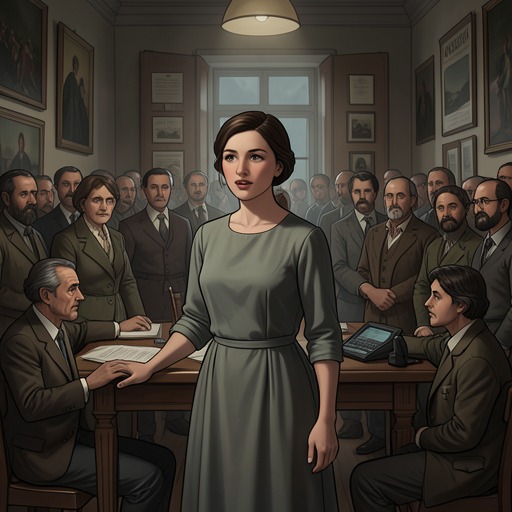
Polly is described as slim, with light, soft hair, a small full mouth, and grey eyes shaded with green. Her eyes tend to glance upward as she speaks, lending her the appearance of a little perverse madonna. The contrast in that description captures the story’s divided presentation of her: she is young and seemingly innocent, yet also a lively participant in the boarding house’s social and erotic life.
Her mother first sent her to work as a typist in a corn-factor’s office. That arrangement ended after a disreputable sheriff’s man came repeatedly to the office asking to speak to Polly’s father. Mrs Mooney brought her daughter home and set her to housework. She intended Polly to have the run of the young men who lodged there, reasoning that their proximity to a young woman would appeal to them. Polly flirted with the lodgers, but Mrs Mooney initially considered their attention casual: none, she believed, meant to marry her daughter.
Polly also performs at the boarding house’s Sunday-night gatherings, where music-hall entertainers oblige and Sheridan plays waltzes and polkas. Her song, “I'm a ... naughty girl. / You needn't sham: / You know I am,” gives her a public voice that knowingly plays with sexual reputation. The performance belongs to a sociable household in which flirtation and entertainment are visible, even as the serious consequences of intimacy remain governed by respectability and marriage.
Life in the Boarding House
The lodgers pay fifteen shillings a week for board and lodging, with beer or stout at dinner excluded. They share tastes and occupations, talk over the prospects of favourites and outsiders, and are described as being very chummy. Their Sunday-night reunions bring this male social world into the front drawing-room. Polly is part of its entertainment, but she is also the young woman around whom her mother has organized the household’s prospects.
Mrs Mooney does not immediately object when Polly flirts. She is a shrewd judge of the lodgers and understands that their attention is ordinarily only a way of passing the time. Her view changes when she notices something developing between Polly and one of the young men. She watches the pair without speaking, while the people in the house begin to talk about the affair. Polly knows that her mother is observing her, but Mrs Mooney’s silence is not an open agreement; it is an unspoken tolerance that leaves the situation unresolved until her mother judges the moment ripe for intervention.
This household arrangement makes Polly’s position particularly exposed. She is neither simply an employee nor an independent visitor: her mother has brought her home, assigned her domestic work, and allowed her to circulate among the lodgers. The same roof that enables the relationship also gives Mrs Mooney the authority to confront the man involved and to frame the affair as an abuse of her hospitality.
Relationship with Bob Doran
The young man involved is Bob Doran, a lodger whom Mrs Mooney judges to be thirty-four or thirty-five. In her account, he cannot excuse himself by appealing to youth or ignorance: he has seen something of the world, lived under her roof, and taken advantage of Polly’s youth and inexperience. Mrs Mooney therefore treats the relationship not as a private attachment between equals but as a matter requiring reparation. The story does not provide a direct account of how Polly and Bob first became involved; instead, their intimacy is disclosed through the mother’s inquiries, the household’s gossip, and Bob’s apprehension.
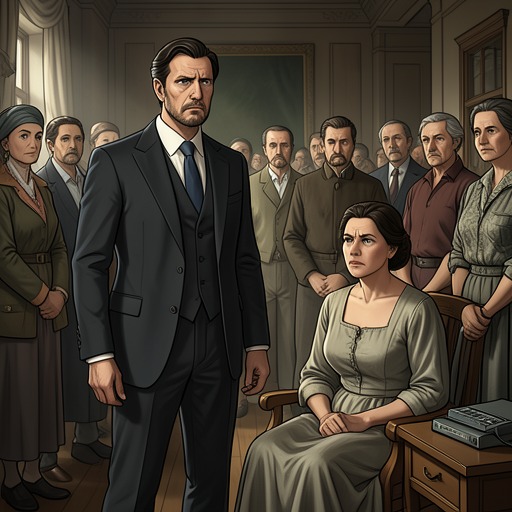
Polly knows that her mother has been watching. When she and Mrs Mooney discuss the situation, both are frank, but both are awkward. Mrs Mooney does not want to seem to receive the news too cavalierly or to imply that she connived in the affair. Polly, in turn, does not want her mother to think that she understood the intention behind her earlier tolerance. Their conversation exposes a delicate imbalance: the mother has allowed the circumstances to develop without an explicit agreement, while the daughter must now account for what has happened within terms the mother controls.
On the morning of the confrontation, Polly goes to Bob’s room and tells him that she has told her mother everything and that Mrs Mooney will speak with him. She throws her arms around his neck, cries, and asks what she is to do; she says she will put an end to herself. Her distress makes the prospect of the interview immediate and personal for Bob. As he goes downstairs, his glasses grow dim with moisture and he has to remove and polish them. He longs to escape to another country, yet feels himself pushed step by step toward the conversation with Mrs Mooney.
The household’s menacing social context sharpens that pressure. Bob passes Jack Mooney, Polly’s brother, on the stairs. Bob remembers an earlier gathering when a music-hall performer made a free allusion to Polly and Jack threatened violence, saying that anyone who played such a game with his sister would have his teeth put down his throat. The memory gives Bob a concrete reason to fear the family’s response, even as Mrs Mooney’s case rests on social opinion and the lodger’s breach of hospitality.
Waiting and the Marriage Crisis
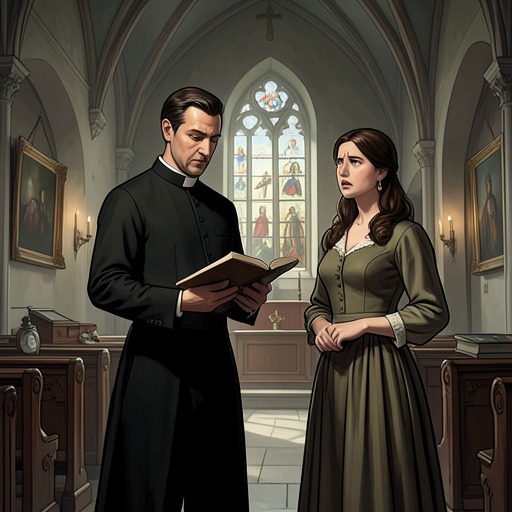
After telling Bob, Polly returns to her room and cries for a time. She then dries her eyes, refreshes them with water from the jug, looks at herself in the mirror, and adjusts a hairpin above her ear. She sits at the foot of the bed, gazing at the pillows; they awaken secret, amiable memories. Resting her neck against the cool iron bed-rail, she falls into a reverie. By the time her mother calls, the disturbance has disappeared from her face.
Her waiting changes in tone. Polly sits patiently, almost cheerfully and without alarm, while memories give way to elaborate hopes and visions of the future. So absorbed does she become that she no longer sees the pillows on which she has fixed her gaze or remembers that she is waiting at all. The movement from tears to imaginative absorption does not settle the outcome, but it shows how completely the coming decision governs her horizon: what follows depends on the man summoned to speak with her.
At last Mrs Mooney calls from below and tells Polly that Bob wants to speak to her. Polly runs to the banisters, answers her mother, and only then remembers what she has been waiting for. The ending leaves the marriage crisis unresolved on the page. It gives no account of the ensuing conversation or of Polly’s later life; instead, it closes on the moment when her mother’s summons turns private anticipation back into an immediate decision.
Narrative Role and Significance
Polly’s story is organized around a threshold between tolerated flirtation and public consequence. Her mother’s delay is as consequential as her eventual intervention: Mrs Mooney watches, keeps silent while the household talks, questions Polly, and then calls Bob to account at a time she considers advantageous. Polly is present in each change of pressure, but the decisive terms of the confrontation are set by her mother and the social judgement that Mrs Mooney invokes.
The narrative also places Polly between performance and vulnerability. Her song makes mischievous play of the label of a naughty girl; her tears to Bob, by contrast, convey fear and dependence at the point when the affair can no longer remain private. Her subsequent calm is not proof that the crisis has passed. The careful washing and rearranging of her appearance, her gaze at the pillows, and her future-directed reverie register a turn toward hope while leaving its object unspecified. Polly’s final response to the summons preserves that uncertainty: she has been waiting for a decision, but the story stops before revealing what it will be.