Martin Cunningham
DublinersMartin Cunningham is an influential, intelligent friend of Tom Kernan whose practical authority makes him the chief organizer of a plan to bring Kernan back into religious practice. In a story where Catholic devotion is presented alongside domestic habit and social maneuvering, Cunningham acts as the capable intermediary: his good sense earns trust, while the friends’ concealed scheme gives that trust a calculated edge.
Identity and Reputation
Cunningham is an elder colleague of Mr Power and a man whom his friends respect. The narrator describes him as thoroughly sensible, well informed, and naturally astute; his understanding of people has been sharpened through long association with police-court cases and tempered by brief encounters with general philosophy. His friends defer to his opinions, and even his face is said to resemble Shakespeare’s. The comparison contributes to his public stature, though the qualities that matter most to the plot are practical judgment and persuasive competence.
Domestic Experience and Practical Authority
Cunningham’s private life is not happy. He married a woman described as unpresentable and incurably alcoholic, and he established a household for her six times; each time, she pawned the furniture. This history gives his steadiness a hard-earned quality, without making him a simple moral exemplar. The narrative sets his sympathetic reputation beside the repeated damage in his own home, presenting a man whose experience of disorder coexists with an ability to manage other people’s difficulties.
The Plan for Tom Kernan
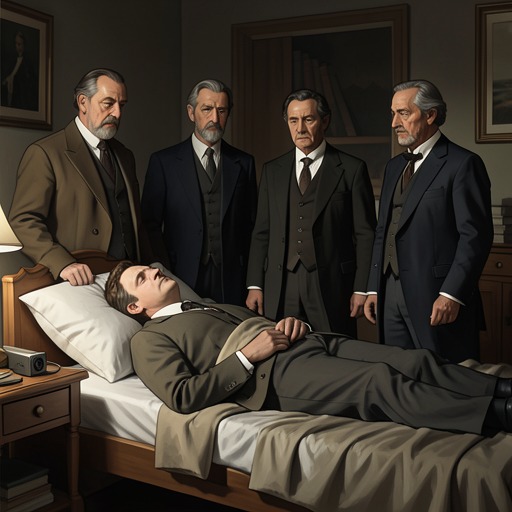
When Kernan is recovering in bed after an accident, Cunningham’s friends have already disclosed their plot to Mrs Kernan in the parlour. Mr Power conceived the idea, but its development was entrusted to Cunningham. The plan responds to a particular religious history: Kernan came from a Protestant family, converted to Catholicism when he married, and had remained outside the Church for twenty years. He was also fond of making pointed remarks against Catholicism. Cunningham’s task is therefore not simply to arrange a visit, but to guide a skeptical and long-lapsed man toward a retreat without letting him see the friends’ design.
Mrs Kernan accepts Cunningham’s direction, telling him, “I leave it all in your hands, Mr Cunningham.” Her confidence rests on his capability, but her support is unsentimental. After twenty-five years of marriage, she has few illusions about her husband changing, and she sees religion as a habit; nevertheless, she thinks the scheme may do good and cannot do harm. Cunningham’s organizing role thus depends on the assent of a wife who is realistic about the limits of both marriage and religious reform.
Persuasion and Narrative Role
Kernan does not know that he has become the subject of his friends’ plan. When Mr Power finally states, “To tell you the truth, Tom, we're going to make a retreat,” Cunningham reinforces the proposal with a homely metaphor about washing the pot. The shift from concealment to direct disclosure marks the practical culmination of the scheme: Cunningham has helped bring Kernan to the moment when the retreat can be named plainly. The evidence establishes the proposal and Cunningham’s central part in arranging it, rather than detailing a completed spiritual transformation.
Cunningham’s character is shaped by the contrast between his sound reputation and the discreet manipulation through which he serves his friends’ religious purpose. He is neither shown as a detached theologian nor reduced to a joke about hypocrisy: his knowledge is social and practical, and his credibility makes the intervention possible. The story leaves the outcome open, so his significance lies chiefly in the effort to turn friendship, persuasion, and everyday good sense toward a man who has long kept the Church at a distance.