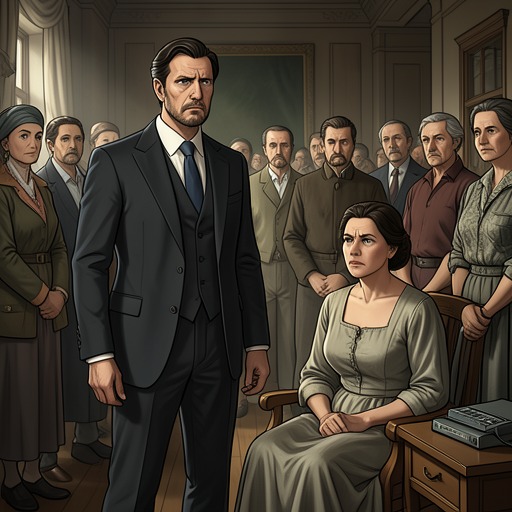
Mrs Mooney
DublinersMrs Mooney, known to the young men in her Hardwicke Street boarding house as “The Madam,” is a determined businesswoman who turns experience of domestic violence and financial ruin into a talent for managing other people’s conduct. In her dealings with her daughter Polly and lodger Bob Doran, she combines maternal concern, social calculation, and control of the house: after quietly observing their intimacy, she decides that marriage is the only reparation and summons Doran to speak with Polly.
Identity and Background
Mrs Mooney is the daughter of a butcher. She married her father’s foreman and opened a butcher’s shop near Spring Gardens, but after her father died her husband began drinking, taking money from the till, and accumulating debt. Attempts to make him take the pledge failed; he resumed drinking within days. His fights with her in front of customers and his purchase of bad meat damaged the business, while one night he went at her with a cleaver, forcing her to sleep at a neighbour’s house.
The marriage ended in separation. Mrs Mooney went to a priest and obtained a separation with care of the children. She refused her husband money, food, and lodging, and he eventually enlisted as a sheriff’s man. The account presents her response as firm and practical: she removed what remained of her money from the butcher business and established a boarding house rather than continue to support a husband whose drinking and violence had wrecked their livelihood.
The Boarding House and Its Rules
Mrs Mooney’s boarding house on Hardwicke Street has a shifting population of visitors from Liverpool and the Isle of Man, as well as occasional music-hall performers, alongside resident clerks from the city. She governs it “cunningly and firmly,” knowing when to extend credit, when to be stern, and when to let matters pass. The resident young men’s nickname for her, “The Madam,” registers the authority she exercises over the establishment.
The household has both economic and social routines. Lodgers pay fifteen shillings a week for board and lodging, with beer or stout at dinner excluded. They share interests, talk about likely winners and outsiders, and gather on Sunday nights in the front drawing-room. Music-hall performers entertain; Sheridan plays waltzes and polkas and supplies accompaniments, while Polly sings. Mrs Mooney’s house is therefore not only a business but a closely observed social world, where flirtation, gossip, money, and reputation meet under her roof.
Her authority also rests on intimate knowledge of the people who live there. The young men pass time with one another, but she distinguishes their casual flirtations from serious intentions. That ability to read the household becomes decisive when one relationship ceases to look like harmless amusement. She does not announce her suspicions or act on the first hint; she watches until she believes the situation has reached the point at which intervention will work.
Polly and Bob Doran
Mrs Mooney first sent Polly to work as a typist in a corn-factor’s office. She withdrew her after Polly’s father repeatedly came to the office asking to speak to her, and put her to housework instead. Because Polly was lively, her mother allowed her to mix with the young male lodgers. She understood that they enjoyed having a young woman nearby, but judged that none of them meant serious business.
That assessment changes when she notices that something is happening between Polly and Bob Doran. Mrs Mooney watches the pair and keeps her own counsel. Polly knows she is being watched, yet her mother’s persistent silence communicates that she has not mistaken the situation. There is no explicit agreement between them and no open complicity; meanwhile, other people in the house begin talking about the affair. Polly grows strange in her manner, and Doran is visibly perturbed. Mrs Mooney delays until she judges the moment right, then intervenes with the decisiveness of someone who treats a moral problem as something to be cut through.
The choice of Doran matters to her calculation. He is thirty-four or thirty-five, so she considers him too old to claim youth as an excuse, and too experienced to plead ignorance. He has been employed for thirteen years in the office of a Catholic wine merchant. Mrs Mooney expects that public exposure could cost him his position, while the lodgers already know something of the affair and some have invented details. She considers him serious and unlike the louder, more rakish young men, and believes he will not want publicity. She also knows he has a good salary and suspects he has savings.
The Marriage Demand
On a bright Sunday morning, after breakfast, Mrs Mooney sits watching the servant Mary clear the table. She has Mary collect the broken bread for Tuesday’s bread pudding and puts the sugar and butter under lock and key. These small acts of household economy accompany her private review of the previous night’s interview with Polly. Mother and daughter had both answered frankly, though awkwardly: Mrs Mooney did not want to appear to have welcomed the news too casually or to have connived in it, and Polly did not want her mother to think she had understood the purpose behind her tolerance all along.
Mrs Mooney checks the gilt clock when the bells of George’s Church stop. It is seventeen minutes past eleven, leaving time to confront Doran and catch the short twelve at Marlborough Street. The timetable sharpens the scene’s sense of purposeful management: she has settled on her course and has a particular window in which to pursue it. She expects social opinion to support her as an outraged mother, since she had allowed Doran to live beneath her roof on the assumption that he was a man of honour.
For Mrs Mooney, the affair imposes unequal costs. A man can leave after his pleasure, she reasons, while a girl must bear the consequences. Though she knows of mothers who accept money to patch up such affairs, she rejects that option. In her judgment, only marriage can make reparation for what Polly has lost. This demand is both a defence of her daughter’s standing and a means of converting the lodger’s vulnerability to scandal into a definite outcome.
She counts her advantages before sending Mary upstairs to Doran’s room. She thinks that a less serious or less vulnerable man would make the task harder; Doran’s age, employment, reputation, and possible savings all weigh in her assessment. She also considers herself better placed than mothers who cannot arrange a future for their daughters. The narration thus shows her maternal purpose intertwined with a practical appraisal of leverage: she wants a remedy for Polly, and she has deliberately chosen the moment and the terms on which to seek it.
Decision and Narrative Significance
After reviewing her position in the pier-glass, Mrs Mooney is satisfied with the decisive expression on her face. She sends Mary to tell Doran that she wishes to speak with him. When she later calls Polly downstairs because Doran wants to speak to her, Polly remembers what she has been waiting for. The summons marks the point at which Mrs Mooney’s silent observation becomes an open confrontation and the marriage question passes from calculation to action.
Mrs Mooney’s methods are shaped by her past without being reduced to it. Having watched a husband destroy a business through drinking, debt, and violence, she now controls a household through money, rules, timing, and close attention to reputation. Her comparison between handling moral problems and cutting meat recalls both the butcher’s shop she once ran and her unsentimental willingness to act. At the same time, her decision is not simply an exercise of power: she insists that Polly, rather than Doran alone, bears the lasting consequences of the affair.
The boarding house makes private conduct visible and gives Mrs Mooney the information and leverage she uses. Its residents gossip; Doran’s job and standing are exposed to the possibility of publicity; and the mother who governs this small community turns its social knowledge toward a settlement. The episode’s tension lies in the double character of her intervention: it can be read as protection for her daughter and as a carefully staged negotiation in which marriage is the only acceptable answer. What is clear is that Mrs Mooney does not leave the matter to chance. She watches, weighs the available pressures, sets her deadline, and acts.