Corley
DublinersCorley is one of the two gallants whose Sunday walk in Dublin turns into a display of self-assurance, social opportunism, and calculated pursuit. The son of a police inspector, he carries himself like a man accustomed to authority, yet his account of his dealings with a young woman and the gold coin he finally shows Lenehan reveal how his confidence depends on extracting material favors from others.
Identity and manner
Corley is physically imposing and conspicuous. He has inherited his father’s frame and gait, walks erect with his hands by his sides, and habitually swings his head from side to side. His large head, oily hair, and round hat contribute to a presence that is difficult to overlook. On this evening he wears a jaunty air, but the narration’s attention to his bulk and movement also shows how much of his authority is performed through sheer physical presence.
His manner is self-centered and assured. Corley speaks at length about his own conversations and decisions, often without listening to his companions, and likes to deliver final judgments. He presents himself as an insider who knows how affairs work. When he is about town, friends are ready to pass him word of a vacant job, and he is often seen talking earnestly with plain-clothes policemen. These associations suggest access and familiarity, but not secure employment: his position remains dependent on other people’s assistance.
The story he tells Lenehan
As the walk begins, Lenehan has just listened to Corley’s long monologue. When asked where he met the young woman, Corley recounts an encounter on Dame Street beneath Waterhouse’s clock, followed by a walk near the canal. He says she told him she worked as a servant in a house on Baggot Street. He describes meeting her again by appointment the following Sunday and going with her to Donnybrook.
Corley’s account is notably transactional. He says that she brought him cigarettes, paid his tram fare, and later supplied cigars. He also says he feared she might become pregnant, then dismisses the concern by saying she knows how to avoid that outcome. The exchange places the young woman’s provisions and his own advantage at the center of his story, while revealing little about her perspective or intentions.
He has told her that he is out of work and claims to have a position at Pim’s. He also admits that she does not know his name. Corley explains this as a way of protecting his supposed class standing, while insisting that she considers him a man of some distinction. His story therefore exposes a gap between the social identity he performs and the insecurity he conceals: he is unemployed, relies on connections when jobs become available, and sustains his image through claims the young woman cannot verify.
The encounter in the street
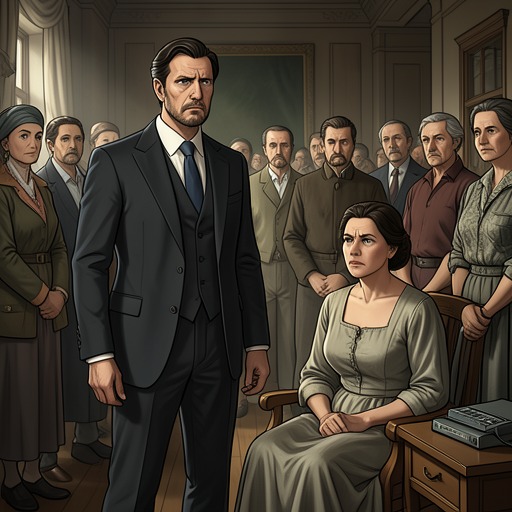
The two men see the young woman standing at a street corner in a blue dress and white sailor hat, holding a sunshade. Lenehan asks to look at her, while Corley approaches her without first offering a formal greeting and begins speaking. She swings the sunshade more quickly, turns on her heels, and sometimes laughs when he speaks close to her. Corley’s size and easy pace lend his approach an air of command; the scene does not establish what she makes of the encounter beyond her visible gestures.
Lenehan watches from a distance, then inspects the woman as she stands near Corley. He notices her Sunday clothes, including a blue serge skirt, a black jacket, a ragged boa, and red flowers. His scrutiny makes the encounter a spectacle shared by the two men: Corley engages her, while Lenehan observes and evaluates her appearance. Corley’s behavior fits his habit of making himself the center of events, but the woman’s position in the scene remains distinct from the story he later tells about her.
When Corley and the woman walk away together, Lenehan waits nearby. His attention shifts from the moon and the harpist’s music to uncertainty about whether Corley will succeed or has simply left him behind. He worries that Corley may have taken another route and abandoned him, and burns his last cigarette while watching the trams. Their partnership is therefore unequal in the moment: Corley controls the encounter, while Lenehan is left to wait for its result.
The coin and the ending
At last Lenehan sees Corley and the woman returning. Their quick pace and lack of conversation lead him to conclude that Corley has failed. They turn down Baggot Street, and the woman goes down the steps into a house’s area. Corley remains outside. After several minutes the hall door opens cautiously; a woman comes down the steps, coughs, and approaches him. His broad figure briefly obscures her from view, after which she runs back up the steps and the door closes. Corley then walks briskly toward Stephen’s Green.
Lenehan follows and asks whether Corley tried with her. Corley does not answer directly. At a street lamp he stops, stares ahead, and extends his hand toward the light. He opens it slowly to show Lenehan a small gold coin. That silent reveal resolves the episode’s suspense: despite Lenehan’s expectation of failure, Corley has obtained money from the woman. The scene confirms the result through an object rather than an explanation, leaving the precise exchange unstated.
Relationships and narrative significance
Corley’s relationship with Lenehan combines companionship with unequal control. Lenehan listens to his stories, laughs at them, offers him a cigarette, and waits anxiously while Corley pursues the encounter. Corley, in turn, often speaks without attending to what his companion says. The coin becomes the answer Lenehan has been waiting for, but Corley offers it as a display rather than an account of what happened.
The episode links Corley’s social confidence to a more precarious reality. He moves through Dublin with the manner of a conqueror, claims knowledge of how affairs are settled, and presents himself to the young woman as a man of class. Yet his employment is uncertain, and the closing proof of his success is a coin received from someone else. His character is shaped by this contrast between authority as appearance and advantage as a practical, immediate gain; the story leaves the young woman’s motives and the full terms of the exchange undisclosed.