Ignatius Gallaher
DublinersIgnatius Gallaher, a former Dublin acquaintance of Little Chandler, returns after eight years as a journalist on the London Press, carrying the visible signs and practiced confidence of a man who has travelled and prospered. At Corless’s, he turns their reunion into a performance of worldly experience: Parisian gaiety, continental vice, and plans to marry for money. His success unsettles Chandler, who sees in Gallaher both a possible model of escape and a patronizing reminder of his own constrained life. Gallaher’s decisive significance lies in that contrast: he seems to have got on, but the freedom he celebrates is inseparable from self-display, calculation, and a refusal of lasting commitment.
Identity and Background
Eight years before the reunion, Little Chandler had seen Gallaher off at the North Wall and wished him godspeed. The friend who then appeared shabby and necessitous has since become a notable figure on the London Press. Chandler recognizes the change immediately in Gallaher’s travelled air, well-cut tweed suit, and fearless accent. He also believes that Gallaher possessed talent even in his earlier, rougher circumstances, and thinks his friend deserved his success. The reunion therefore begins with sincere admiration as well as the envy that will later surface.
Gallaher’s route to success has not been presented as uncomplicated. Chandler remembers that people called him wild: he mixed with a rakish set, drank freely, and borrowed money widely. One account of his departure connected him with a shady money transaction, although Chandler acknowledges that this was only one version of what happened. The uncertainty matters: Gallaher’s polished London standing is visible, while the circumstances of his escape from Dublin remain a matter of rumor rather than settled fact. His talent and nerve, rather than a clean or fully known past, form the explanation Chandler accepts.
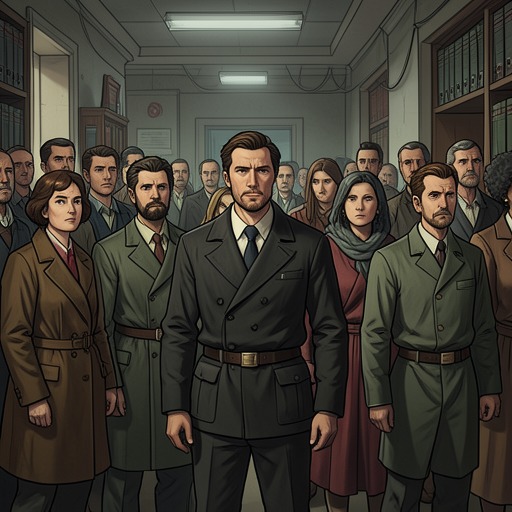
The story renders Gallaher through Chandler’s attentive, admiring perspective, so his public image arrives already shaped by comparison. At Corless’s, Gallaher is physically marked by the close-cropped head he exposes while joking about thinning hair, a heavy pale face, slate-blue eyes, and a vivid orange tie. The self-mocking gesture does not puncture his authority for long; it lets him manage the impression he makes. His ease in the bar, his strong drink, and his cigar reinforce the contrast with Chandler’s delicate, abstinent manner.
The Reunion and Its Performance
Chandler’s thoughts have revolved around the meeting since lunchtime, and he approaches Corless’s with both attraction and apprehension. The room’s lights and noise briefly confuse him; the red and green glasses seem to make the bar full of people watching. Once his sight clears, he finds Gallaher leaning against the counter, feet planted wide. Gallaher immediately takes charge of the encounter, greeting Chandler familiarly, choosing whisky, and ordering two drinks. His brisk hospitality makes the reunion feel effortless on his side, while Chandler has had to overcome indecision simply to enter.
Gallaher describes the pressures of press work as a life of hurry, searching for copy, and having to produce something new. He says he is glad to be back in Ireland for a holiday and feels better since landing in Dublin. His account complicates the apparent glamour of his London position: success has given him movement and status, but he presents the work itself as exhausting. Even so, the contrast remains vivid to Chandler, who has spent his day at tiresome writing in the King's Inns while imagining Gallaher’s far larger world.
Gallaher needles Chandler about his seriousness, recalling that Chandler used to lecture him on Sunday mornings when he had a sore head. He urges him to knock about in the world and asks whether he has travelled even for a trip. Chandler can name only the Isle of Man, a small answer that prompts Gallaher’s laughter. The exchange makes travel more than a topic of conversation: it becomes a measure of divergent lives, with Gallaher speaking from experience and Chandler exposed as someone whose movement has been slight.
When Chandler asks whether Paris is truly as beautiful as people say, Gallaher pauses over the word and distinguishes scenery from urban life. Paris, he says, is defined by gaiety, movement, and excitement. He recounts visits to the Moulin Rouge and Bohemian cafés, calling them unsuitable for a pious person like Chandler. The teasing establishes Gallaher as the guide to forbidden pleasures and Chandler as the sheltered listener. Gallaher’s authority depends partly on having been there, but also on making his experience vivid enough to dominate the conversation.
Over cigars, Gallaher broadens the performance from travel to sexual and social corruption. He claims to have heard of, and personally known, cases of immorality. In a calm, almost historical manner, he sketches the vices of various capitals, seeming to give Berlin the highest place, while distinguishing things he can attest to from stories supplied by friends. He also describes secrets of religious houses on the Continent and practices in high society, ending with a detailed story about an English duchess that he says is true. Chandler is astonished; Gallaher closes the contrast by casting Dublin as a place where such matters are unknown. His tales present cosmopolitan knowledge as both entertainment and a means of keeping his friend in the position of an impressed audience.
Chandler’s Envy and Gallaher’s Ambition
As the meeting continues, the whisky and cigar alter Chandler’s response. He is sensitive to small causes of embarrassment and has had three small whiskies; the strong cigar further confuses his mind because he is delicate and abstinent. The reunion, the noisy setting, and the temporary proximity to Gallaher’s triumphant, itinerant life upset his composure. The contrast now feels unjust to him. Chandler thinks that Gallaher was inferior in birth and education, and becomes convinced that he himself could accomplish something higher than tawdry journalism if only he had the chance.
That conviction is inseparable from Chandler’s recognition of his own timidity. He wants to vindicate himself and assert his manhood, but his supposed opportunity remains imagined rather than acted upon. He interprets Gallaher’s friendliness as patronage: in his reading, Gallaher is patronizing him just as he patronizes Ireland by visiting it. Gallaher does not explicitly state that he considers himself superior; that judgment belongs to Chandler’s increasingly wounded interpretation of the encounter. The reunion thus exposes a difference between Gallaher’s ease and Chandler’s self-doubt without making Gallaher the sole cause of Chandler’s frustration.
Chandler raises the prospect of Gallaher marrying on a future visit, wishing him long life and happiness with a wife. Gallaher rejects the suggestion of imminent marriage and says he intends to have his fling and see something of life and the world before settling down, if he ever does. Chandler responds calmly that Gallaher will marry someday, but the prediction meets a more emphatic answer: Gallaher says he would not want sentimental courtship, and would marry for money, insisting that a prospective wife must have a substantial bank account.
Gallaher goes further, boasting that he need only say the word to obtain both a woman and money, and invoking the many wealthy German and Jewish women he believes would be eager to accept him. He promises to play his cards properly and says that when he undertakes something he means business. Yet he immediately qualifies the boast by saying there is no hurry and that he does not want to tie himself to one woman. His remarks reveal a calculated conception of marriage as a route to wealth, alongside a present preference for freedom from commitment. The certainty of his language gives the plan the force of a performance; the story does not show him carrying it out.
Narrative Role and Significance
Gallaher functions as the concrete image of a life Chandler imagines might have been his: mobile, successful, worldly, and unconstrained by Dublin routine. But that image is delivered through boasts, anecdotes, drink, and self-conscious gestures, not through an independent account of Gallaher’s inner life. His claims about the capitals and his prospects in marriage make him vivid, while the unresolved story of his departure and the absence of any demonstrated future plan leave the substance behind the bravado partly uncertain.
The meeting sharpens the difference between experience and aspiration. Gallaher has travelled to London and Paris, speaks confidently about the press, and commands the bar conversation; Chandler has the Isle of Man, office writing, and an imagined capacity for greater work. Yet Gallaher’s account of exhausting press life and his openly transactional plans prevent his apparent success from serving as a simple ideal. His freedom has costs and limits of its own, even as Chandler can see mainly its glamour and his own exclusion from it.
Gallaher’s significance therefore rests as much on what Chandler makes of him as on what he says. Admiration gives way to resentment, and casual drinking becomes the occasion for Chandler to measure his life against his friend’s. Gallaher remains socially confident and forward-looking at the end of their conversation, unwilling to hurry into marriage or bind himself to one woman. Chandler, by contrast, leaves the encounter burdened by the conviction that his own timidity has held him back. The friend’s triumphant return does not resolve that dissatisfaction; it gives it a face, a voice, and an orange tie.