Farrington
DublinersFarrington is a Dublin office clerk whose day of reprimands, drinking, and public humiliation ends in violence against his young son. His attempt to recover dignity through alcohol, boasting, and a contest of strength repeatedly fails; at home, the authority denied him at work is imposed on a child who cannot escape it.
Identity and Working Life
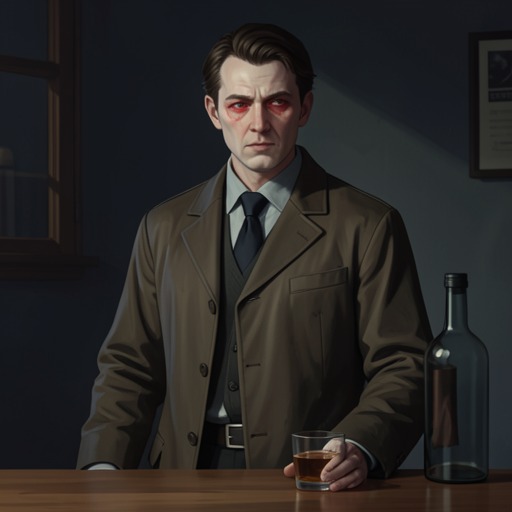
Farrington is introduced at the office as a man of great bulk, with a dark, wine-coloured face, fair eyebrows and moustache, and slightly bulging eyes. When Miss Parker tells him that Mr Alleyne wants him upstairs, he mutters an angry response and leaves his desk with a heavy step. His physical presence is striking, but at work he remains subordinate to the demands of his employer and the office hierarchy.
Mr Alleyne reprimands him for failing to copy a contract between Bodley and Kirwan by the four o’clock deadline. Farrington begins to explain that Mr Shelley had told him something different, but Mr Alleyne dismisses that explanation and warns that he will take the matter to Mr Crosbie if the contract is not copied that evening. The reprimand makes clear that Farrington’s work is monitored and that his standing in the office is precarious: his own account of instructions offers little protection against a superior’s accusation of shirking.
The conflict between reprimand and unfinished work continues downstairs. Farrington counts the pages left to copy and tries to resume writing, but stares at the unfinished legal sentence in front of him. He is distracted by thirst and leaves the office. Though he tells the chief clerk, Mr Shelley, that his errand is legitimate, he slips out wearing a cap taken from his pocket and hurries to O’Neill’s shop. The clandestine departure connects his drinking to the pressures of the workplace: instead of completing the task that has brought him under scrutiny, he seeks immediate relief in the public house.
The Office Conflict and the Pawned Watch
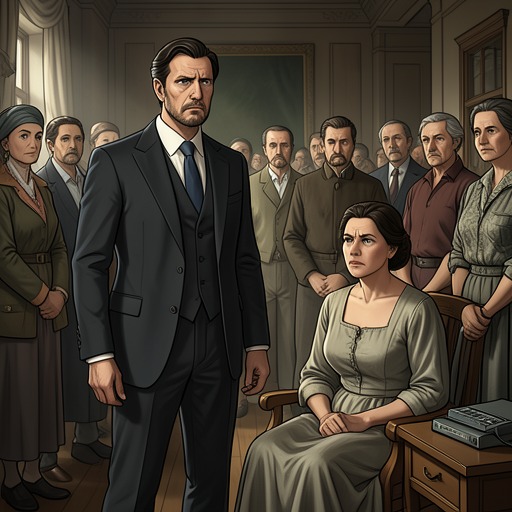
Farrington’s working day brings a second confrontation. Mr Alleyne appears with Miss Delacour and accuses him of losing two letters. Farrington says he knows nothing about them and maintains that he made a faithful copy. Mr Alleyne continues his bitter tirade, while Farrington struggles to contain his anger. The dispute does not resolve into a recovery of authority: the accusation remains, and Farrington’s response is limited to a denial that leaves him exposed before his colleagues.
The narrator connects this hostility to an earlier incident: Mr Alleyne’s resentment dates from the day he overheard Farrington mimicking his North of Ireland accent to amuse Higgins and Miss Parker. Farrington’s anger at the present reprimands therefore has a history in workplace mockery and retaliation. But his resentment does not lead to a direct challenge that could alter the balance of power. He turns instead to thoughts of drinking and of the men he expects to meet, imagining a night of disorder as compensation for the indignities of the day.
To obtain money, Farrington takes his watch to Terry Kelly’s pawn-office in Fleet Street. The clerk offers a crown, but Farrington holds out for six shillings and is given that amount. He leaves pleased, rolling the coins between his fingers, and makes his way through Westmoreland Street, where workers and newspaper-selling children fill the evening crowd. He rehearses how he will tell his companions about standing up to Mr Alleyne, shaping the office quarrel into a story of cool defiance. The gap between that imagined account and his actual power at work marks the difference between the bravado he can perform socially and the authority he lacks in the office.
Drinking, Companions, and Defeat
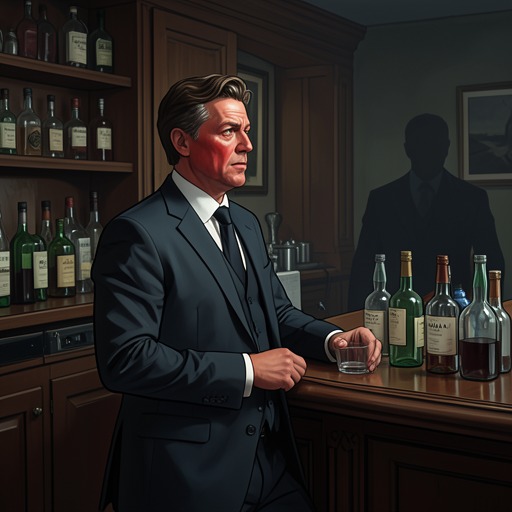
At the public house Farrington watches a woman in a large hat, hoping she will return his attention. She brushes against his chair and apologizes in a London accent, but leaves without looking back. Farrington curses his lack of money and the drinks he has bought for others, especially the whiskies and Apollinaris he stood for Weathers. His resentment is sharpened by a sense that generosity has brought him no return, and his interest in the woman is likewise frustrated rather than fulfilled.
The conversation among the men turns to feats of strength. When Weathers boasts about his biceps, Farrington is called on to uphold the national honour. He rolls up his sleeve and joins Weathers in an arm-wrestling contest. After about thirty seconds, Weathers slowly forces Farrington’s hand down onto the table. Farrington, already angry, is humiliated at losing to a much younger man and objects that Weathers has used his body weight unfairly. His protest does not reverse the outcome; the contest makes visible the failure of the physical strength on which he has relied to restore his pride.
By the time Farrington waits for the Sandymount tram at O’Connell Bridge, he has spent his money, pawned his watch, and failed to get drunk. He has also been defeated twice by a young man, losing the reputation as a strong man that mattered to him. He feels anger and revengefulness, and the memory of the woman who brushed past him adds to his discontent. The evening has not delivered the pleasure or triumph he anticipated: the coins gained from the pawnshop have been spent, and the imagined defiance of his rehearsed story has given way to frustration.
Home and the Ending
Farrington gets off at Shelbourne Road and returns home reluctantly. He finds the kitchen empty and its fire nearly out, then calls upstairs for Ada. When the scene reaches the child, he focuses his anger on the extinguished fire and threatens to teach the child not to let it go out again. He takes a walking-stick from behind the door and rolls up his sleeve, making the threat an action rather than an outburst that passes.
The child tries to get away around the table, but Farrington catches him. The boy falls to his knees and pleads with his father to stop, promising to say a Hail Mary for him. The scene ends with the child’s repeated plea, not with any account of reconciliation or remorse from Farrington. The contrast with the office and public house is decisive: Farrington cannot master his employer, recover the money he has spent, or win the contest of strength, but at home he can turn his frustration on a dependent child.
Character and Narrative Significance
Farrington’s day is organized by reversals of status. At the office, Mr Alleyne controls the reprimand and the threat of escalation to Mr Crosbie; among his companions, Farrington tries to recast that subordination as a tale of composure; in the contest with Weathers, his claim to physical superiority fails; at home, his child becomes the target of the anger he has carried through the day. The sequence links workplace humiliation and social frustration to domestic intimidation without making the violence an inevitable or justified response.
His repeated recourse to drinking is part of that sequence. He leaves work for O’Neill’s, pawns his watch to secure six shillings, spends money on drinks for others, and ends the evening still feeling thirsty and dissatisfied. Alcohol offers a sought-after escape and an imagined route to sociability, but it does not repair his standing, restore his money, or relieve his anger. The pawned watch gives this failed escape a concrete cost: Farrington trades an object he owns for an evening whose promised satisfaction never arrives.
The narrative’s movement from the office to the street, public house, tram, and home tracks the narrowing of Farrington’s options. He has room to imagine retaliation and to perform a version of himself for his companions, but the day’s encounters repeatedly strip those performances of force. The final scene turns the story’s concern with power toward the household, where the person with the least power bears the consequences. Farrington’s defining action is therefore not simply his failure to command respect elsewhere, but his use of authority over his son to discharge anger he has not been able to direct at its sources.