Gabriel Conroy
DublinersGabriel Conroy is the central consciousness through which the final movement of “The Dead” turns a festive Dublin gathering into an unsettling reckoning with love, pride, and mortality. At the Morkan sisters’ annual dance he arrives late with Gretta, already self-conscious about his social performance; by the end of the night, her recollection of Michael Furey has displaced Gabriel’s confidence in his own place in her life. In the closing snow scene, he imagines the living and the dead under one falling weather, and his sense of himself begins to dissolve into a larger, less possessive vision.
Identity and Entrance
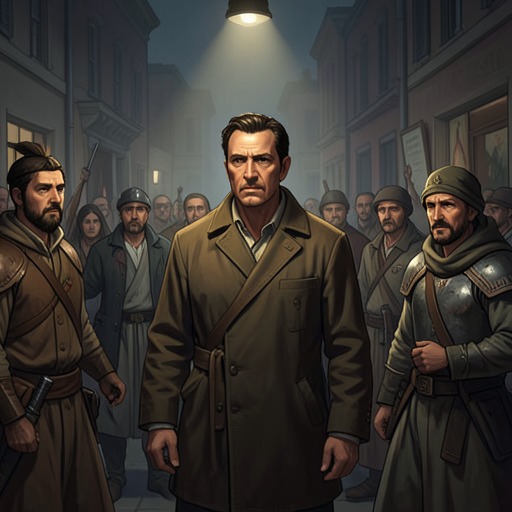
Gabriel is Gretta’s husband and the nephew of the Morkan sisters, whose annual dance gives the story its social setting. The household has been waiting for him and his wife long after ten o’clock. When Lily opens the door, she relays that Miss Kate and Miss Julia had thought he was never coming. Gabriel responds lightly that they have forgotten how long his wife takes to dress, a joke that establishes his ease with the rituals of the gathering even as it makes his lateness a subject of conversation.
His entrance is marked by snow: he stands on the mat scraping it from his goloshes while Lily leads Gretta toward the stairs. The practical detail places him between the outside winter and the brightly occupied house. He comes in as a guest expected to help sustain the evening, but he is not entirely at ease in that role. The dance will expose how much his confidence depends on reading an audience correctly and being received as he intends.
Social Confidence and Its Fracture
Outside the drawing-room, Gabriel waits for a waltz to finish, listening to skirts brushing the door and feet shuffling inside. Lily’s sudden, bitter retort has left him discomposed. He attempts to recover his composure by arranging his cuffs and tie, then consults the headings he has prepared for his speech. Even this small pause becomes an examination of how he will appear to others: he worries that Robert Browning will be beyond his hearers and considers choosing Shakespeare or the Melodies instead.
His calculation turns into self-reproach. The men’s clacking heels and shuffling soles lead him to conclude that his audience’s culture differs from his own; a literary quotation, he fears, would make him seem to display superior education. He imagines failing with them as he has failed with Lily, recognizes that he has taken the wrong tone, and judges his whole speech a mistake before he has delivered it. Gabriel’s composure is therefore not simple assurance. It depends on social distinctions and on his ability to control how his words are understood; Lily’s response has unsettled that control before the public performance even begins.
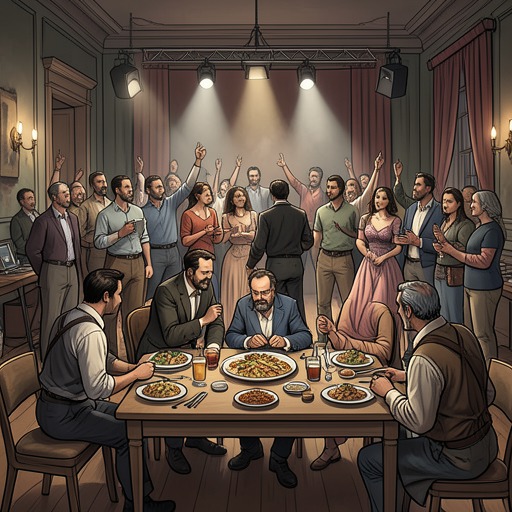
Later, as the company settles after the meal, Gabriel rises to address it. The setting briefly offers him an expansive, almost theatrical vista: the piano plays a waltz, the lighted windows look out toward the quay, and snow caps the trees and the Wellington Monument in the distant park. Against this wintry scene he begins with the formal address, “Ladies and Gentlemen,” and presents speaking to the company as a pleasing task for which his powers may be inadequate. The speech places him once more in a public role, but the private doubt already attached to his words gives that role a fragile foundation.
Gretta, Michael Furey, and the Reversal of Perspective
After Gretta tells him about Michael Furey, Gabriel’s first response remains colored by irony: he asks what the young man did, and she says he worked in the gasworks. Gabriel feels humiliated when his irony fails and the figure of the dead boy enters the room between them. He had been full of memories of his and Gretta’s secret life together, tenderness, joy, and desire; Gretta, he realizes, had been comparing him with someone else. What he had treated as a shared past is suddenly shown to contain a history of feeling that he does not own.
That reversal cuts into Gabriel’s image of himself. He sees a ludicrous figure who performs errands for his aunts, a nervous and well-meaning sentimentalist, and an orator addressing people he has privately judged as vulgar. His own desire, which he had idealized, now appears clownish to him. He turns his back toward the light so Gretta will not see the shame burning on his forehead. The gesture makes the new knowledge physical: he cannot immediately meet her gaze, and the confidence of the public speaker gives way to embarrassment in the privacy of the room.
Gabriel tries to maintain a coldly interrogative tone, but his voice becomes humble and indifferent as he asks whether Gretta had been in love with Michael. The change is not yet a resolution; it registers the collapse of his earlier posture. Gretta’s memory has made visible a dimension of her past that his own recollections and assumptions had excluded. The encounter forces him to recognize not only that her emotional life exceeds his knowledge, but that his self-conception has been sustained by treating his own feelings as the measure of love.
The Dead and the Snow
In bed beside Gretta, Gabriel reflects that people are becoming shades and contrasts a passionate death with the slow fading of age. He thinks of the image of her lover’s eyes, preserved in her heart for so many years after Michael told her he did not wish to live. This memory is not Gabriel’s own recollection; it is the understanding he has gained through Gretta’s account. His response joins tenderness with a newly acknowledged distance: he has never felt that way toward a woman, yet knows that such a feeling must be love.
Tears fill his eyes. In the partial darkness he imagines a young man standing beneath a dripping tree and other forms nearby; his awareness approaches the realm of the dead, whose existence he can sense but not comprehend. His own identity seems to fade into a grey, impalpable world as the solid world made and inhabited by the dead appears to dissolve. The shift is larger than regret over one romantic comparison. Gabriel’s sense of a stable, self-contained present gives way to the recognition that the living world is inseparable from lives that have ended and memories that persist beyond his control.
A few light taps at the window turn his attention outward: snow has begun to fall again. The flakes move obliquely against the lamplight, and Gabriel thinks of the westward journey he must undertake. The snow reaches across the dark central plain, the treeless hills, the Bog of Allen, and the Shannon; it falls as well upon the churchyard where Michael Furey lies buried, thick on crooked crosses, headstones, the gate’s spears, and barren thorns. From the room beside Gretta, Gabriel’s attention travels across the whole island and ends at the grave of the man whose memory has altered the night.
Narrative Role and Significance
Gabriel’s movement from social calculation to self-doubt and then to a widened awareness gives the story its decisive change of scale. At first, he is preoccupied with the right quotation, the right tone, and the judgment of an audience. Lily’s rebuke exposes the limits of his social tact; Gretta’s account then exposes the limits of his intimate knowledge. Each disturbance makes his self-image less secure, until his concern with how he appears gives way to attention to lives and deaths beyond himself.
The snow gathers these shifts into a single image without erasing their differences. It covers Dublin and the western landscape, the crowded world of the living and Michael Furey’s lonely churchyard. Gabriel does not solve the distance between himself and Gretta, nor does he claim to understand the dead. Instead, he becomes conscious of an existence beyond his own identity, and the final descent of snow joins his private awakening to the shared condition of living and dying. The man who feared that his words would fail to reach a roomful of guests ends in an inward silence that reaches across Ireland.