Bob Doran
DublinersBob Doran is a lodger in Mrs Mooney’s boarding house and the older man involved with her daughter, Polly. In the story’s final crisis, he weighs marriage against the damage that exposure could do to his work and social standing. His predicament is sharpened by the gap between his wish to remain free and his recognition that his conduct has created an obligation he cannot simply evade.
Identity and Circumstances
Doran is thirty-four or thirty-five, and has worked for thirteen years in the office of a large Catholic wine merchant. Mrs Mooney regards him as serious rather than rakish or loud-voiced, and therefore as someone unlikely to brazen out a public scandal. His long service gives him something concrete to lose: he imagines that the affair could reach his employer and undo years of industry and diligence.
He has enough money to settle down, so financial incapacity is not his stated obstacle. Instead, he worries that his family will look down on Polly because of her disreputable father and the growing reputation of her mother’s boarding house. He also judges Polly’s speech as vulgar, recalling her grammatical mistakes, even as he recognizes that he has participated in the very conduct for which he is judging her. His private calculations expose the social distinctions he hopes marriage will not force him to cross.
The Affair and Its Immediate Crisis
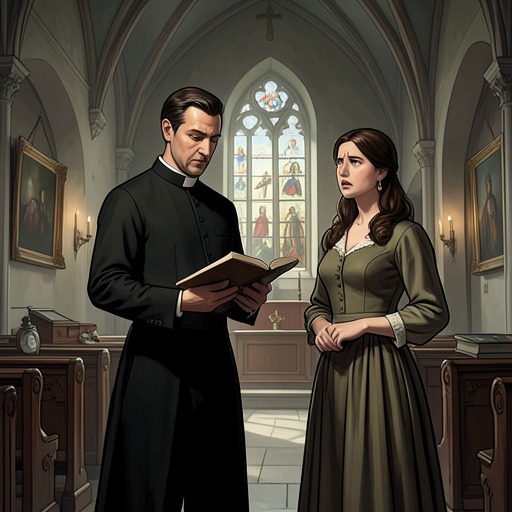
On Sunday morning, the consequences of the affair press in from several directions. The night before, Doran confessed its details to a priest, who drew out what had happened and magnified its significance as a sin. Doran is left with the sense that the harm is already done and that his remaining alternatives are to marry Polly or run away; he cannot face simply denying what occurred.
Polly comes to him while he sits helplessly on the side of the bed, dressed in his shirt and trousers. She tells him she has made a clean breast of the matter to her mother and that Mrs Mooney will speak with him that morning. Crying, she throws her arms around his neck and asks what she is to do; she also says she will put an end to herself. Doran responds by comforting her and assuring her that things will be all right, but the narration does not make clear that he has settled on marriage.
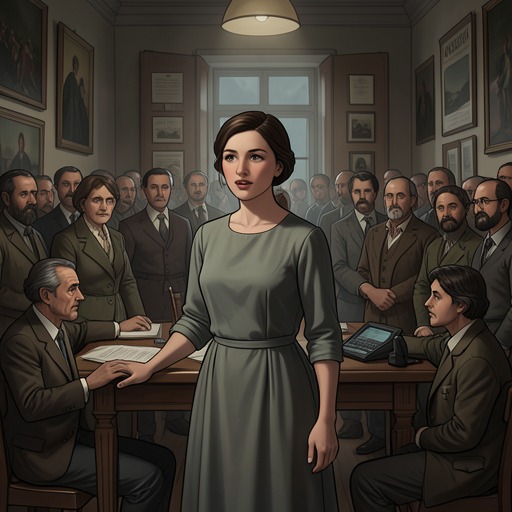
The prospect of publicity is not abstract. The other lodgers know something of the affair, and some have invented details. Mrs Mooney expects that Doran will fear the consequences at work, since the scandal might reach his employer. Doran himself imagines the summons from his employer, Mr Leonard, and sees his accumulated service and diligence threatened. The smallness of the city, where everyone knows everyone else’s business, makes concealment seem unlikely.
Honour, Religion, and Resistance
Doran’s conflict is not simply between affection and indifference. In remembering their intimacy, he recalls Polly warming his dinner when he came home late, preparing punch on cold, wet, or windy nights, and sharing quiet good-nights with him on the third landing. He remembers her eyes, her touch, and his own delirium. But he also concludes that delirium passes, and his wish to remain free returns with force.
That resistance is expressed as an instinct against marriage: once married, he feels, a man is done for. At the same time, his religious confession and sense of honour point in the opposite direction. He echoes Polly’s question about what to do, then recognizes that reparation must be made for the sin. Marriage is the only reparation Mrs Mooney will accept for the loss of her daughter’s honour; for Doran, it is both a moral obligation and a frightening surrender of freedom.
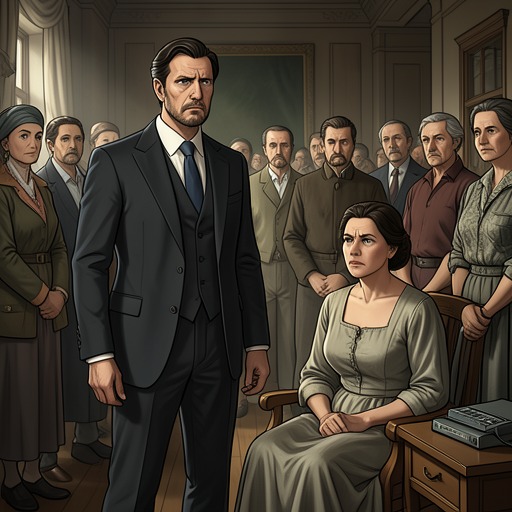
The conflict is therefore shaped by several kinds of pressure that do not align. His fear of scandal and job loss urges him toward agreement; his concern for family opinion and social rank makes him hesitate; his religious duties and honour tell him that he cannot simply leave Polly to bear the consequences. The narrative presents no easy reconciliation among these demands. Doran can acknowledge his responsibility while still resenting the prospect of being bound by it.
Mrs Mooney’s Decision and Doran’s Ending
Mrs Mooney has calculated her advantage before sending Mary to summon Doran. She considers herself an outraged mother, believes that the lodgers’ knowledge and invented gossip make publicity dangerous for him, and expects that losing his position would be a serious cost. She dismisses payment as inadequate: only marriage, in her view, can repair the injury to Polly’s honour. Doran is thus not only responding to his private conscience; he is being called to answer within a negotiation whose terms Mrs Mooney has already set.
After comforting Polly, Doran dresses and goes downstairs to the parlour. His glasses mist with moisture as he descends, and he has to remove them and polish them. He longs to escape to another country, yet feels himself pushed down the stairs step by step. On the landing he passes Jack Mooney, who is carrying two bottles of Bass; the two men salute coldly, and Doran notices Jack’s thick, bulldog-like face and short arms. The encounter gives the passage a physical reminder of the household and its power over the crisis, while Doran’s continued descent registers that he has not fled.
The story ends when Mrs Mooney calls Polly down because Doran wants to speak with her. Polly remembers what she has been waiting for, but the narrative stops before their conversation and does not state the outcome. Doran’s movement toward the parlour is decisive without being conclusive: he has accepted that he must confront the matter, yet the reader is not told whether he marries Polly.
Narrative Role
Doran’s predicament gives the story’s marriage crisis its double pressure. He is neither presented as an innocent victim of Mrs Mooney’s strategy nor as a man wholly indifferent to Polly: he has shared the intimacy he now weighs against its costs, and he recognizes that his own conduct demands reparation. Yet his recollections of tenderness coexist with social condescension and a pronounced fear of losing freedom.
The ending preserves that contradiction rather than resolving it. Doran’s confession has made the affair a religious matter; the likely exposure makes it an economic and social one; Polly’s distress and Mrs Mooney’s intervention make it a question of responsibility to another person. His descent toward the parlour brings these forces together in a single action, while the unanswered question of what he will say leaves the story’s settlement just beyond view.