Father James Flynn
DublinersFather James Flynn is the dead priest at the center of the boy’s conflicted recollection in “The Sisters.” He had taught the boy Latin, the ceremonies of the Mass, and the grave duties of priesthood, yet the account of his final decline—linked to a broken chalice and ending with his discovery laughing alone in a confessional—makes him at once a beloved teacher and an unsettling mystery. His death brings neither straightforward mourning nor a settled explanation: the boy feels an unexpected freedom, while the family can only repeat what people say happened.
Identity and Introduction
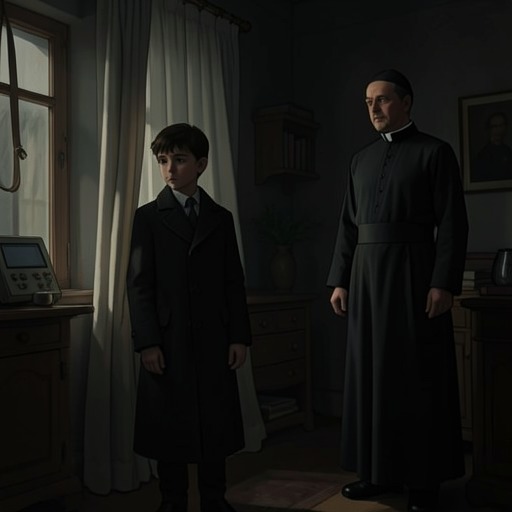
The news of Father James Flynn’s death reaches the boy at home through Old Cotter, who had been passing the house. The boy’s uncle tells him that his “old friend is gone,” and explains that the two had been close: Father James Flynn taught the boy a great deal and, people said, had a particular fondness for him. The announcement makes clear that this was not simply a priest known to the household; he had occupied an intimate, formative place in the boy’s life.
The boy’s reaction is initially guarded. Aware that he is being watched, he continues eating as if the news has not affected him. Old Cotter, meanwhile, studies him with small, keen eyes, as though testing what the loss means to him. The boy refuses to look up and give him a response. This silence establishes the private character of the boy’s attachment: others may describe their friendship, but he does not openly perform grief for them.
Teaching and Daily Life
Father James Flynn’s influence is recalled through concrete lessons and habits. He had studied at the Irish college in Rome and taught the boy to pronounce Latin properly. He also told him stories about the catacombs and Napoleon Bonaparte, and explained the meaning of the Mass’s ceremonies and the priest’s vestments. His instruction ranged between history, language, and the visible forms of Catholic worship, giving the boy a close and unusually detailed view of religious practice.
Their lessons also involved difficult questions about moral and clerical responsibility. Father James Flynn asked what one should do in particular circumstances and whether particular sins were mortal, venial, or merely imperfections. These questions unsettled the boy’s sense that church institutions were simple: they showed him how complex and mysterious those institutions could be. The priest’s duties toward the Eucharist and the secrecy of the confessional seemed so weighty that the boy wondered how anyone could have the courage to assume them. He understood that extensive theological books had been written to work through such intricacies.
The boy remembers failing to answer some of these questions, or answering haltingly and foolishly. Father James Flynn would smile and nod two or three times. He also trained the boy in the responses of the Mass, which he made him learn by heart. As the boy recited, the priest smiled pensively and pushed large pinches of snuff into his nostrils, alternating from one side to the other. The recollection makes instruction intimate and physical: religious learning appears beside the priest’s trembling hands, his snuff, and his familiar gestures.
The priest’s body and clothing are recalled with the same precision. In the boy’s imagined visit to him, Father James Flynn sits in an armchair by the fire, nearly smothered in his greatcoat. His hands tremble so much that he cannot empty a packet of High Toast into his black snuff-box without spilling much of it; the boy had usually done this for him. Snuff dust dribbles through the priest’s raised fingers onto his coat, and he tries to brush it away with a red handkerchief darkened by a week’s stains. The priest’s garments are faded green, and his large discoloured teeth and tongue resting on his lower lip had once made the boy uneasy. Such details complicate the dignity of the priestly office with an image of physical fragility and ordinary dependence.
The Broken Chalice and Decline
In the family’s account, the broken chalice marks the beginning of Father James Flynn’s decline. Eliza says that the vessel contained nothing, according to what people said, but adds that they also blamed the boy. She does not establish the boy’s responsibility as fact; the explanation remains hearsay, qualified by uncertainty and pity for a priest remembered as nervous. The broken sacred object is therefore both a reported incident and an unresolved point around which the family’s explanations gather.
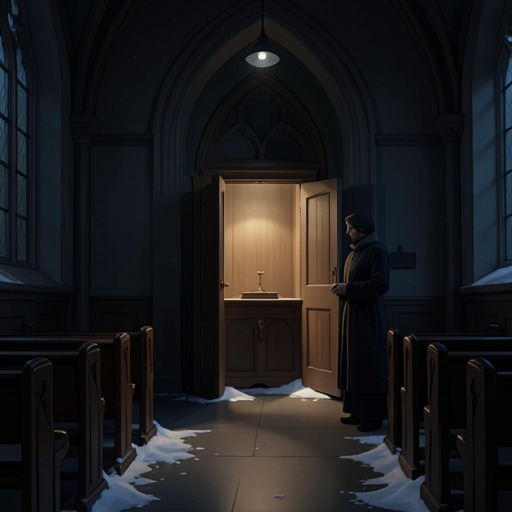
Eliza says that the incident affected his mind. Afterwards, Father James Flynn began to mope alone, speak to no one, and wander by himself. One night, when he was needed to go on a call, nobody could find him. The search led from place to place until the clerk proposed looking in the chapel. The clerk, Father O’Rourke, and another priest brought in a light and opened the chapel with its keys. There they found Father James Flynn sitting by himself in the dark, awake in his confession-box and laughing softly to himself.
The scene sharpens rather than resolves the mystery. The confidential confessional, associated in the boy’s lessons with grave priestly obligations, becomes the place where the priest is found isolated and laughing. Eliza presents the discovery as what made those around him think something had gone wrong, but no precise diagnosis or fuller explanation is supplied. The reader receives a sequence of reported signs and interpretations, not a definitive account of what happened within Father James Flynn’s mind.
Death and the Boy’s Response
The boy reads the death notice, which gives Father James Flynn’s age as sixty-five and ends with “R. I. P.” The card persuades him that the priest is dead, and he is disturbed to find himself hesitating. Had the priest still been alive, he imagines going into the small dark room behind the shop to see him by the fire. Instead, he wishes to enter and look at him after death but lacks the courage to knock. The movement from imagined familiar visit to withheld final visit makes his response a mixture of longing and avoidance.
Walking away along the sunny side of the street, the boy reads theatrical advertisements and notices that neither he nor the day seems to be in a mourning mood. More disturbing to him is the freedom he feels, as though death has released him from something. He cannot reconcile that sensation with the fact that Father James Flynn taught him so much. The contradiction is left intact: affection and gratitude do not cancel the boy’s relief, and relief does not erase the intimacy of their past.
He also remembers a dream whose ending he cannot recover. Its surviving images are long velvet curtains and an antique swinging lamp; he feels he had been far away, in a strange land, and thinks of Persia. The fragment does not explain the priest’s death or the boy’s relief, but it extends the story’s atmosphere of incomplete knowledge: even the boy’s private memory breaks off before it can supply a conclusion.
Narrative Significance
Father James Flynn’s character is built through a tension between instruction and disturbance. He introduced the boy to the elaborate duties of the priesthood, especially responsibility toward the Eucharist and the confessional, while the account of his own collapse centers on the broken chalice and a discovery inside a confession-box. The religious objects and spaces that once carried lessons of order and obligation become entangled with failure, isolation, and uncertainty.
The narrative withholds a single authoritative explanation for the priest’s decline. The boy’s uncle reports what Old Cotter has said; Eliza recounts what people say about the chalice, the boy’s supposed fault, and the priest’s behavior; and the boy himself is unable to name the meaning of his own freedom or finish recalling his dream. Father James Flynn is consequently known through affection, physical memories, and second-hand accounts whose gaps remain visible. His importance lies not only in what he taught the boy, but in the unsettling residue his death leaves: the boy cannot turn their friendship into uncomplicated grief, and the story cannot turn the priest’s final breakdown into a settled explanation.