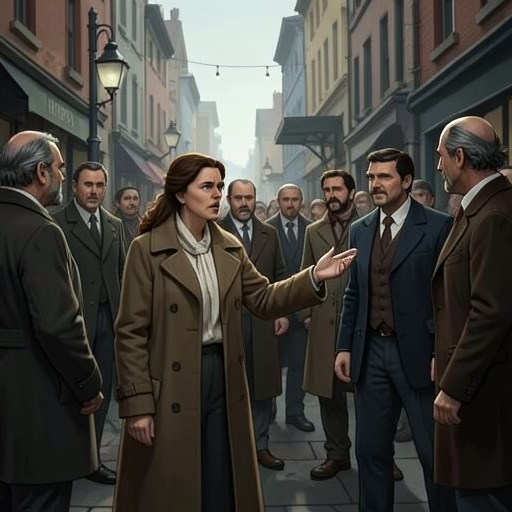
Mrs Kearney
DublinersMrs Kearney, born Miss Devlin, is a devout and socially polished Dublin woman whose romantic expectations have hardened into practical resolve. When the Éire Abu Society engages her daughter Kathleen as accompanist for four concerts, she helps shape the programme and secures a contract for eight guineas. As the organizers delay payment, she demands that they honor the agreement, turning a family’s claim into an open confrontation with the committee.
Identity and Background
Miss Devlin became Mrs Kearney partly out of spite, marrying Mr Kearney, a much older bootmaker on Ormond Quay, after the ordinary young men she met failed to match the brilliant life she had imagined. Educated at a high-class convent, she had learned French and music. Pale and unbending in manner, she made few friends at school; later, her playing and polished manners were admired in the houses where she was introduced as a prospective bride. She kept her romantic ideas even after deciding that her husband’s sober character would wear better than a romantic temperament, and secretly consoled herself by eating Turkish Delight.
Her marriage is presented through small acts of accommodation and care. Mr Kearney is sober, thrifty, and pious, attending the altar every first Friday, sometimes with his wife and more often alone. Mrs Kearney remains religious and proves a good wife: at a party, a slight lift of her eyebrow is enough for him to stand and leave with her; when his cough troubles him, she covers his feet with an eider-down quilt and makes him a strong rum punch. He, in turn, is a model father, setting aside a small weekly payment to provide each daughter with a hundred-pound dowry at age twenty-four.
Building Kathleen’s Musical Standing
Mr Kearney paid for Kathleen to attend a good convent, where she studied French and music, and then covered her fees at the Academy. During the Irish Revival, Mrs Kearney saw an opportunity in her daughter’s name and brought an Irish teacher into the house. The sisters exchanged Irish picture postcards with their friends; after special Sunday Mass at the pro-cathedral, the Kearneys’ musical and Nationalist circle gathered on Cathedral Street, exchanged gossip, and parted in Irish. Kathleen became known as a capable musician and a supporter of the language movement. Mrs Kearney was pleased by this recognition, which joined cultural commitment to her daughter’s social and professional prospects.
When Hoppy Holohan proposed Kathleen as accompanist for four grand concerts at the Antient Concert Rooms, Mrs Kearney received him in the drawing-room and helped settle the enterprise’s terms. The agreement provided eight guineas for Kathleen’s services. Her contribution went beyond arranging the engagement: because Holohan was inexperienced with bills and programme order, she advised him on typography, performance sequence, and how to keep the audience entertained. She understood that the first tenor would resent following Mr Meade’s comic turn and placed uncertain items between established favorites. Holohan visited her daily for advice, and she treated him with friendly hospitality while exercising practical control over the arrangements.
The Payment Dispute
At the concerts, Mrs Kearney tried to remain on good terms with the organizers, bringing Kathleen over to speak amiably with them. Yet she watched Holohan’s limping, indirect movements and, when she could, followed him out of the room. In a discreet part of the corridor she asked when Kathleen would be paid. Holohan referred her to Mr Fitzpatrick, but she answered that Kathleen had signed a contract for eight guineas and was entitled to receive the money. When Holohan said payment was not his business, Mrs Kearney insisted that the matter was hers and that she would pursue it.
After the first part of the concert, Holohan and Fitzpatrick told her that the remaining four guineas would be paid only after the committee met the following Tuesday. They added that if Kathleen did not play the second part, the committee would regard the contract as broken and pay nothing. Mrs Kearney rejected the committee’s delayed timetable and its condition. She demanded that four pounds eight be put into Kathleen’s hand before her daughter returned to the platform, making performance conditional on payment rather than allowing the organizers to treat the signed agreement as optional.
Conflict and Significance
Mrs Kearney interprets the committee’s conduct as an attempt to take advantage of Kathleen because she is a young woman. In a separate group at the concert, she says that she has spared neither trouble nor expense and that the committee has treated her scandalously. She argues that they would not have treated Kathleen this way had she been a man, and vows to make Dublin hear of the matter if the fee is not paid to the last farthing. Her appeal to the second tenor wins his agreement that she has been badly treated; Miss Healy, although friendly with Kathleen and often invited to the Kearneys’ home, hesitates to join the group openly criticizing the committee.
The confrontation exposes the tension between Mrs Kearney’s careful cultivation of musical and nationalist connections and the practical limits of those networks when payment is at issue. She has helped make the concerts possible, improved their programme, and promoted her daughter’s reputation, but these contributions do not guarantee that the committee will meet its obligation promptly. Her insistence on the written fee converts the dispute from a private request into a public test of professional respect and the value assigned to a woman’s work. The supplied scenes establish her demand and the organizers’ ultimatum; they do not disclose the dispute’s final resolution.