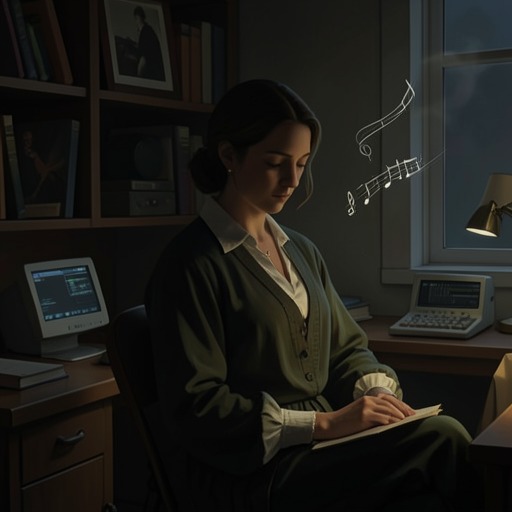
Gretta Conroy
DublinersGretta Conroy, Gabriel Conroy’s wife, becomes the focus of the final story’s emotional reversal when a song awakens her memories of Michael Furey, a young man she knew before her marriage. Her tears and account of his illness and devotion reveal a past that Gabriel had not understood, shifting the scene from his expectation of marital intimacy to an encounter with grief, memory, and the limits of his knowledge of her.
Identity and Introduction
Gretta arrives late to the annual gathering at the Morkan sisters’ home with Gabriel. At the door, Lily greets Gabriel and then wishes Gretta good-night; Gabriel jokes that his wife takes three hours to dress. The exchange introduces her in relation to her husband and the evening’s social company, but she soon commands attention for reasons Gabriel cannot initially discern.
Later, while the guests discuss Bartell D’Arcy’s cold, Gretta stands beneath the dusty fanlight, apparently separate from the conversation. Gabriel watches her in the gaslight, noticing the bronze of her hair, which he had seen her drying by the fire a few days earlier. When she turns, he sees colour in her cheeks and brightness in her eyes, and joy rises in him. His response is shaped by what he sees, while the cause of her absorption remains hidden from him.
The Song and the Memory It Opens
Gretta asks Bartell D’Arcy the name of the song he had been singing. He identifies it as “The Lass of Aughrim,” adding that he could not remember it properly. Gretta repeats the title, saying she could not think of its name. The exchange is brief, but the song has already drawn her attention away from the gathering and toward an association she has not yet explained.
Later, when Gabriel asks what is troubling her, Gretta does not answer immediately. She then breaks into tears and says she is thinking about “The Lass of Aughrim.” She pulls away from him, runs to the bed, and hides her face across its rail. Gabriel stands motionless in astonishment before following her. His reflection in the cheval-glass arrests him: he sees his broad shirt-front, the face whose expression puzzles him, and his gilt-rimmed eyeglasses. The moment turns his attention from the wife he had been watching to his own bewilderment at the distance between his assumptions and her feeling.
Michael Furey and Gretta’s Past
When Gabriel asks whether the person connected with the song was someone she had loved, Gretta names Michael Furey. He was a young boy she used to know, she says, and he sang “The Lass of Aughrim.” She remembers him as very delicate, with big, dark eyes and a striking expression. Her recollection gives the song a personal history: it is not simply a tune from the evening, but a link to someone whose presence remains vivid in her memory.
Gretta says that she thinks Michael died for her. She explains that the events took place in winter, around the time she was leaving her grandmother’s home to come up to the convent in Dublin. Michael was ill in lodgings in Galway and was not allowed to go out. His family in Oughterard had been written to; people said he was in decline, though Gretta admits she never knew exactly what the illness was. The account establishes the circumstances as she remembers them, including the uncertainty surrounding his condition.
She recalls that Michael was very fond of her and describes him as a gentle boy. They used to walk together in the country, and he intended to study singing, though she says he was doing so only for his health. She remembers that he had a very good voice. These details connect the song to their shared walks and his singing, while her tender description makes clear how strongly she continues to regard him.
Marriage, Perspective, and Narrative Significance
Gretta’s disclosure changes the emotional balance of the scene. Gabriel had felt a surge of joy when he saw her face lit with colour and her eyes shining; he later approaches her believing he can identify what is troubling her. Instead, she speaks of a past love and of a young man she believes died for her. Gabriel experiences the answer as a source of terror and tries to shake off its force through reason, but the memory belongs to Gretta and cannot be reduced to the romantic meaning he had assigned to her earlier appearance.
The narrative gives Gretta an explicit voice at the point when the explanation matters most. She names Michael, recalls his appearance and singing, describes the winter illness, and sets the story within her departure from her grandmother’s home. Her account is personal rather than exhaustive: she is unsure of the precise nature of his illness, but certain of her memory of his affection and gentleness. That mixture of emotional clarity and factual uncertainty keeps the past intimate and partial, rather than turning it into a complete account that Gabriel—or the reader—can possess.
Gretta’s role in the episode is therefore more than that of the object of Gabriel’s gaze. The song prompts her to recover and articulate a history that his perspective had not contained. Her tears, withdrawal from his arm, and recollection redirect the scene away from his anticipated intimacy and toward the living force of memory. Through her, a private attachment from before the marriage becomes newly present between the spouses, exposing how little Gabriel had known of the inward life he thought he understood.