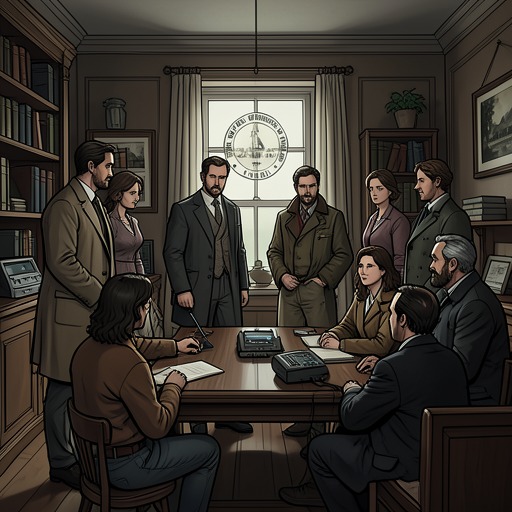
Emily Sinico
DublinersEmily Sinico is a married woman and mother whose relationship with James Duffy exposes the distance between intellectual intimacy and emotional commitment. In their companionship she offers him attentive understanding and urges him toward a fuller life; when she responds physically to his intimacy, he withdraws and ends their meetings. Her later death, reported in a newspaper and followed by Duffy’s reckoning with his own loneliness, makes her an absent presence at the story’s close.
Identity and First Meetings
Duffy first encounters Emily at the Rotunda, where they sit beside one another at a poorly attended concert. She remarks on the empty seats and the hardship of performing to a sparse audience, giving him an opening to speak with her. He is struck by how little awkwardness she shows and studies her as they talk, trying to fix her in his memory. His attention registers both her composure and the sensibility that seems to surface briefly beneath it, before prudence reasserts itself.
A few weeks later, Duffy meets her again at a concert in Earlsfort Terrace. Her daughter is present, and Duffy takes the moments when the young woman is distracted to speak more intimately with Emily. She mentions her husband, but not in a way Duffy reads as a warning. He learns that her husband is Captain Sinico, a merchant sailor whose work takes him between Dublin and Holland, and that the couple have one child. Emily is thus introduced within a family life that Duffy can approach but does not fully understand.
Companionship and Intellectual Intimacy
After another chance meeting, Duffy finds the courage to arrange an appointment. It begins a series of evening meetings, with the two choosing quiet places for their walks. Duffy dislikes the secrecy their meetings require and presses Emily to invite him to her home. Captain Sinico welcomes Duffy’s visits, mistakenly supposing that he is interested in marrying the daughter. He does not suspect that Duffy’s attention is directed toward his wife; with the captain often away and the daughter giving music lessons, Emily and Duffy have opportunities to spend time together.
Their connection develops through conversation and shared thought. Duffy lends Emily books, gives her ideas, and shares his intellectual life; she listens, and sometimes answers his theories with details from her own life. She urges him to let his nature open fully and becomes the person to whom he confides. He tells her of his brief involvement in an Irish Socialist Party whose members met in separate garrets after it split into three sections. Duffy had left because he judged the workers’ discussions timid and their concern with wages excessive, revealing the distance he maintained even while describing his political engagement.
The relationship also alters the experience of Duffy’s private life. At Emily’s cottage outside Dublin, they often spend evenings alone. Sometimes they let darkness settle instead of lighting the lamp; their isolation and the music still resonating in their ears heighten their sense of union. Duffy feels that her companionship has softened him and made his mental life more emotional. Yet even as he imagines that he might appear elevated in her eyes, he hears within himself an impersonal insistence on the soul’s incurable loneliness and the impossibility of giving oneself to another. Emily’s care draws him toward intimacy, while his own ideas keep retreating from it.
The Break with Duffy
The decisive rupture comes one night when Emily shows unusual excitement, takes Duffy’s hand passionately, and presses it to her cheek. He is surprised; her response reveals that she has understood their closeness differently from him. Duffy stays away for a week, then asks to meet, determined that their final conversation should not be clouded by the intimacy he now considers compromised. They meet in a small cakeshop near the Parkgate and walk for nearly three hours despite the cold autumn weather.
They agree to end their relationship. Duffy expresses his governing belief that every bond leads to sorrow. As they leave the Park, they walk silently toward the tram. Emily begins to tremble so violently that Duffy fears she may collapse; instead of remaining with her, he says goodbye quickly and leaves. A few days later, she sends back his books and music. The returned belongings make the separation concrete: the intellectual exchange that had linked them is over, and Duffy resumes the solitary life he regards as orderly.
Death and Duffy’s Reckoning
Four years pass. Emily is absent from Duffy’s routine, though he avoids concerts lest he meet her. Then a newspaper paragraph interrupts his dinner. The report identifies her as Emily Sinico, aged forty-three, and states that she was killed at Sydney Parade Station after being struck by a train while attempting to cross the line. At the inquest, Captain Sinico says he was away from Dublin and had returned from Rotterdam that morning. He describes their twenty-two-year marriage as happy until about two years earlier, when Emily began drinking excessively. Their daughter, Mary Sinico, says her mother had recently been going out at night to buy spirits; she had tried to reason with her and persuaded her to join a league. The jury follows the medical evidence and exonerates the railway staff.
Duffy reads the report repeatedly, first at dinner and later in his bedroom by the failing light. As memory wanders, he imagines Emily’s hand touching his and feels the news as an assault on his nerves. He leaves the house and goes to a public house at Chapelizod Bridge, where he orders hot punch. There, while the other customers talk among themselves, he relives their connection and understands that she is dead and has become a memory. He asks himself whether he could have acted differently: he could not, in his view, have continued a deceptive relationship or lived openly with her. Though he still defends what seemed best to him, he now recognizes how lonely her life must have been, spent night after night alone.
Walking through the Park where they had once walked together, Duffy feels Emily’s presence in the darkness and wonders why he withheld life from her. The memory turns his earlier certainty against him. He sees that by refusing a shared life he may have helped leave her isolated, though the story does not establish that he caused her later drinking or death. At Magazine Hill, he looks toward the lights of Dublin and sees figures lying in the shadow below. Their presence sharpens his sense of exclusion: he condemns furtive forms of love, yet recognizes that he has denied the one person who seemed to love him a life of happiness. Emily’s death leaves him confronting the possibility that his own carefully maintained solitude will end with him becoming a memory, if anyone remembers him.
Narrative Role and Significance
Emily is presented through Duffy’s attention and subsequent memories, but the inquest briefly supplies facts he could not know from their private meetings. This shift complicates the composed, intellectually focused woman he recalls: the newspaper and testimony reveal her later drinking, her daughter’s efforts to intervene, and a domestic situation in which her husband believed their marriage had once been happy. The account does not explain the full causes of Emily’s decline, and it does not reduce her life to Duffy’s relationship with her.
Her role in the story turns on a contrast between her readiness for closeness and Duffy’s conviction that people cannot truly give themselves to one another. The hand-to-cheek gesture changes the meaning of their meetings for him and precipitates his withdrawal; her death later makes the cost of that decision newly legible. Emily cannot answer Duffy’s retrospective questions, and the narrative leaves her final motives unresolved. What changes is his understanding: the woman he once treated as the object of a private intellectual bond becomes, too late, someone whose loneliness he can recognize as kin to his own.