Eliza Flynn
DublinersEliza Flynn, the sister of Father James Flynn, appears at her brother’s wake as both mourner and custodian of the family’s account of his last days. In the quiet rooms where his body lies, she describes the work of caring for him and arranging his funeral, then identifies the broken chalice as the beginning of his decline. Her recollections connect a concrete mishap in a religious setting with his growing withdrawal and a final, disturbing discovery in the confessional.
At the Wake
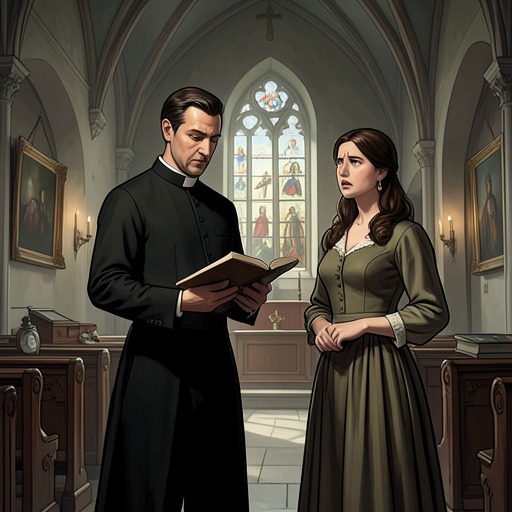
Eliza is seated in Father James Flynn’s arm-chair in the small room downstairs when the narrator and his aunt return from viewing the body. Nannie brings out sherry and wine-glasses; at her sister’s bidding, she pours and passes the drinks. Eliza invites the visitors to take wine, and Nannie offers cream crackers, which the narrator declines because he fears the noise of eating. The visit is marked by pauses rather than conversation: the family and guests gaze at the empty fireplace until the aunt speaks of the dead priest’s having gone to a better world.
The scene places Eliza amid the practical and ritual aftermath of death. Upstairs, she and Nannie have brought the visitors to the room where Father James Flynn lies in his coffin, vested as for the altar, his hands loosely retaining a chalice. Downstairs, the sisters receive condolences and wine in his own house. The contrast between the funeral observance and the ordinary furnishings of the sitting room makes Eliza’s presence part of both: she is grieving, but also maintaining the hospitality and composure expected of the household.
Care and Funeral Arrangements
The aunt tells Eliza that it must be a comfort to know she did all she could for her brother, and that both sisters were kind to him. Eliza answers that they had done everything they could, poor as they were, and would not let him want for anything while he was alive. Her reply emphasizes care under financial constraint rather than ease or abundance.
Eliza names the work that fell to her and Nannie: they found a woman to wash and lay out the body, arranged the coffin, and organized the Mass in the chapel. She credits Father O’Rourke with helping them through the arrangements. He brought flowers and two candlesticks from the chapel, wrote a notice for the Freeman’s General, and took charge of the cemetery papers and Father James Flynn’s insurance. The list conveys how much of mourning consists of practical labor, and how the priest’s death leaves his sisters responsible for tasks that had to be completed even as they grieved.
The accustomed acts of care are also registered through their absence. Eliza says she will no longer bring her brother his cup of beef-tea, nor will the aunt send him snuff. These small routines make his death tangible: the relationship had been sustained not only by kinship and religious standing but by repeated acts of tending to his needs.
Recalling His Decline
Eliza recalls that, latterly, something seemed queer in her brother’s behavior. When she brought him soup, she would sometimes find his breviary fallen to the floor while he leaned back in his chair with his mouth open. Her account sets this lapse beside the ordinary activity of bringing him food; a book associated with his religious life lies abandoned as he appears unresponsive. She does not offer a diagnosis, but her recollection gives the visitors a concrete sign that his condition had changed.
She also remembers a plan he continued to describe: before summer ended, he hoped to take her and Nannie for a drive to the old house in Irishtown where they had all been born. He imagined hiring one of the new, quiet carriages with rheumatic wheels from Johnny Rush’s across the way and making the journey together on a Sunday evening. The plan gives his decline a poignant counterpoint. He continued to picture a shared outing and a return to the sisters’ childhood home, but Eliza recounts it after his death, when the proposed journey can no longer take place.
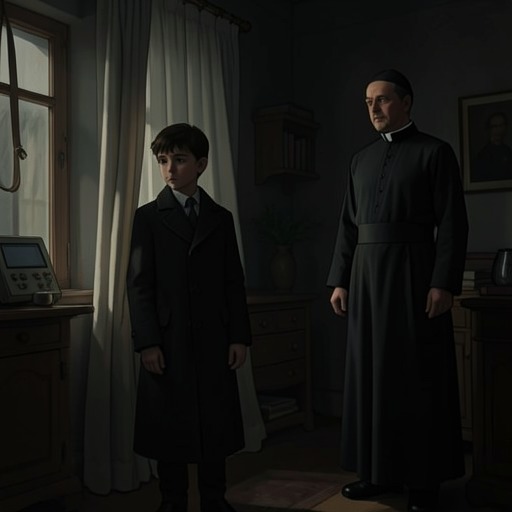
Eliza identifies the chalice-breaking as the beginning of his trouble. She reports that people said the vessel contained nothing and that the boy was at fault, but she does not treat those explanations as settling the matter. The broken object remains decisive in her telling: although others could minimize the incident, she remembers it as the point after which Father James Flynn’s state changed. The chalice, once associated with the altar, becomes the material mark around which the family’s understanding of his decline gathers.
Withdrawal and the Confessional
In Eliza’s account, the chalice incident affected her brother’s mind. Afterward he began to mope alone, speak to no one, and wander by himself. The change is described through a narrowing of ordinary contact: isolation replaces conversation, and his movements become solitary. Eliza’s explanation does not establish what happened inwardly, but it makes clear that the family understood his later behavior in relation to the broken chalice.
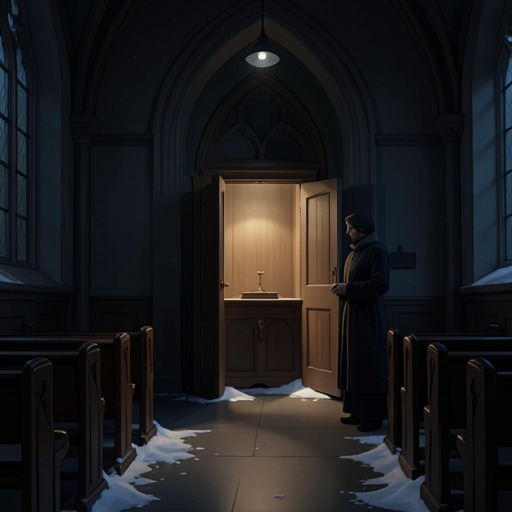
She recounts one night when Father James Flynn was wanted to go on a call and could not be found. People searched high and low without success. The clerk then suggested trying the chapel; after the keys were obtained, the clerk, Father O’Rourke, and another priest entered with a light. They found him sitting alone in the dark in his confessional, wide awake and laughing softly to himself. The episode brings his professional religious setting into sharp tension with his apparent disconnection from the duties and company around him: he is found not answering a call, but hidden in the place where penitents would ordinarily come to speak.
Eliza stops in the middle of the story as if listening. The narrator also listens, but the house is silent; Father James Flynn lies motionless in his coffin, the chalice idle on his breast. The sudden return from the remembered search to the present body gives Eliza’s account its unsettling frame. The man found laughing in darkness is now a solemn figure at rest, while the object she associates with the beginning of his decline lies visibly with him.
Narrative Role
Eliza’s account supplies the central explanation offered at the wake for Father James Flynn’s deterioration, but it remains the testimony of a sister recalling what she saw and what others said. She distinguishes her own observations—his abandoned breviary, his solitude, his unrealized plan for a drive—from reports that the chalice contained nothing or that the boy was to blame. The difference matters: the story does not resolve the cause of the priest’s breakdown, but presents the family’s effort to make sense of it through remembered signs and a decisive incident.
Her testimony also shifts the wake from ritual reassurance toward uncertainty. The visitors begin with prayers, wine, and conventional condolences; Eliza’s memories disclose the labor behind the funeral and the strange behavior that preceded it. Through her, the chalice is at once a broken vessel, a disputed mishap, and the point from which the family dates a change in Father James Flynn. Her restrained, matter-of-fact recollections leave the mystery open while making the personal cost of his decline legible in the care she and Nannie gave him.